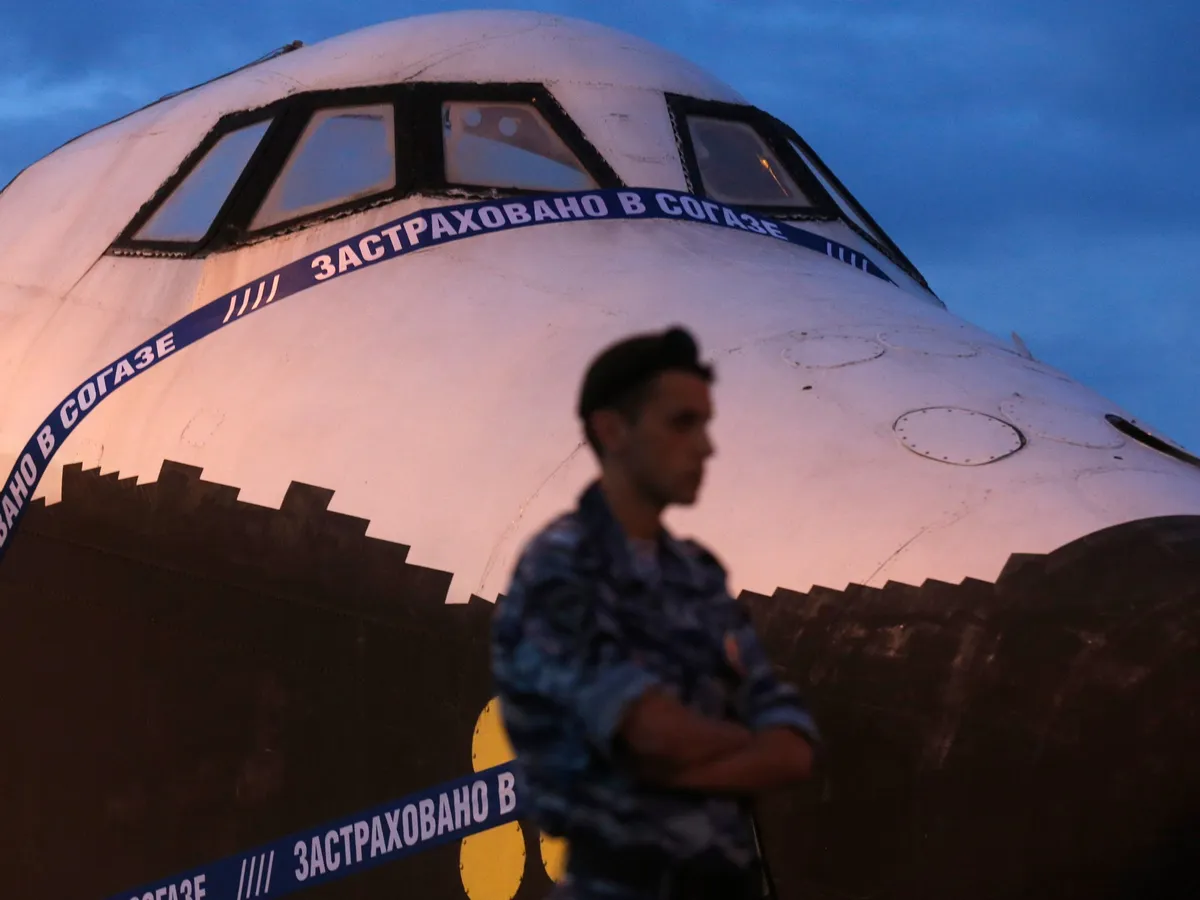
From Moscow to Plesetsk, Ukraine appears to be trying to hit infrastructure that powers Russia’s war from space.A Russian police officer stands guard in front of a life-sized model of the Soviet-made Buran space orbiter [File: Maxim Shemetov/Reuters]Published On 3 Sep 2026Kyiv, Ukraine – Russian Aerospace Forces (RAF) chief Aleksandr Chayko barely survived a blast that killed his son-in-law.Chayko, who turned 55 in the last week of July, was reportedly having a belated birthday party on August 1 at a high-end Italian restaurant in central Moscow.Recommended Stories list of 4 itemslist 1 of 4Is Trump wooing Russia again – and why?list 2 of 4Germany accuses Russia of failed drone attack on Leipzig airport in Augustlist 3 of 4Can Ukraine’s drones shut Russian airspace? What that means for airlineslist 4 of 4‘An impasse’: EU ministers fail to break deadlock over Israel and Ukraineend of listBut the celebration was cut short, as an unidentified woman carrying a homemade bomb tried to enter the restaurant. She was stopped by a security guard, according to Russia. The explosive in her bag detonated, killing at least five people.The Kremlin did not confirm the casualties, but blamed the attack on the “bloody tentacles” of Ukrainian President Volodymyr Zelenskyy’s government.Kyiv has not commented on the attack.Russia’s space programme in the firing lineChayko helped lead Russia’s intervention in Syria and commanded Russian forces north of Kyiv in early 2022.Ukraine has accused him of war crimes.In May, President Vladimir Putin appointed him commander-in-chief of the RAF that controls the military component of Russia’s space programme.The RAF’s satellites and ground-space facilities have been used for gathering intelligence, navigation, and supporting the coordination of ground troops and drone and missile attacks.These facilities are located mostly in western Russia, and new Ukrainian long-range drones and missiles are capable of striking them.“Key factories are few, and they all are within the reach of Ukrainian missiles,” Nikolay Mitrokhin, a researcher with Germany’s University of Bremen, told Al Jazeera.“These attacks may result – and certainly will – in the problems with all of Russia’s space programme, including specifically civilian and international programmes,” he said.‘Long-range sanctions’In late June, Ukrainian drones hit the giant space communications centre in the leafy, tranquil town of Dubna outside Moscow that managed reconnaissance satellites and processed military data.The strike damaged a 32-metre (105-foot) satellite antenna, hardware modular complexes, central control consoles and technical buildings.“Our long-range sanctions against Russia for this war once again reached the Dubna space communications centre,” Zelenskyy said on June 30.Russian authorities said an unspecified building in Dubna was damaged and a six-month-old baby died.Ukrainian drones also struck three smaller space communication centres in western Russia and annexed Crimea.“These centres are very expensive, very labour-consuming from the viewpoint of construction,” Anatoly Zak, a United States-based author and one of the foremost experts on the Russian space programme, told Al Jazeera. “It’s very difficult to transfer their functions to another infrastructure” because they manage geostationary satellites “tied” to a certain location.So far, there have been no signs that the satellites lost orbit or became unmanageable, but “behind the scenes there are for sure serious communication problems”, Zak said.Ukraine attacks ‘when there’s a fully-fuelled rocket on the launchpad’On August 23, swarms of Ukrainian drones flew more than 1,800km (1,120 miles) to reach Russia’s northwestern Arkhangelsk region.Some 40 drones were downed, regional authorities claimed, but at least two reached the area near Plesetsk, Russia’s military cosmodrome, or spaceport, and launchpad for intercontinental ballistic missiles and rockets carrying military satellites.No harm was done. A day later, Roscosmos, the state-run space corporation, reported the successful launch of a rocket with unnamed “military satellites”.The timing of the Ukrainian attack – along with two more strikes earlier this year – was calculated to strike a booster rocket that had just been fuelled and lifted for takeoff.“There have been three attempts to air-raid Plesetsk, and not just air-raid, but air-raid at the moment when there’s a fully-fuelled rocket on the launchpad that is about to start,” Zak said.The attempts were serious enough to be publicly reported to Putin.“Our [Ukrainian] ‘friends’ did everything to make this launch not happen,” Dmitry Bakanov, head of the Kremlin-run Roscosmos space agency, told Putin in April.At least a dozen drones are necessary to damage Plesetsk’s launch table or rocket assembly shop, according to Pavel Luzin, an analyst with the Jamestown Foundation, a think tank in Washington, DC.The military satellites launched from Plesetsk are part of the Rassvet (Dawn) satellite fleet designed to rival and replace Starlink satellite modems by Elon Musk’s SpaceX company, Moscow claimed.The world’s most launched spaceshipSputnik 1, the Earth’s first artificial satellite, was the size of a fitness ball, and had nothing but a radio transmitter and three silver-zinc batteries inside.The “Sputnik moment” was the US’s realisation, after the Soviet Union launched the first satellite in 1957, that the USSR had taken the lead in space technology and science.But Sputnik 1 was launched on a modified R-7 – the world’s first intercontinental ballistic missile, designed to carry a hydrogen bomb across continents. The same rocket technology that could deliver a nuclear warhead into the US had been repurposed to put a satellite into orbit.The R-7 became a prototype of the Soyuz booster rockets, the world’s most launched spaceships that made Soviet and then Russian launches routine and precise, unlike US launches of space shuttles.“Rain or shine or sleet or snow don’t matter,” Mark Bowman, deputy director of NASA’s human spaceflight programme, told this reporter in 2007 at the Baikonur spaceport, the world’s oldest in southern Kazakhstan that Russia leases.The only place where the Soyuz rockets are produced is the Progress Rocket and Space Centre in the Volga River city of Samara – and Ukrainian missiles struck it on August 15. The attack ignited a fire and slightly damaged one of the facilities.“So far, we see that the damage in Samara wasn’t critical,” Luzin said.If it becomes critical, Russia would be unable to manufacture the Soyuz rockets, but the existing stash of rockets would still last a year, he said.Communist Moscow never advertised the military component of its space programme, emphasising its “peaceful exploration of space”.The USSR was first to send a dog, a man and a woman into space, and to launch the world’s first space station. In 1988, its Buran space shuttle became the first to complete an unmanned orbital flight and land automatically.Its unmanned probes soft-landed on Venus and Mars and took the first photos of the moon’s dark side.Some key figures of the Soviet space programmes were born in what is now Ukraine, and a string of crucial design bureaus and manufacturing facilities kept working there after the 1991 Soviet collapse.Following Russia’s 2014 annexation of Crimea and the subsequent breakdown in Russian-Ukrainian relations, Ukrainian aerospace facilities severed their longstanding ties with Moscow, disrupting decades-old supplies of booster rockets, guidance systems, electronics and other components.Russia’s invasion of Ukraine also deepened the international isolation of its civilian space programme, with Western governments and space agencies suspending or abandoning several planned missions and partnerships.
SRCAl Jazeera
LANGEN
LEANCenter
WORDS1 166
ENT12
THU · 2026-09-03 · 13:30 GMTBRIEF NSR-2026-0903-108863
NSR-2026-0903-108863News Report·EN·Conflict
Ukraine takes the war to Russia’s space programme in tactical shift
Ukraine is reportedly targeting Russia's space program infrastructure as a tactical shift in the war. Recent strikes have hit facilities like the Dubna space communications center near Moscow and smaller centers in western Russia and Crimea, damaging satellite antennas and control systems.
Mansur MirovalevAl JazeeraFiled 2026-09-03 · 13:30 GMTLean · CenterRead · 5 min
Al JazeeraFIG 01
Reading time
5min
Word count
1 166words
Sources cited
2cited
Entities identified
12entities
Quality score
100%
§ 01
Briefing Summary
AI-generatedNEWSAR · AI
Ukraine is reportedly targeting Russia's space program infrastructure as a tactical shift in the war. Recent strikes have hit facilities like the Dubna space communications center near Moscow and smaller centers in western Russia and Crimea, damaging satellite antennas and control systems. Ukraine has also attempted to strike the Plesetsk cosmodrome, a launchpad for military satellites and missiles, coinciding with rocket fueling and launch preparations. These attacks, attributed by Russia to Ukraine, aim to disrupt Russia's intelligence gathering, navigation, and troop coordination capabilities that rely on its space assets. The strikes could impact both civilian and international space programs.
Confidence 0.90Sources 2Claims 5Entities 12
§ 02
Article analysis
Model · rule-basedFraming
Conflict
Technology
Tone
Mixed Tone
AI-assessed
CalmNeutralAlarmist
Factuality
0.70 / 1.00
Factual
LowHigh
Sources cited
2
Limited
FewMany
§ 03
Key claims
5 extracted01
Ukrainian drones hit the space communications centre in Dubna, damaging a satellite antenna and other equipment.
factual
Confidence
0.90
02
Attacks on Russian space facilities will cause problems with all of Russia’s space programmes, including civilian and international ones.
predictionNikolay Mitrokhin
Confidence
0.80
03
The Kremlin blamed the Moscow restaurant attack on Ukrainian President Volodymyr Zelenskyy’s government.
factualRussia
Confidence
0.80
04
Ukraine appears to be targeting infrastructure that powers Russia’s war from space.
factual
Confidence
0.80
05
An unidentified woman carrying a homemade bomb tried to enter a Moscow restaurant, causing an explosion that killed at least five people.
factualRussia
Confidence
0.70
§ 04
Full report
5 min read · 1 166 words§ 05
Entities
12 identifiedKey playerOppositionContextPositiveNeutralNegative
People3
Organizations1
§ 06
Keywords & salience
10 termsrussia space program
1.00
ukraine war
1.00
russian aerospace forces
0.90
tactical shift
0.80
long-range drones
0.70
infrastructure attacks
0.70
military satellites
0.60
kyiv
0.50
moscow
0.50
war crimes
0.40
§ 07
Topic connections
Interactive graph Network visualization showing 51 related topics
View Full Graph Person Organization Location Event|Click node to navigate|Edge numbers = shared articles