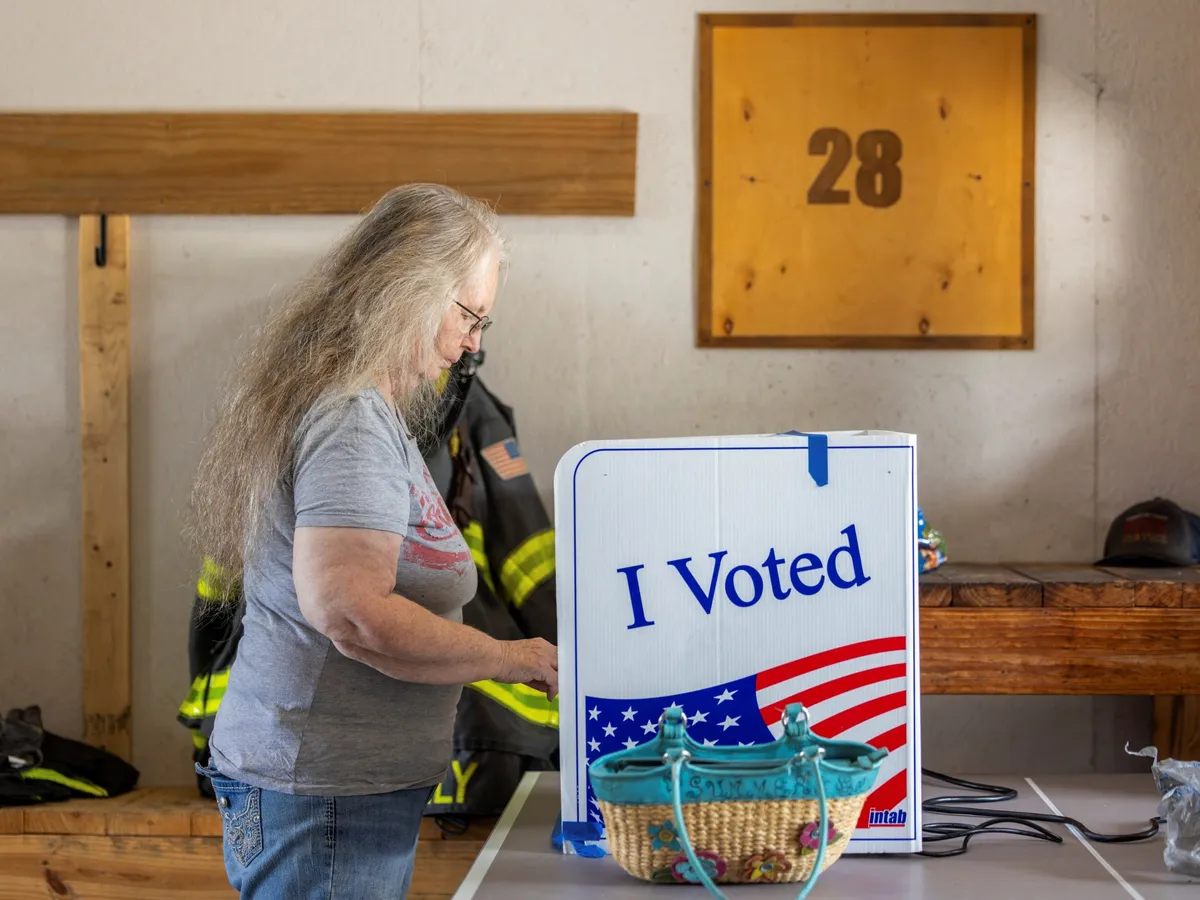
EXPLAINERAs Midterm Elections approach in November, a legal battle is ensuing over attempts to regulate Mail-in Voting.A voter casts her ballot at a polling station in a Republican primary run-off in South Carolina on August 25 [Sam Wolfe/Reuters]Published On 3 Sep 2026Voters across the United States are set to take part in Midterm Elections on November 3.But with two months left until polling day, a major legal battle is taking place that could throw the entire process into chaos.Recommended Stories list of 3 itemslist 1 of 3US Postal Service says mail-in ballot restrictions now in effectlist 2 of 3Thousands take part in March on Washington to promote voting rightslist 3 of 3Top US general says no plans to deploy troops for 2026 midterm electionsend of listActing on election fraud concerns raised by President Donald Trump, the US Postal Service (USPS) is scrambling to take steps purportedly to ensure the security of mail-in ballots.Roughly 48 million US voters cast their ballots through the mail, as of 2024. Critics have warned that restricting the process could disenfranchise groups who rely on Mail-in Voting ahead of the critical midterm vote.In late August, however, the Supreme Court granted an emergency request to allow the Trump administration to proceed with its reforms.That has injected uncertainty into the last-minute election preparations, with early voting slated to begin in some states as early as September.On Tuesday, Democratic Senator Richard Blumenthal made public a whistleblower complaint he received detailing problems with the Postal Service’s plans to restrict Mail-in Voting.“Their system is set up to fail – and risk the right to vote for millions of Americans who cast their ballots by mail,” Blumenthal said in a statement.What changes are under way? Why are they happening now? And what lies inside the whistleblower complaint? We unpack that and more in this explainer.What prompted these changes?Trump has long claimed, without proof, that his opposition, the Democratic Party, is involved in rigging elections.To justify that statement, he has made two intertwined but unsubstantiated allegations.First, he maintains that Democratic-led states are allowing non-citizens to vote. Second, he argues that states are not doing enough to secure the millions of mail-in ballots sent out each election season.But experts and election officials have cast doubt on those assertions.“There’s a mythology that mass-mail ballots are being mailed to nobody by election offices, just phantom people being mailed ballots,” said Stephen Richer, a former Republican election official who now serves as a fellow at the Cato Institute think tank and a lecturer at Harvard University.Election fraud is incredibly rare, and experts say the few documented instances have not swayed election outcomes.Why spread election fraud claims?Critics have argued that raising concerns about election fraud is a tactic to undermine faith in US democracy.That, in turn, can lead to poor voter turnout. Misinformation can also sow public confusion, allowing election results to be more easily manipulated by bad actors.Politicians have also cited such claims to push forward voting restrictions, which critics say could limit who has access to the elections.A study this year from the University of California, San Diego, found that voter confidence in the US had dropped by 17 percentage points over the last two years. It now sits at 60 percent, down from 77 percent in 2024.How widely used are mail-in ballots?About 30 percent of people who voted in the 2024 elections sent their ballots through the mail, according to the Election Assistance Commission, a bipartisan government commission.This is a slight decrease from 2020, during the height of the COVID-19 pandemic. Approximately 43 percent of votes were cast through the mail that year, as many voters chose to avoid polling stations out of concern for their health.In some states, primarily in the western US, the vast majority of votes are cast through the mail.According to 2024 estimates, some 99 percent of votes in Oregon were cast through the mail. Rates were similarly high in nearby states. The percentage was 98 in Washington state, 93 in Hawaii, 91 in Colorado, and 91 in Utah.Critics point out that many states that rely on Mail-in Voting, like Oregon and Washington, traditionally lean Democratic.Who prepares mail-in ballots?Preparing the ballots, then sending and collecting them is a massive undertaking, with work often beginning several months before the actual election.State and county officials design the ballots, which are specific to their jurisdictions. The ballots are then sent out through the Postal Service. Voters can return the ballots through the mail or through official election drop boxes.To ensure a mail-in vote is valid, local election officials pour over the ballots, checking names and addresses against voter lists and matching signatures to their records.What prompted the changes at the Postal Service?In March, Trump issued an executive order ostensibly aimed at ensuring the integrity of federal elections.It directed the Postal Service to propose new rules, reforming the design of mail-in ballots to include identifying barcodes that the federal government could scan and track.As part of the new system, states would be required to provide a list of eligible voters who intend to vote by mail.Trump’s executive order says that the Postal Service “shall not transmit mail-in or absentee ballots from any individual unless those individuals have been enrolled” on a state-specific list.What legal challenges has the order faced?A lower court in Massachusetts blocked the March executive order, ruling that the Trump administration had overstepped its constitutional authority.Under the Constitution, the administration of elections falls to the states, not the federal government.But last month, the Supreme Court temporarily cleared the way for the Trump administration to enact the changes by lifting the lower court’s injunction.The legal battle, however, continues. After the Postal Service announced the restrictions to Mail-in Voting were in effect, 24 states filed a new lawsuit, as did a coalition of voting rights groups.On August 27, the same judge in Massachusetts issued an order that the new rules not be implemented for 14 days while parties prepare a more detailed case.Are Trump’s rules for mail-in ballots practical?Aside from the question of whether Trump’s efforts are constitutional, there are also practical concerns about changing ballot procedures so close to an election.Richer, the former election official, told Al Jazeera that he questions whether the Postal Service is prepared for the added responsibility of tracking ballots.“USPS is going to be taking on this massive new burden of having to keep lists of every single mail voter in the US, and checking all ballot packets before sending them out,” Richer said. “There’s a real opportunity now for mistakes.”What’s in the whistleblower complaint?The whistleblower complaint obtained by Senator Blumenthal alleges that Trump’s executive order has created chaos in the Postal Service, as it seeks to implement the new rules before Election Day.According to the whistleblower, the Postal Service had aimed to launch an online portal this week for state election officials to identify ballots they intended to mail to voters.But the complaint alleges the Postal Service has struggled to set up a working software system in so short a time span.The software is reportedly designed to match the barcodes on ballot envelopes to lists of eligible voters. Part of the problem, according to the whistleblower, is that the system will reject entire batches of ballots if a single barcode cannot be verified.
SRCAl Jazeera
LANGEN
OutletState media · Qatar
WORDS1,204
ENT10
THU · 2026-09-03 · 17:14 GMTBRIEF NSR-2026-0903-108940
NSR-2026-0903-108940Analysis·EN·Political Strategy
What’s behind the vote-by-mail controversy in the US?
As the November midterm elections approach, a legal dispute is underway regarding regulations on mail-in voting. The US Postal Service (USPS), acting on election fraud concerns raised by President Trump, is implementing changes to mail-in ballot security.
Umar FarooqAl JazeeraFiled 2026-09-03 · 17:14 GMTOutlet · State media · QatarRead · 5 min
Al JazeeraFIG 01
Reading time
5min
Word count
1,204words
Sources cited
3cited
Entities identified
10entities
NEWSAR · AI
As the November midterm elections approach, a legal dispute is underway regarding regulations on mail-in voting. The US Postal Service (USPS), acting on election fraud concerns raised by President Trump, is implementing changes to mail-in ballot security. Critics argue these restrictions could disenfranchise voters, particularly those who rely on mail-in ballots. The Supreme Court has allowed the Trump administration's reforms to proceed, creating uncertainty for election preparations. A whistleblower complaint suggests the USPS system is designed to fail, potentially jeopardizing millions of mail-in votes. President Trump has alleged, without proof, that Democrats are rigging elections through non-citizen voting and insecure mail-in ballot processes, claims disputed by experts who state election fraud is rare. Mail-in voting is widely used, with approximately 30% of voters casting ballots by mail in 2024, and significantly higher percentages in some Western states.
Confidence 0.90Sources 3Claims 5Entities 10
Framing
Political Strategy
Legal & Judicial
Tone
Mixed Tone
AI-assessed
CalmNeutralAlarmist
Factuality
0.60 / 1.00
Mixed
LowHigh
Sources cited
3
Well sourced
FewMany
01
Election fraud is incredibly rare, and experts say documented instances have not swayed election outcomes.
factualarticle
Confidence
0.90
02
President Trump claims, without proof, that his opposition, the Democratic Party, is involved in rigging elections.
factualarticle
Confidence
0.90
03
Critics warn that restricting mail-in voting could disenfranchise groups who rely on it.
factualarticle
Confidence
0.90
04
A legal battle is ensuing over attempts to regulate mail-in voting as midterm elections approach.
factual
Confidence
0.90
05
The US Postal Service is taking steps to ensure the security of mail-in ballots, acting on election fraud concerns raised by President Donald Trump.
factualarticle
Confidence
0.80
§ 04
Full report
5 min read · 1,204 wordsKey playerOppositionContextPositiveNeutralNegative
Organizations4
mail-in voting
1.00
election controversy
0.90
midterm elections
0.80
us postal service
0.70
election security
0.70
voter disenfranchisement
0.60
election fraud allegations
0.50
supreme court
0.50
donald trump
0.40
whistleblower complaint
0.40
§ 07
Connections
Who appears together in the newsIn this articleWider coverageLine weight = articles in common
Laying out network…
Strongest ties articles in common
- 15,009
- 694
- 421
- 390
- 383
- 318
Recurring context not named in this article
- ODepartment of Justicelinks 10
- LNorth Carolinalinks 10
- ODepartment of Homeland Securitylinks 10
- LCalifornialinks 10
- ORepublican Partylinks 9
- OTrump administrationlinks 9
- LIranlinks 9
- LWhite Houselinks 9