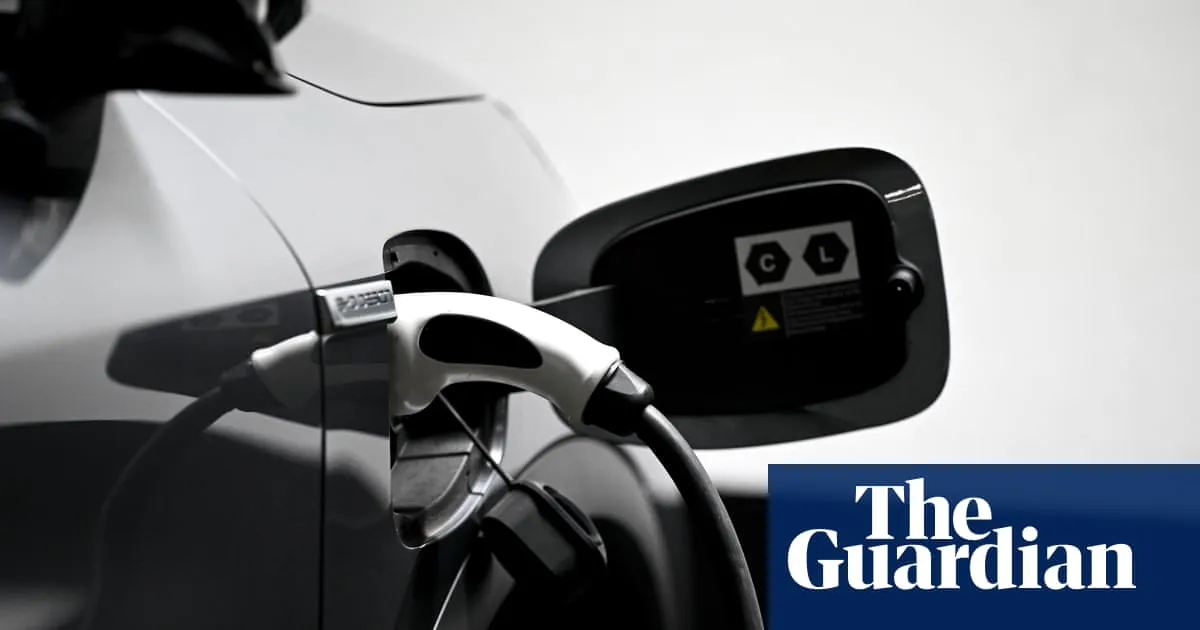
The rise in EV sales in Australia has been helped by the Iran" class="entity-link entity-event" data-entity-id="142746" data-entity-type="event">War in Iran pushing up Oil Prices and the introduction last year of a federal Vehicle Emissions Standard. Photograph: Dan Himbrechts/AAP View image in fullscreen The rise in EV sales in Australia has been helped by the Iran" class="entity-link entity-event" data-entity-id="142746" data-entity-type="event">War in Iran pushing up Oil Prices and the introduction last year of a federal Vehicle Emissions Standard. Photograph: Dan Himbrechts/AAP EV sales outpace petrol cars for first time as Australians dodge soaring fuel costs New record for Australia as more than 27,000 EVs sold in August, driven by the rising cost of fuel and new government policy Follow our Australia news live blog for latest updates Get our breaking news email, free app or daily news podcast Electric Vehicle Sales in Australia exceeded petrol cars for the first time last month as a transformation driven by high fuel prices and government policy encouraging clean car uptake accelerated. More than 27,000 EVs were sold in August, a new record for a single month and representing 24.9% of new cars sold. The climate-friendly technology surpassed both petrol vehicles (nearly 26,000 sold) and diesel cars (23,600). If plug-in hybrids were added, the proportion of new cars with a plug jumped to 36% of sales. The rise in EVs has been helped by two factors – the Iran" class="entity-link entity-event" data-entity-id="142746" data-entity-type="event">War in Iran pushing up Oil Prices and making running a petrol car significantly more expensive, and the introduction last year of a federal Vehicle Emissions Standard that required auto companies to cut average tailpipe emissions year-on-year. The latter has triggered a big increase in the number of models of low and zero-emission cars available at a range of prices. Australia had previously trailed most OECD countries in EV take-up, and the technology has been the focus of political scare campaigns, including former prime minister Scott Morrison claiming in 2019 that introducing a Vehicle Emissions Standard would “end the weekend”. They made up less than 2% of sales just four years ago and about 8% last year. The climate change and energy minister, Chris Bowen, said EV sales surpassing petrol cars was a “landmark moment”. “Australians have seen through the scare campaigns and are voting with their wallets for cars that are cheaper to run, cleaner and reduce their exposure to international petrol price shocks,” he said. Toyota was Australians’ most popular car brand in August, followed by Chinese EV manufacturer BYD and trillionaire Elon Musk’s Tesla. Five of the top 10 brands were Chinese: BYD, GWM, MG, Geely and Cheery. The Tesla Model Y was the most popular new model, with more than 6,400 sold. The Electric Vehicle Council said there had been a “structural shift in the way Australians choose their cars”, with both economic and environmental benefits driving the change. The council’s chief executive, Julie Delvecchio, said there were now nearly 200 EV models on offer. “The priority now is to make the benefits of going electric accessible to more Australians, including people in regional communities, apartment residents and the 30% of Australians who rent their home,” she said. The Federal Chamber of Automotive Industries CEO, Tony Weber, said consumer choice and competition were rapidly reshaping the new-vehicle market and infrastructure settings needed to keep pace. “Accessible and dependable charging will remain critical to consumer confidence, particularly on highways, in rural and regional areas and for motorists without access to charging at home,” he said. Explore more on these topics Environment Electric vehicles Electric, hybrid and low-emission cars Business news Share Reuse this content
SRCThe Guardian - World News
LANGEN
LEANCenter-Left
WORDS590
ENT12
FRI · 2026-09-04 · 03:26 GMTBRIEF NSR-2026-0904-109067
NSR-2026-0904-109067News Report·EN·Economic Impact
EV sales outpace petrol cars for first time as Australians dodge soaring fuel costs
For the first time, electric vehicle (EV) sales in Australia surpassed petrol car sales in August, with over 27,000 EVs sold, setting a new monthly record. This surge, representing 24.9% of new car sales, was driven by rising fuel costs, partly due to the war in Iran, and the introduction of a federal vehicle emissions standard last year.
Adam MortonThe Guardian - World NewsFiled 2026-09-04 · 03:26 GMTLean · Center-LeftRead · 3 min
The Guardian - World NewsFIG 01
Reading time
3min
Word count
590words
Sources cited
3cited
Entities identified
12entities
Quality score
100%
§ 01
Briefing Summary
AI-generatedNEWSAR · AI
For the first time, electric vehicle (EV) sales in Australia surpassed petrol car sales in August, with over 27,000 EVs sold, setting a new monthly record. This surge, representing 24.9% of new car sales, was driven by rising fuel costs, partly due to the war in Iran, and the introduction of a federal vehicle emissions standard last year. The emissions standard has increased the availability of low and zero-emission models across various price points. This marks a significant shift from previous years, where EVs made up a much smaller portion of sales. The government views this as a landmark moment, with consumers choosing EVs for their lower running costs and reduced exposure to fuel price shocks.
Confidence 0.90Sources 3Claims 5Entities 12
§ 02
Article analysis
Model · rule-basedFraming
Economic Impact
Technology
Tone
Measured
AI-assessed
CalmNeutralAlarmist
Factuality
0.80 / 1.00
Factual
LowHigh
Sources cited
3
Well sourced
FewMany
§ 03
Key claims
5 extracted01
The Tesla Model Y was the most popular new car model in August.
statistic
Confidence
1.00
02
Australians have seen through scare campaigns and are voting for cars that are cheaper to run and cleaner.
quoteChris Bowen
Confidence
1.00
03
More than 27,000 EVs were sold in August, representing 24.9% of new cars sold.
statistic
Confidence
1.00
04
EV sales exceeded petrol cars for the first time in Australia in August.
statistic
Confidence
1.00
05
The rise in EV sales is attributed to the war in Iran increasing oil prices and the introduction of a federal vehicle emissions standard.
factual
Confidence
0.90
§ 04
Full report
3 min read · 590 words§ 05
Entities
12 identifiedKey playerOppositionContextPositiveNeutralNegative
People3
§ 06
Keywords & salience
10 termsev sales
1.00
fuel costs
0.90
vehicle emissions standard
0.80
petrol cars
0.70
government policy
0.60
clean car uptake
0.50
oil prices
0.50
plug-in hybrids
0.40
climate change
0.40
australia
0.40
§ 07
Topic connections
Interactive graph Network visualization showing 51 related topics
View Full Graph Person Organization Location Event|Click node to navigate|Edge numbers = shared articles