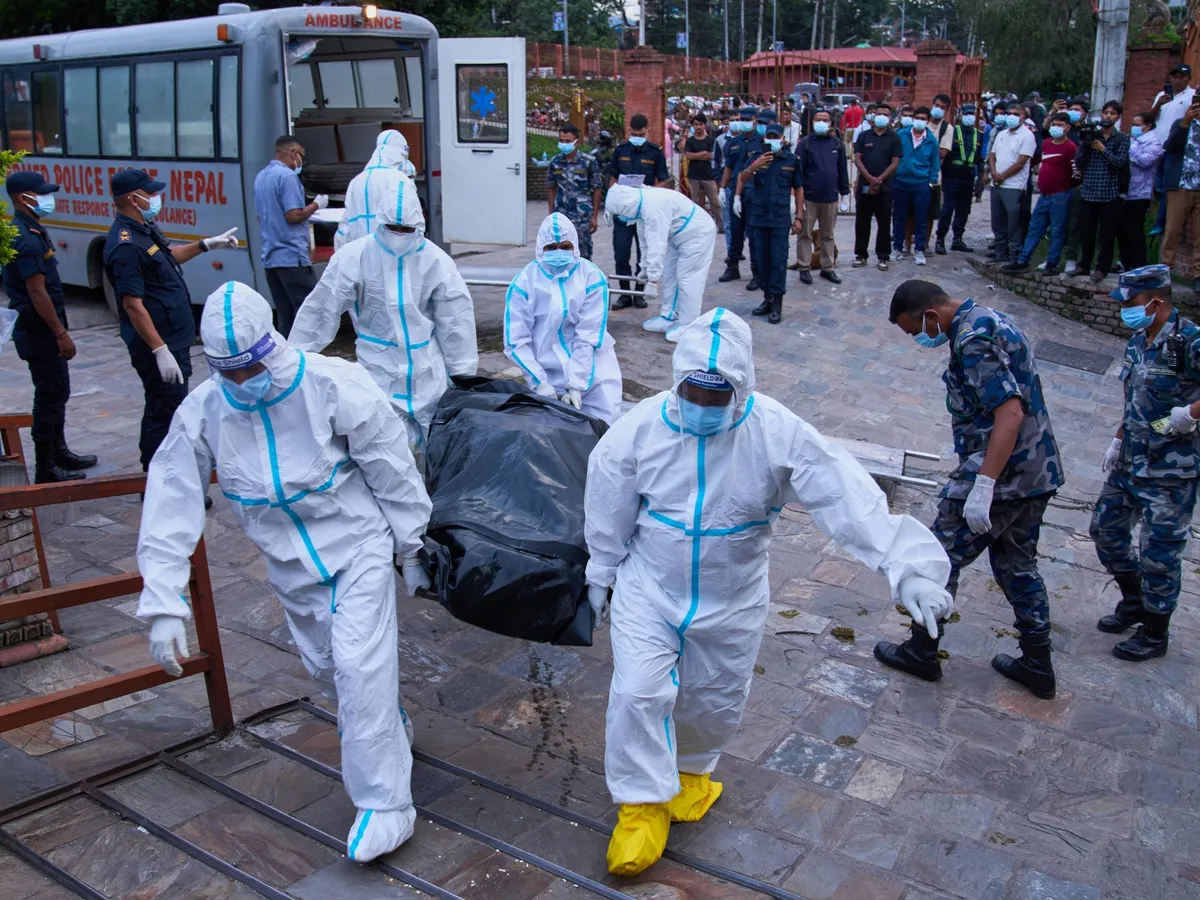
EXPLAINERDNA testing helps identify bodies that may be unrecognisable due to mutilation and decomposition.Police personnel in protective suits carry the body of an unidentified victim of the flash floods for storage at a crematorium in Kathmandu, Nepal [Dar Yasin/AP]Published On 4 Sep 2026More than a week after a glacial collapse near the Langtang Lirung mountain peak set off devastating floods in Nepal and Tibet, sending a deluge of rocks, mud and water to the valleys below, forensic experts are working to identify bodies.More than 1,270 people have been killed, and more than 4,700 are still missing, authorities said on Thursday. On Friday morning, reports emerged that two of the hundreds of workers trapped in tunnels at hydropower projects along the affected rivers had been rescued.Recommended Stories list of 4 itemslist 1 of 4Exclusive access as the search for Nepal’s tunnel workers intensifieslist 2 of 4Photos: Symbolic funerals held in Nepal for missing flood victimslist 3 of 4Rescue efforts continue as Nepal-China flood death toll rises to 1,280list 4 of 4Families perform symbolic funerals for missing Nepal flood victimsend of listMeanwhile, authorities are using DNA testing to try to identify hundreds of bodies that have left morgues overflowing. Officials are urging first-degree relatives – fathers, mothers, sons, or daughters – of those reported missing to provide fresh blood samples for DNA profiling, police have said.For missing foreign nationals, a first-degree relative (also a father, mother, son, or daughter) abroad can also undergo DNA profiling in their home country and email the results to Nepal-police" class="entity-link entity-organization" data-entity-id="36616" data-entity-type="organization">Nepal Police for comparison. Hundreds of DNA samples have so far been collected from relatives.The samples collected are being sent to the Nepal-police-forensic-science-laboratory" class="entity-link entity-organization" data-entity-id="200045" data-entity-type="organization">Nepal-police" class="entity-link entity-organization" data-entity-id="36616" data-entity-type="organization">Nepal Police Forensic Science Laboratory and the Nepal-academy-of-science-and-technology" class="entity-link entity-organization" data-entity-id="200046" data-entity-type="organization">Nepal Academy of Science and Technology.So why is DNA identification important in the aftermath of the floods and how does it work?Why is DNA testing needed?In Nepal’s capital, Kathmandu, forensic teams are working to identify bodies – but many have been found in a state of decomposition, said Al Jazeera’s Jessica Washington, reporting from a DNA testing facility in the city.“Forensic teams on the ground told us that there are some things that can help with the identification process, such as tattoos and jewellery, but many bodies were found in such a state that it is very challenging to identify them,” said Washington.Decomposition is why DNA testing becomes essential, say experts: mutilated bodies often become unrecognisable, especially after prolonged submersion in water.DNA profiles can be generated from blood, soft tissue, bone and teeth. According to Kerstin Montelius, a molecular biologist at Sweden’s National Board of Forensic Medicine, DNA material can still be extracted from bone even if most of the tissue has decomposed.“Visual identification might be impossible at an early stage of the process, with confusion as a result,” Montelius told Al Jazeera. But, she cautioned, “DNA degrades, too, and circumstances set the decisions.”How does DNA testing work?The globally recognised framework for managing and identifying disaster victims is Interpol’s Disaster Victim Identification (DVI).DNA molecules contain the information all living cells in the human body need to function, and apart from identical twins, who share almost the same DNA, each person’s DNA is unique. As such, it can be used to identify disaster victims or missing people.As a part of the DVI process, human remains are inspected by specialists to detect as much biometric data as possible.“There are three primary methods of identification that have shown to stand by themselves with a high score of probability in the identification process: DNA comparison, fingerprints and teeth comparison,” Montelius said, adding that the method chosen depends on the circumstances.When a direct DNA profile of the missing person is available – for example, a missing person’s DNA sample can be taken from personal items such as toothbrush or hairbrush – the unidentified body’s DNA profile is compared with that of the missing person to see if they match.However, sometimes there are “no fingerprints of the victim anywhere, or it could be difficult to find information on the teeth at the dentist’s”, said Montelius.In such cases, DNA profiles can also be collected from victims’ next of kin, said the molecular biologist. In Nepal, that is being done through blood samples.Once the data is collected, a team of specialists compares and reconciles the two sets of information – from the next of kin, as well as the human remains found – to identify the victims.This can be done in one of several computer systems on the market, with the system able to suggest matches for the DNA expert to scrutinise, said Montelius.Identification can be declared if there is a 100 percent match between the two sets of data.India has sent a 19-member forensic team that began a DNA sample analysis alongside their Nepali counterparts at the Nepal-police" class="entity-link entity-organization" data-entity-id="36616" data-entity-type="organization">Nepal Police Central Forensic Science Laboratory and the National Forensic Science Laboratory, according to the Indian embassy in Nepal’s capital.“The team is working to expedite the processing of DNA samples in Nepal for the identification of those affected by the recent flash floods,” the embassy said.China has also sent a second contingent of DNA identification experts, alongside a third batch of emergency relief supplies, the state-run Xinhua news agency reported on Thursday.
SRCAl Jazeera
LANGEN
LEANCenter
WORDS863
ENT12
FRI · 2026-09-04 · 06:56 GMTBRIEF NSR-2026-0904-109115
NSR-2026-0904-109115News Report·EN·Human Interest
Nepal floods: How DNA identification of bodies works
Following devastating floods in Nepal and Tibet, forensic experts are using DNA testing to identify hundreds of unrecognisable bodies. The floods, caused by a glacial collapse, have resulted in over 1,270 deaths and thousands missing.
Urooba JamalAl JazeeraFiled 2026-09-04 · 06:56 GMTLean · CenterRead · 4 min
Al JazeeraFIG 01
Reading time
4min
Word count
863words
Sources cited
2cited
Entities identified
12entities
Quality score
100%
§ 01
Briefing Summary
AI-generatedNEWSAR · AI
Following devastating floods in Nepal and Tibet, forensic experts are using DNA testing to identify hundreds of unrecognisable bodies. The floods, caused by a glacial collapse, have resulted in over 1,270 deaths and thousands missing. DNA identification is crucial because decomposition and mutilation often make visual identification impossible. Authorities are collecting blood samples from first-degree relatives of the missing, both domestically and internationally, for comparison with DNA profiles from the unidentified remains. This process, part of Interpol's Disaster Victim Identification framework, allows for definitive identification when DNA profiles from victims or their next of kin match with 100 percent certainty.
Confidence 0.90Sources 2Claims 5Entities 12
§ 02
Article analysis
Model · rule-basedFraming
Human Interest
Technology
Tone
Measured
AI-assessed
CalmNeutralAlarmist
Factuality
0.80 / 1.00
Factual
LowHigh
Sources cited
2
Limited
FewMany
§ 03
Key claims
5 extracted01
DNA material can still be extracted from bone even if most of the tissue has decomposed.
quoteKerstin Montelius
Confidence
1.00
02
DNA profiles can be generated from blood, soft tissue, bone and teeth.
factual
Confidence
1.00
03
DNA testing helps identify bodies that may be unrecognisable due to mutilation and decomposition.
factual
Confidence
1.00
04
Authorities are using DNA testing to identify hundreds of bodies that have left morgues overflowing.
factual
Confidence
0.95
05
More than 1,270 people have been killed, and more than 4,700 are still missing in Nepal floods.
statisticauthorities
Confidence
0.90
§ 04
Full report
4 min read · 863 words§ 05
Entities
12 identifiedKey playerOppositionContextPositiveNeutralNegative
Organizations4
Locations4
§ 06
Keywords & salience
10 termsnepal floods
1.00
dna identification
1.00
forensic experts
0.90
dna testing
0.80
decomposition
0.80
body identification
0.70
missing persons
0.70
dna profiling
0.60
glacial collapse
0.50
forensic science
0.40
§ 07
Topic connections
Interactive graph Network visualization showing 51 related topics
View Full Graph Person Organization Location Event|Click node to navigate|Edge numbers = shared articles