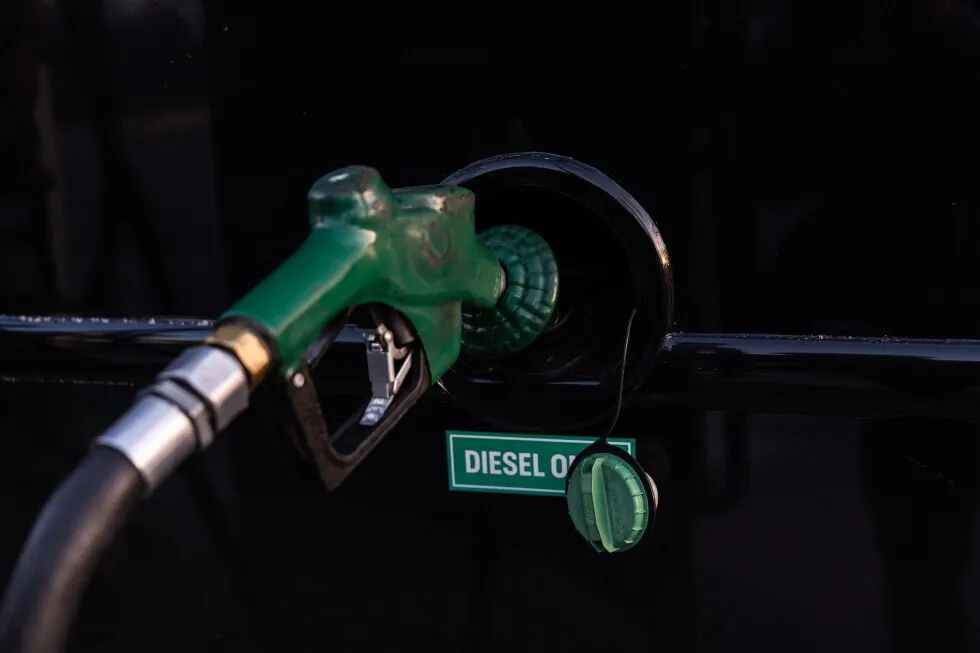
A nozzle pumps diesel into the fuel tank of bus in Orange, Calif., Tuesday, April 7, 2026. (AP Photo/Jae C. Hong, File) By Wyatte Grantham-Philips Updated 11:13 AM MESZ, September 4, 2026 Add AP News on Google Add AP News as your preferred source to see more of our stories on Google. Share Share Facebook Copy Link copied Print Email X LinkedIn Bluesky Flipboard Pinterest Reddit CHICAGO (AP) — diesel hit a new record price in the U.S. on Friday, soaring to an average of $5.85 a gallon for the first time ever as the six-month Iran" class="entity-link entity-event" data-entity-id="149138" data-entity-type="event">war with Iran disrupts the world’s flow of fuel. Because diesel is used for many freight and delivery networks, higher diesel prices mean higher transportation costs for a long list of everyday goods. More expensive fuel is increasing bills for businesses across sectors — some of which have already passed off costs to consumers in the form of added fees on online orders and packages in the mail. And shoppers may see more and more sticker shock trickle into store shelves. The increases could have political implications, with economic issues likely to be top of mind for many voters in November’s midterm elections. One of the most immediate strains falls in the grocery aisle, particularly with produce, meat and other perishable foods that need to be hauled in and restocked frequently — or even harvested using diesel-powered farm equipment. It can take time for all of those costs to trickle down. Still, experts warn that price hikes could mount the longer diesel remains expensive. A range of other products are also transported by diesel trucks, trains and boats, including clothing, cosmetics, furniture and more. The price for regular gasoline has also been going up, although not as fast as the price of diesel. The average price was $4.15 a gallon, compared with $3.20 at this time last year, according to AAA. Before the U.S. and Israel launched their war against Iran in late February, the national average for a gallon of diesel was about $3.76 in the U.S., per AAA. Prices quickly climbed as the cost of crude oil — the main ingredient in diesel, as well as gasoline — soared amid supply chain disruptions and production cuts across the Middle East, notably with most tanker traffic bottlenecked in the key Strait of Hormuz. Inflation slows but prices remain elevated as Iran war and spending on AI push up prices 5 MIN READ 338 US consumer confidence falls to lowest level in 7 months with gas stuck above $4 5 MIN READ 102 Key inflation gauge remains elevated during Iran conflict and ongoing US trade fights 5 MIN READ 102 Despite prices cooling some during hopes for peace earlier in the summer, oil has now renewed its climb as fighting once more escalates between the U.S. and Iran. Brent crude, the international standard, was trading at more than $95 a barrel Friday, up from roughly $70 before the war. Prices at the pump always follow closely behind. The last time U.S. businesses and drivers saw sky-high fuel prices was in June 2022, when diesel reached as high as nearly $5.82 a gallon on average, months after the Ukraine war began and world leaders imposed sanctions against Russia, a leading oil producer. When adjusted for inflation, however, prices have been higher in the past. Ahead of the 2008 financial crisis, for example, diesel peaked at about $4.74 a gallon — equivalent to $7.20 in 2026, according to the government’s latest data. And 2022’s record of nearly $5.82 would be about $6.56 this year when accounting for inflation. That doesn’t take the pain away from today’s steep prices, which are already bringing ripple effects for the economy and wider costs of living. Drivers are feeling the pain each time they fill up gasoline, too. The average $4.15 for a gallon of regular unleaded is up from $2.98 before the Iran war, although still well below the 2022 peak of nearly $5.02 a gallon nationwide. diesel has been more expensive than gasoline for decades, and its price has risen at a faster pace during recent energy crises. Some reasons include more limited supply, less flexibility in demand, and diesel’s position in global commerce overall. Individual households may find ways to drive less when gas prices are high, for example, but there’s fewer immediate substitutes for networks that rely on diesel to help produce and haul goods worldwide. diesel is integral to every part of the food supply chain. It powers farm equipment and fishing boats as well as the trains, cargo ships and trucks that get food to grocery stores. Fuel accounts for roughly 15% to 30% of the total cost of food, according to the Independent Grocers Alliance, a grouping of 7,500 global supermarkets. Because of this, higher diesel costs often result in more expensive food, although it can take a while for energy shocks to wind their way through the supply chain. Items that need to stay refrigerated while they’re transported are often the first to see prices rise, according to David Ortega, a professor of food economics and policy at Michigan State University. In July, for example, overall U.S. grocery prices were up 2.7% compared to last July, but seafood prices were up 7% and fresh fruit prices were up 4.9%. Ortega cautioned that there can be other factors at play when food prices go up or down. Lettuce also faced higher transportation costs in July, but a drop in demand due to the cyclospora outbreak caused prices to fall. Still, consumers could feel more of a squeeze the longer diesel prices remain high. “Early on, much of the cost increase gets absorbed along the supply chain through existing freight contracts and retailer margins,” Ortega said. “But as contracts reprice and fuel surcharges take hold, more of that cost makes its way to the grocery store.” Back in April, e-commerce giant Amazon rolled out a temporary 3.5% fuel and logistics surcharge on some third-party sellers. And United Parcel Service, FedEx and the United States Postal Service also moved to add fees on some of the packages they ship earlier in the war, citing rising operational costs for fuel overall. Ajesh Kapoor, CEO and founder of trucking technology company SemiCab, said trucking and transportations can adapt to rising diesel prices — but at some point there is a limit. “diesel price has a very, very direct impact on everything that moves on pretty much any mode,” Kapoor said. The ramifications extend beyond the movement of consumer goods. Some public transit buses and trains also run on diesel — and diesel generators are often used for backup or emergency power, if not central electricity sources in some remote parts of the world. Experts warn that the consequences could continue to deepen — particularly in countries in Africa and Asia, which rely more heavily on imports from the Middle East and have already been hit the hardest by energy shocks over the course of the war. Neil Atkinson, energy analyst and senior fellow at the National Center for Energy Analytics, said refined oil products like diesel are becoming more expensive as supplies get stretched. “This is gradually becoming a major crisis because A) the prices themselves are very high — but the physical stocks of these products are dwindling,” he said in a weekly briefing with maritime data firm Lloyd’s List Intelligence, pointing to the strain on the global refining system. “This cannot go on forever.” Associated Press writers Dee-Ann Durbin in Detroit and Mae Anderson in New York contributed to this report. Wyatte Grantham-Philips Grantham-Philips is a business reporter who covers trending news for The Associated Press. She is based in Chicago. twitter mailto
SRCAssociated Press (AP)
LANGEN
LEANCenter
WORDS1 288
ENT12
FRI · 2026-09-04 · 08:53 GMTBRIEF NSR-2026-0904-109164
NSR-2026-0904-109164News Report·EN·Economic Impact
US diesel prices hit a record high of $5.85 on average as the Iran war disrupts the flow of fuel
US diesel prices have reached a record average of $5.85 per gallon due to the ongoing six-month war with Iran disrupting global fuel flow. This surge in diesel costs, essential for freight and delivery networks, is increasing transportation expenses for numerous everyday goods.
Associated Press (AP)Filed 2026-09-04 · 08:53 GMTLean · CenterRead · 6 min
Associated Press (AP)FIG 01
Reading time
6min
Word count
1 288words
Sources cited
2cited
Entities identified
12entities
Quality score
100%
§ 01
Briefing Summary
AI-generatedNEWSAR · AI
US diesel prices have reached a record average of $5.85 per gallon due to the ongoing six-month war with Iran disrupting global fuel flow. This surge in diesel costs, essential for freight and delivery networks, is increasing transportation expenses for numerous everyday goods. Businesses across various sectors are facing higher bills, with some already passing these costs to consumers through added fees on online orders and mail packages, leading to potential sticker shock on store shelves. Perishable foods, which require frequent transport and diesel-powered harvesting, are particularly affected. Experts warn that price hikes could escalate if diesel remains expensive, impacting a wide range of products transported by diesel-powered vehicles, trains, and boats.
Confidence 0.90Sources 2Claims 5Entities 12
§ 02
Article analysis
Model · rule-basedFraming
Economic Impact
Conflict
Tone
Measured
AI-assessed
CalmNeutralAlarmist
Factuality
0.80 / 1.00
Factual
LowHigh
Sources cited
2
Limited
FewMany
§ 03
Key claims
5 extracted01
Brent crude oil is trading at over $95 a barrel, up from roughly $70 before the war.
statistic
Confidence
1.00
02
Before the war, the national average diesel price was about $3.76 a gallon.
statisticAAA
Confidence
1.00
03
The average price for regular gasoline is $4.15 a gallon, up from $3.20 last year.
statisticAAA
Confidence
1.00
04
Higher diesel prices increase transportation costs for everyday goods, impacting businesses and consumers.
factual
Confidence
1.00
05
US diesel prices hit a new record average of $5.85 a gallon due to the war with Iran disrupting fuel flow.
statistic
Confidence
1.00
§ 04
Full report
6 min read · 1 288 words§ 05
Entities
12 identifiedKey playerOppositionContextPositiveNeutralNegative
Organizations1
Locations5
§ 06
Keywords & salience
8 termsdiesel prices
1.00
iran war
0.90
fuel prices
0.80
transportation costs
0.70
supply chain disruptions
0.60
crude oil
0.50
inflation
0.50
midterm elections
0.40
§ 07
Topic connections
Interactive graph No topic relationship data available yet. This graph will appear once topic relationships have been computed.