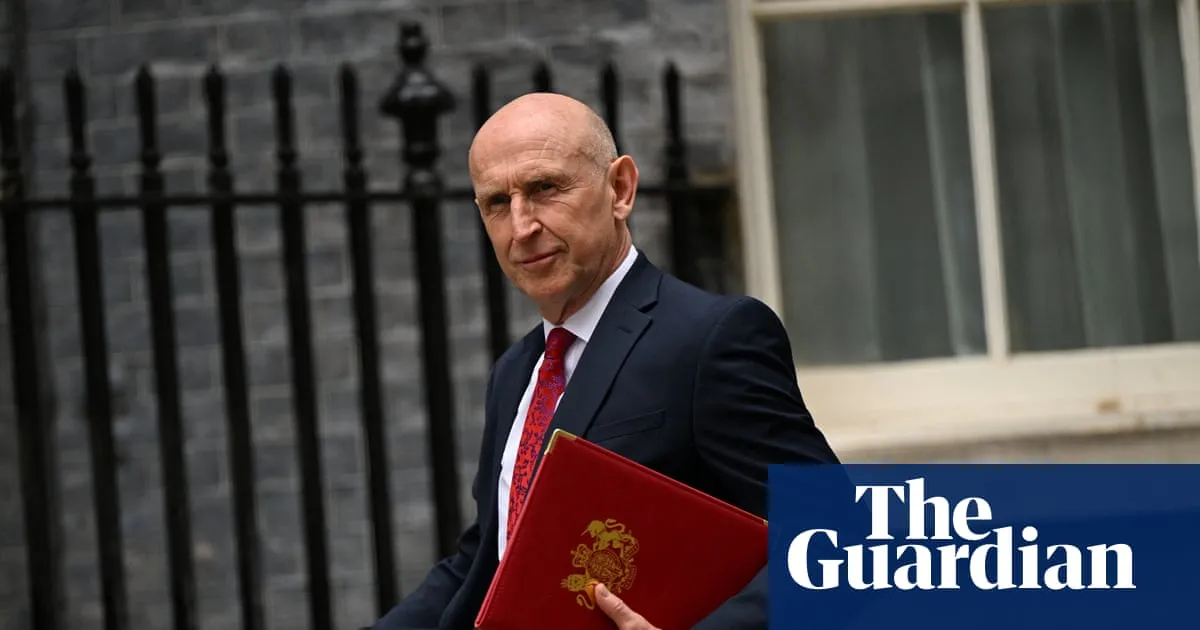
The chancellor has indicated that the UK will face a tough budget next month due to Trump’s war in the Middle East.In an interview with the Financial Times, John Healey said the conflict in Iran would probably have a strong influence on his first budget on 28 October.Healey, who succeeded Rachel Reeves when Andy Burnham became prime minister in July, told the newspaper he wanted to ensure the country had a robust “buffer against uncertainty” amid increasing global instability.However, economists have predicted that Healey will need to raise taxes or implement significant cost-cutting measures to protect the £24bn fiscal headroom that Reeves had after her March statement.“What’s happening in the Middle East is hitting inflation, it’s hitting growth, it’s hitting borrowing costs,” Healey said. “It’s part of a more dangerous world that is more uncertain and it’s one of the challenges we have to meet in this country, but have to meet with other [countries].”Healey declined to say how much headroom he aimed to have, but insisted he and Burnham were “in lockstep in our determination to meet the fiscal rules”.The newspaper said he planned to stick to Labour’s 2024 manifesto pledges not to raise taxes on “working people”, such as income tax, national insurance contributions or VAT, and was also not expected to raise the rate of corporation tax.The public finances are under pressure from soaring global bond yields , which hit an 18-year high earlier this week. Bond yields have a significant impact on government spending plans, as higher yields drive up borrowing costs.Healey has faced criticism for failing to commit to the goal of raising defence spending to 3% of GDP by 2030. In June, he resigned as defence secretary because he was unable to get the Treasury to commit to the target, in what was seen as a fatal blow to Keir Starmer’s government.Acknowledging tough economic conditions, Healey said: “The country’s under pressure. People are under pressure with the cost of living. Households are feeling that. We’re concerned about the cost of living, and we’re concerned about the cost of business.”He also said he was committed to cutting the welfare bill. “We must cut the cost of welfare, we have to get more people back into work,” he said. “I know that some of the decisions I must take – and will take – will show the benefits in years to come.”Jim O’Neill, the cross-bench peer and economist who advised Burnham as he prepared to enter Downing Street, has suggested that the prime minister could reassure the bond markets by taking “credible actions” to rein in the “excesses” of welfare spending and the pensions triple lock.Speaking to Times Radio earlier this week, he said: “If you have the markets carrying on doing what they’re doing globally … eventually they’re going to have absolutely no choice [but to cut spending] because the penalty of the debt servicing cost and the knock-on effect to other markets including mortgage rates will be too severe for a government to resist.”skip past newsletter promotionafter newsletter promotionThe triple lock, introduced in 2010, means that state pension increases annually in line with inflation, average wage growth or 2.5% – whichever is highest. It has led to an increase of about £16bn in the state pension bill.On Saturday morning, Jonathan Cribb, deputy director of the Institute for Fiscal Studies, told BBC Radio 4’s Today programme that the government could consider an Australian-style system.He suggested that the state pension could increase in line with workers’ earnings, with an inbuilt “temporary lock” to safeguard against a decline in average wages due to recession or high inflation.“It’s a reasonable way to increase the state pension over the long run that’s not as expensive but still generates increases,” he said.Reform UK has said it would cut £80bn of public spending within five years by reducing welfare payments, net zero investment and overseas aid. Speaking at the party’s annual conference in Birmingham, its economic spokesperson, Robert Jenrick, also pledged to reduce the number of civil servants.
SRCThe Guardian - World News
LANGEN
LEANCenter-Left
WORDS667
ENT12
SAT · 2026-09-05 · 11:26 GMTBRIEF NSR-2026-0905-109467
NSR-2026-0905-109467News Report·EN·Economic Impact
John Healey warns of tough first budget as Middle East war puts pressure on economy
UK Chancellor John Healey has warned of a challenging first budget on October 28th, citing global instability, particularly the conflict in the Middle East, as a significant factor. Healey stated this conflict is impacting inflation, growth, and borrowing costs, necessitating a "buffer against uncertainty." He indicated plans to adhere to Labour's manifesto pledges not to raise taxes on working people or corporation tax.
Geraldine McKelvieThe Guardian - World NewsFiled 2026-09-05 · 11:26 GMTLean · Center-LeftRead · 3 min
The Guardian - World NewsFIG 01
Reading time
3min
Word count
667words
Sources cited
3cited
Entities identified
12entities
Quality score
100%
§ 01
Briefing Summary
AI-generatedNEWSAR · AI
UK Chancellor John Healey has warned of a challenging first budget on October 28th, citing global instability, particularly the conflict in the Middle East, as a significant factor. Healey stated this conflict is impacting inflation, growth, and borrowing costs, necessitating a "buffer against uncertainty." He indicated plans to adhere to Labour's manifesto pledges not to raise taxes on working people or corporation tax. The government faces pressure from soaring global bond yields, which increase borrowing costs. Healey also expressed commitment to cutting the welfare bill by encouraging more people into work. Economists suggest potential tax increases or cost-cutting measures may be needed to maintain fiscal headroom.
Confidence 0.90Sources 3Claims 5Entities 12
§ 02
Article analysis
Model · rule-basedFraming
Economic Impact
Conflict
Tone
Measured
AI-assessed
CalmNeutralAlarmist
Factuality
0.70 / 1.00
Factual
LowHigh
Sources cited
3
Well sourced
FewMany
§ 03
Key claims
5 extracted01
Healey is committed to cutting the welfare bill and getting more people back into work.
factualJohn Healey
Confidence
0.95
02
Middle East events are impacting inflation, growth, and borrowing costs.
factualJohn Healey
Confidence
0.95
03
The UK will face a tough budget next month due to the Middle East war impacting the economy.
predictionJohn Healey
Confidence
0.90
04
The conflict in Iran will probably have a strong influence on Healey's first budget.
predictionJohn Healey
Confidence
0.85
05
Economists predict Healey will need to raise taxes or cut costs to protect £24bn fiscal headroom.
predictioneconomists
Confidence
0.80
§ 04
Full report
3 min read · 667 words§ 05
Entities
12 identifiedKey playerOppositionContextPositiveNeutralNegative
People5
§ 06
Keywords & salience
10 termstough budget
1.00
middle east war
1.00
economic pressure
0.90
fiscal headroom
0.80
inflation
0.70
borrowing costs
0.70
cost of living
0.60
global instability
0.50
john healey
0.40
defence spending
0.40
§ 07
Topic connections
Interactive graph Network visualization showing 47 related topics
View Full Graph Person Organization Location Event|Click node to navigate|Edge numbers = shared articles