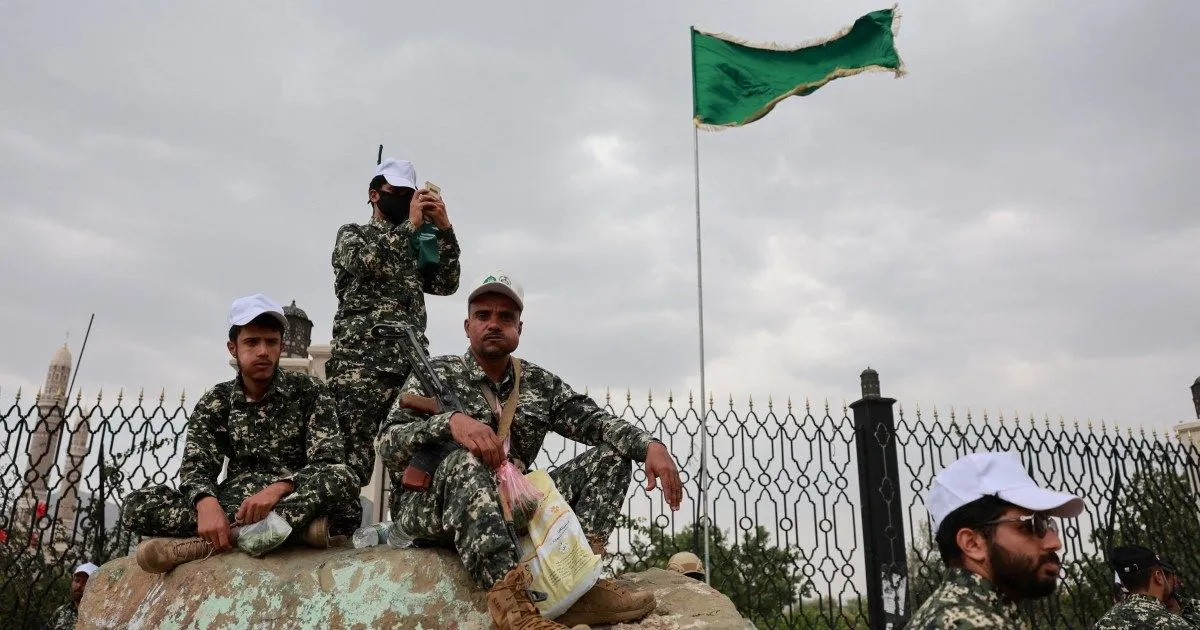
EXPLAINERA major Houthi offensive towards Bab al-Mandeb has triggered some of Yemen’s worst fighting in years.Members of Houthi security forces sit on a rock at the site of a rally held to commemorate Mawlid, marking the anniversary of Prophet Muhammad's birthday, in Sanaa, Yemen, August 25, 2026 [Khaled Abdullah/Reuters]Published On 5 Sep 2026Yemen’s internationally recognised government has launched a series of air attacks against Houthi positions in the country, marking a significant escalation in the conflict, with some of the country’s heaviest fighting since a fragile truce in 2022.Government warplanes carried out at least 15 strikes on Friday against Houthi positions, gatherings and vehicles in the western provinces of Taiz and Hodeidah, according to the Yemeni military.Recommended Stories list of 4 itemslist 1 of 4Qatar removed from Fitch’s negative watch list as risks to LNG sites easelist 2 of 4US ambassador to Israel meets Palestinian-Americans in occupied West Banklist 3 of 4Why is Trump threatening to strike Iran’s Pickaxe Mountain again, now?list 4 of 4At least 5 killed in Russian attacks on Ukraine as US envoys visit Moscowend of listThe air assault against Houthi positions provided support to government forces fighting a major Houthi offensive towards the Red Sea coast and the strategic Bab al-Mandeb Strait, one of the world’s most important shipping routes.These are not the first air attacks by government aircraft since Yemen’s fragile truce began to unravel in July. On July 25, government aircraft struck Houthi missile and drone launch sites and weapons depots in Marib and al-Jawf, according to Yemeni military officials cited by the Reuters news agency.And less than two weeks earlier, on July 13, Yemen’s internationally recognised government said its forces had struck the runway at the Houthi-held Sanaa International Airport to prevent an Iranian aircraft from landing.However, the latest attacks mark a significant step up in the government’s use of its own air power against the Houthis, after Saudi-led coalition aircraft provided much of the aerial firepower supporting anti-Houthi forces during the most intense years of Yemen’s war.Friday’s air campaign comes as the Iran-backed Houthis, who have been vying for control of Yemen for years, attempt to advance through western Taiz and southern Hodeidah towards al-Makha (Mocha), and territory overlooking the critical Bab al-Mandeb Strait at the opening to the Red Sea.Control of the area could strengthen the Houthis’ position along the Red Sea, where the group has previously attacked commercial and military vessels, while threatening a key government supply route.The fighting unfolds against a backdrop of the wider regional conflict, with the Houthis recently declaring a Red Sea maritime blockade against Saudi Arabia, while disruption to shipping through the Strait of Hormuz during the US-Israel war with Iran has raised the strategic importance of alternative routes through the Red Sea. This means any expansion of Houthi influence around Bab al-Mandeb could have consequences for shipping far beyond Yemen.Here’s what we know.What has happened?Fighting erupted on Thursday as Houthi forces launched a major offensive along front lines in western Taiz and southern Hodeidah, using ballistic missiles, drones and artillery as ground forces attempted to advance towards government-held territory along the Red Sea coast.The fighting has centred on areas west of Taiz and around al-Makha, a government-held port near the Bab al-Mandeb Strait.A Yemeni official in Aden told the AFP news agency that the Houthis were seeking to capture hills overlooking Bab al-Mandeb and al-Makha before pushing towards the coast.Al Jazeera’s Yousef Mawry, reporting from Sanaa, said Houthi forces had made gains in western Taiz.“According to military officials from the internationally recognised government, the Houthis have been able to take some of those territories,” Mawry said. “In western Taiz, they’ve managed to take over a strategic military base, which is settled on top of a strategic mountain and gives the Houthis an overview of the entire area.”Mawry said there had been particularly heavy fighting around al-Barah and Maqbanah, where a main road is used to resupply government forces stationed in Taiz and al-Makha.More than 120 fighters have been killed since the Houthi offensive began, according to an AFP tally, making the clashes among Yemen’s deadliest in years.Several civilians were also reported killed and others injured after a ballistic missile hit a restaurant in the al-Makha area, according to government-run Saba TV.On Saturday, at least four civilians were killed and nine others injured in a Houthi missile strike on a crowded road in southwestern Yemen, according to Saba news agency.The attack by the Iran-backed group on Saturday targeted a gathering of civilians along the strategic Heijah al-Abd Road, south of Taiz city, Saba said, citing local and medical sources.What is behind the latest tensions?The Houthis seized Yemen’s capital, Sanaa, in September 2014 and subsequently took control of much of northern and western Yemen, prompting a Saudi-led coalition of Arab countries to intervene in support of the internationally recognised government in March 2015.A United Nations-brokered truce in April 2022 sharply reduced fighting. Although the agreement formally expired six months later, large-scale hostilities between the Houthis and Saudi-backed government forces remained relatively limited and Saudi Arabia pursued negotiations with the group.No comprehensive peace agreement followed, however, leaving front lines largely frozen rather than ending the conflict.That fragile status quo came under increasing pressure after the United States and Israel launched their war against Iran on February 28, but tensions escalated further in July with the government air force strike on the Houthi-held Sanaa International Airport, preventing an Iranian aircraft from landing.(Al Jazeera)What do we know about Yemen’s air force?The modern Yemeni Air Force was created after North and South Yemen unified in 1990, bringing together two militaries equipped with both Soviet and Western aircraft.Its fleet subsequently included MiG-21 and MiG-29 fighters, Su-22 fighter-bombers, US-made F-5 fighters and a range of helicopters and transport aircraft.But Yemen’s armed forces fractured when the Houthis seized Sanaa and the political crisis descended into war in 2014 and 2015.When Saudi Arabia intervened soon after, its coalition targeted airbases, air-defence systems and combat aircraft in a bid to prevent the Houthis from making use of Yemen’s air force.That left the Saudi-led coalition – rather than the Yemeni government’s own depleted air force – providing much of the air power supporting government forces during the subsequent war.Saudi-led coalition aircraft conducted tens of thousands of air raids between March 2015 and the 2022 truce, striking Houthi military positions and providing air support during major government ground offensives. The campaign also caused extensive civilian casualties and became one of the most controversial aspects of the war.Between 2014 and 2022, Human Rights Watch documented dozens of apparently unlawful coalition air attacks on homes, markets, hospitals, schools, detention centres and other civilian sites.In 2024, the US and the United Kingdom launched a new round of air attacks against Houthi positions in Yemen following strikes on Israel-linked shipping in the Red Sea. Earlier this year, the US Pentagon disclosed that US military attacks against Yemen’s Houthis killed 153 civilians in 2025 and wounded another 243. The US had previously denied its attacks had caused civilian deaths.The conflict in Yemen has caused a huge humanitarian crisis. In 2021, the UN estimated that 377,000 people had died in Yemen since 2014, with 60 percent the result of food shortages and lack of accessible health services.Why is the Yemeni government using its own air power now?Previously relying on Saudi-led coalition air force power, the government’s decision to deploy its own warplanes now comes as it tries to blunt a Houthi offensive that initially made gains across several fronts in western Taiz and threatened the main road linking Taiz with the Red Sea port of al-Makha.
SRCAl Jazeera
LANGEN
LEANCenter
WORDS1 263
ENT12
SAT · 2026-09-05 · 12:43 GMTBRIEF NSR-2026-0905-109493
NSR-2026-0905-109493News Report·EN·Conflict
Yemen government launches own air attacks on Houthis: What that means
Yemen's internationally recognized government has launched air attacks against Houthi positions in Taiz and Hodeidah provinces. This escalation follows a major Houthi offensive towards the strategic Bab al-Mandeb Strait, resulting in some of the country's worst fighting since a 2022 truce.
Caolán MageeAl JazeeraFiled 2026-09-05 · 12:43 GMTLean · CenterRead · 6 min
Al JazeeraFIG 01
Reading time
6min
Word count
1 263words
Sources cited
3cited
Entities identified
12entities
Quality score
100%
§ 01
Briefing Summary
AI-generatedNEWSAR · AI
Yemen's internationally recognized government has launched air attacks against Houthi positions in Taiz and Hodeidah provinces. This escalation follows a major Houthi offensive towards the strategic Bab al-Mandeb Strait, resulting in some of the country's worst fighting since a 2022 truce. The government's air campaign supports its ground forces battling the Houthi advance along the Red Sea coast. While the government has used air power before, these recent strikes represent a significant increase in its independent aerial operations. The Houthi offensive aims to control territory overlooking Bab al-Mandeb, a crucial global shipping route, potentially impacting regional maritime security. The clashes have resulted in over 120 fighter deaths and civilian casualties.
Confidence 0.90Sources 3Claims 5Entities 12
§ 02
Article analysis
Model · rule-basedFraming
Conflict
Political Strategy
Tone
Measured
AI-assessed
CalmNeutralAlarmist
Factuality
0.80 / 1.00
Factual
LowHigh
Sources cited
3
Well sourced
FewMany
§ 03
Key claims
5 extracted01
Control of the Bab al-Mandeb Strait could strengthen the Houthis' position along the Red Sea.
factual
Confidence
1.00
02
The Houthis are attempting to advance through western Taiz and southern Hodeidah towards al-Makha.
factual
Confidence
1.00
03
Previous government air attacks occurred on July 25 and July 13.
factualYemeni military officials cited by Reuters
Confidence
1.00
04
The air attacks support government forces fighting a Houthi offensive towards the Bab al-Mandeb Strait.
factual
Confidence
1.00
05
Yemen's government launched air attacks against Houthi positions in Taiz and Hodeidah.
factualYemeni military
Confidence
1.00
§ 04
Full report
6 min read · 1 263 words§ 05
Entities
12 identifiedKey playerOppositionContextPositiveNeutralNegative
Organizations3
§ 06
Keywords & salience
10 termsyemen conflict
1.00
houthi offensive
0.90
bab al-mandeb strait
0.80
yemen government air attacks
0.80
red sea coast
0.70
shipping routes
0.60
iran-backed houthis
0.50
saudi-led coalition
0.50
taiz
0.40
hodeidah
0.40
§ 07
Topic connections
Interactive graph Network visualization showing 51 related topics
View Full Graph Person Organization Location Event|Click node to navigate|Edge numbers = shared articles