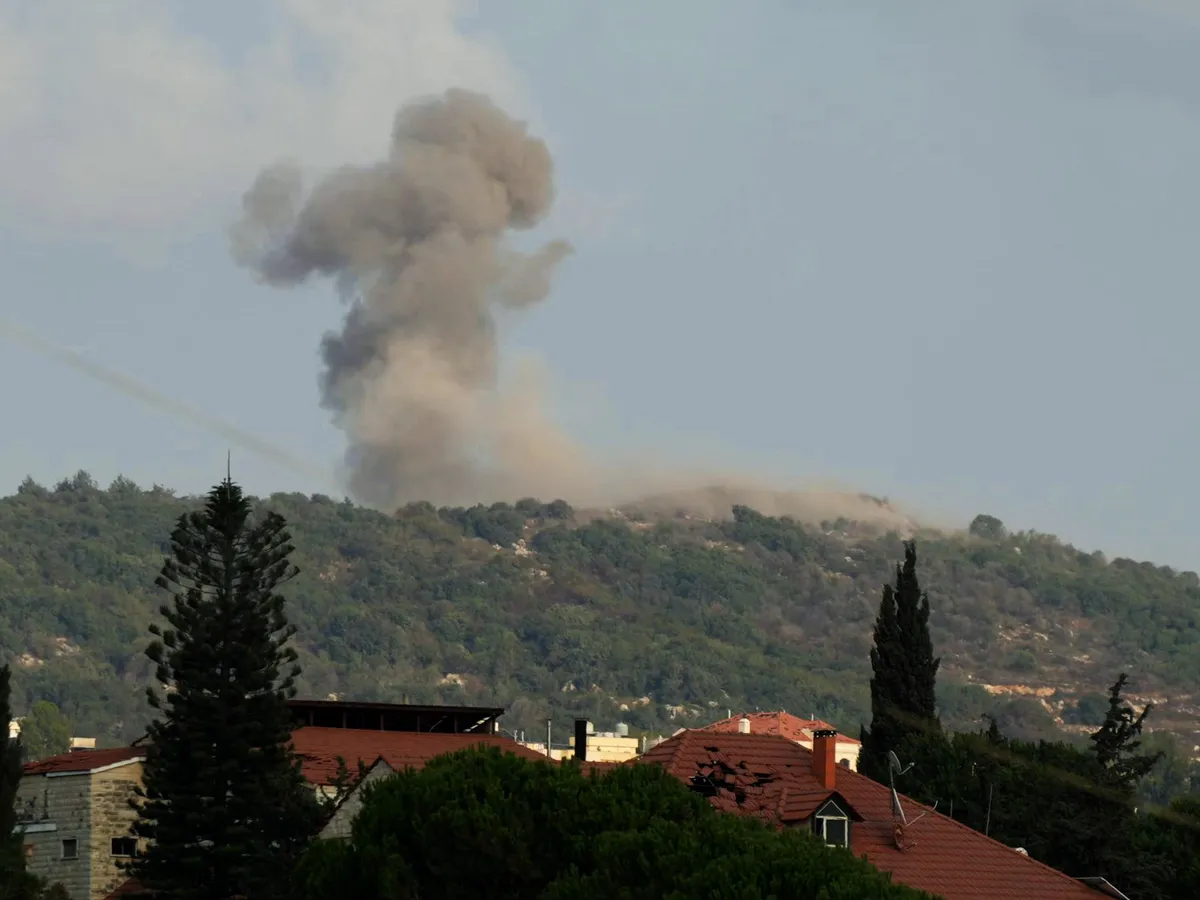
Israeli Defence Ministry asserts operational control over strategic highland; Hezbollah yet to comment.Smoke rises following Israeli strikes on the strategically important Ali al-Taher ridge in southern Lebanon [File: AFP]Published On 5 Sep 2026Israel this week has claimed to have established operational control over the strategically vital Ali al-Taher ridge in southern Lebanon, after an extended operation against positions of the Lebanese armed group Hezbollah.In a statement on Friday, Defence Minister Israel-katz" class="entity-link entity-person" data-entity-id="4249" data-entity-type="person">Israel Katz claimed Israeli forces had driven Hezbollah fighters out of what he said was a network of tunnels under the contested highland, 15km (10 miles) from the border.Recommended Stories list of 4 itemslist 1 of 4Israel releases five detainees to Lebanon after US-mediated negotiationslist 2 of 4October 7 attack shapes Israel’s elections and fuels political blamelist 3 of 4Israeli strike kills three in southern Lebanon amid ongoing escalationlist 4 of 4Israeli drones drop bombs on southern Lebanon’s Mansouriend of list“Prime Minister Netanyahu and I are leading a clear and uncompromising policy, reinforced every day by the [Israeli military]: Israel will not withdraw from the security zone in Lebanon until Hezbollah is disarmed throughout Lebanon and the threats to the residents of the Galilee are removed,” he was quoted as saying by Israeli media. “The capture of Ali Taher is an important step towards achieving this goal.”Iran-backed Hezbollah has yet to formally comment on the Israeli claims. However, hours before Katz’s comments, Reuters news agency reported that Iran had warned the United States last month that it would respond forcefully if Israeli attacks on the ridge, which rises 600 metres above sea level (1,970 feet), continued.Israel and Hezbollah have been fighting, with varying levels of intensity, since October 2023. Israel has twice escalated the conflict – first in September 2024 and then in March this year, following the start of the US-Israeli war on Iran.Israel has been working to embed its occupation of southern Lebanon since the latest escalation, when it announced the creation of a “security” or “buffer” zone, which rights groups say has involved the deliberate destruction of civilian infrastructure – potentially a war crime – and is responsible for the displacement of hundreds of thousands of Lebanese.Israeli strikes and ground operations around the Ali al-Taher ridge continued despite a ceasefire agreed in June, after Israel gained control of nearby Beaufort Castle and part of the higher ground overlooking much of southern Lebanon and northern Israel.According to Mohanad Hage Ali, of the Carnegie Middle East Centre, Israel’s success has partly been down to technological superiority but also due to the complete absence of “inhibition” in their assaults upon Lebanese towns and villages, which have often accrued daily casualty rates of dozens of people.“There aren’t any consequences to their actions,” he said. “They can demolish entire villages and wipe out whole societies in a way they could never do before. It’s ethnic cleansing.”Politics of resistancePitched as a measure to protect citizens of northern Israel, who Israeli analysts such as Ori Goldberg described as being owed an electoral debt by Prime Minister Benjamin Netanyahu ahead of crucial elections later this year, the occupation is also a means of exerting additional pressure on the government in Beirut.“The Israeli ‘operational control’ over the ridge is no doubt a tactical, even strategic, gain, enabling Israel a better control over southern Lebanon,” said Ahron Bregman, an Israeli security analyst and senior teaching fellow at King’s College London. “From an Israeli perspective, it is a way to put pressure on the Lebanese government: Tackle Hezbollah head-on, or we stay here.”Nicholas Blanford, a non-resident senior fellow at the Atlantic Council and an authority on the group, said Hezbollah’s lack of comment on the Israeli claims raised a number of questions.“It could be that a deal’s been done. It could be that Israel is exaggerating what it means by ‘operational control’,” he said, noting that neither the extent of Israel’s military control over the ridge, nor the infrastructure contained within it, is known.Defence Minister Israel-katz" class="entity-link entity-person" data-entity-id="4249" data-entity-type="person">Israel Katz, who faces re-election later this year, has threatened to “return Iran to the Stone Age” if it responds to Israel’s latest attacks in southern Lebanon. [File: Menahem Kahana/AFP]“What we do know is that Hezbollah appears ready to get back into the resistance business, but no longer seems to be making the decisions,” he said. “Those are coming from Iran, who appear to want to keep things quiet for now.”Analysts also suggested that a lack of a response from Tehran may frustrate Netanyahu, who has invested much of his electoral stock in finishing the war with Iran, an opponent he has characterised as posing an existential threat to the country since at least the early 1990s.Katz has described an attack against Israel as freeing its military “from all constraints”, and that in such a scenario, the military would “strike all infrastructure – including energy infrastructure – and return Iran to the Stone Age and darkness”, all of which would almost certainly constitute war crimes.However, how far Israel – diplomatically, economically and militarily dependent upon the US – can proceed beyond rhetoric is open to question.With Netanyahu predicted to struggle in October’s elections, what happens in southern Lebanon may prove crucial.“Will Iran come to Hezbollah’s aid?” Bregman asked. “One person for sure – a certain Benjamin Netanyahu prays that they do – as it could even postpone the forthcoming elections in Israel in which, if judged by current polls, he will be defeated.”
SRCAl Jazeera
LANGEN
LEANCenter
WORDS900
ENT12
SAT · 2026-09-05 · 16:04 GMTBRIEF NSR-2026-0905-109542
NSR-2026-0905-109542News Report·EN·Conflict
Israel claims control of Lebanon’s key Ali al-Taher ridge: What that means
Israel claims to have established operational control over the strategically important Ali al-Taher ridge in southern Lebanon following an extended operation against Hezbollah. Israeli Defense Minister Israel Katz stated that forces drove Hezbollah fighters out of tunnels under the ridge, calling it an important step towards disarming Hezbollah and removing threats to northern Israel.
Simon Speakman CordallAl JazeeraFiled 2026-09-05 · 16:04 GMTLean · CenterRead · 4 min
Al JazeeraFIG 01
Reading time
4min
Word count
900words
Sources cited
2cited
Entities identified
12entities
Quality score
100%
§ 01
Briefing Summary
AI-generatedNEWSAR · AI
Israel claims to have established operational control over the strategically important Ali al-Taher ridge in southern Lebanon following an extended operation against Hezbollah. Israeli Defense Minister Israel Katz stated that forces drove Hezbollah fighters out of tunnels under the ridge, calling it an important step towards disarming Hezbollah and removing threats to northern Israel. Hezbollah has not yet commented on the claims, though Iran reportedly warned the US of a forceful response to continued Israeli attacks on the ridge. The conflict between Israel and Hezbollah has been ongoing since October 2023, with Israel establishing a "security zone" in southern Lebanon. Analysts suggest Israel's gain is tactical and strategic, aimed at pressuring the Lebanese government and potentially influenced by upcoming elections.
Confidence 0.90Sources 2Claims 5Entities 12
§ 02
Article analysis
Model · rule-basedFraming
Conflict
National Security
Tone
Measured
AI-assessed
CalmNeutralAlarmist
Factuality
0.60 / 1.00
Mixed
LowHigh
Sources cited
2
Limited
FewMany
§ 03
Key claims
5 extracted01
Israel will not withdraw from the security zone in Lebanon until Hezbollah is disarmed and threats to Galilee residents are removed.
quoteIsrael Defence Minister Israel Katz
Confidence
0.95
02
Israel claims to have established operational control over the strategically vital Ali al-Taher ridge in southern Lebanon.
factualIsrael Defence Ministry
Confidence
0.90
03
Israeli forces have driven Hezbollah fighters out of a network of tunnels under the contested highland.
factualIsrael Defence Minister Israel Katz
Confidence
0.85
04
Rights groups say Israel's creation of a 'security' or 'buffer' zone has involved deliberate destruction of civilian infrastructure and displacement of hundreds of thousands of Lebanese.
factualrights groups
Confidence
0.75
05
Iran warned the United States last month that it would respond forcefully if Israeli attacks on the ridge continued.
factualReuters
Confidence
0.70
§ 04
Full report
4 min read · 900 words§ 05
Entities
12 identifiedKey playerOppositionContextPositiveNeutralNegative
Organizations3
Locations6
§ 06
Keywords & salience
9 termsali al-taher ridge
1.00
hezbollah
0.90
israel
0.90
southern lebanon
0.80
operational control
0.70
security zone
0.60
escalation
0.50
disarmament
0.40
iran
0.40
§ 07
Topic connections
Interactive graph Network visualization showing 51 related topics
View Full Graph Person Organization Location Event|Click node to navigate|Edge numbers = shared articles