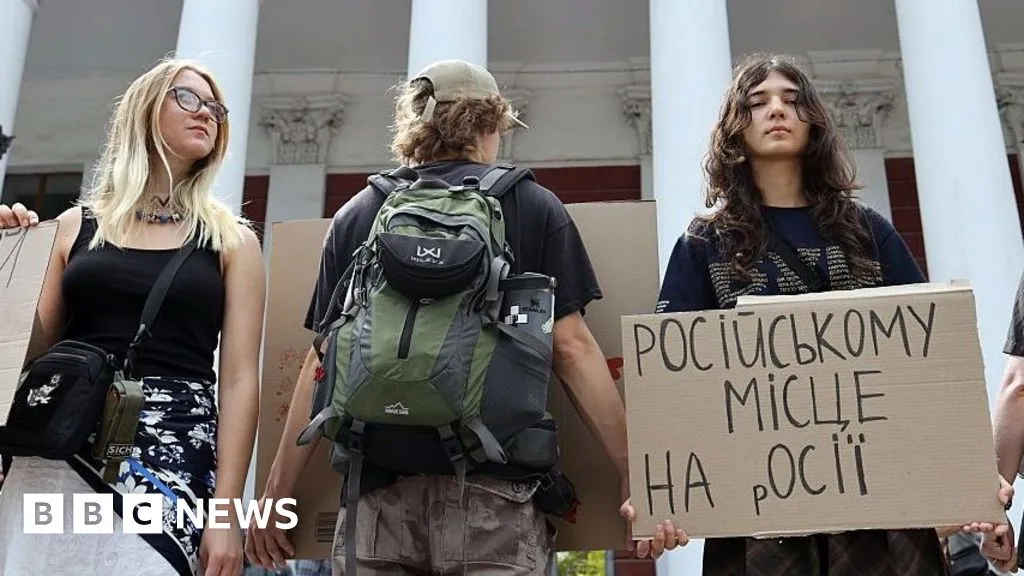
Global Images Ukraine via Getty ImagesThese young activists hold up signs saying the Russian language should remain in RussiaUkraine's third-biggest city Odesa will decide this week whether to back a controversial plan to ban the Russian language in the arts.The proposal being considered by councillors in Odesa on the Black Sea coast aims to add to existing restrictions on Russian imposed by national legislation. It is particularly significant because Odesa is overwhelmingly Russian-speaking, although the ban would only affect public spaces and everyday usage of Russian would remain unaffected.For millions of Ukrainians, Russian is their first language including many of the troops defending the country in its war with Russia. But Ukrainian is the only state language and spoken by the majority, and some see Russian as a tool of Russian influence.The proposal in Odesa, which is targeted daily by Russian drone and missile strikes, calls for a complete halt to Russian-language content in music and literature, in streets, parks, public institutions and state-run arts and entertainment venues. It would also recommend a ban in privately owned spaces.In a city famous for Russian-language writers and musicians, it has provoked strong passions. The ban would extend in public spaces to old Odesa songs almost universally known throughout the former Soviet Union. All Russian-language books would be removed from display in public libraries. Currently, they can be shown, but not prominently.Comic actor Borys Barsky (L) says only Vladimir Putin would benefit from Ukrainians banning the Russian language"The Russian language is a weapon of Russia, and we need to try to fix that," says Odesa lawyer Artem Kartashov, who has advised local authorities on an official programme to "decolonise" the city of its historic Russian legacy."With Russian-speaking music and other things, Russians try to deconstruct Ukrainian identity and influence especially young people, because they grow up in a Russian-speaking environment."But comic actor Borys Barsky, one of Odesa's best-known entertainers, says: "Russian isn't [only] the language of Putin, it's the language of [writers like] Dostoyevsky and Bulgakov. "Who benefits from setting people against other people who love Ukraine just as deeply, only love it in a different language? Only Putin benefits from this."Russian President Vladimir Putin has often referred to what he falsely describes as repression of the Russian-speaking minority in Ukraine as one of his justifications for launching his invasion of the country.Russian and Ukrainian are closely related, but distinct in many ways. Many in Ukraine speak a mixture of the two, known as surzhyk. Russian is the native language of President Volodymyr Zelensky, which he used often in his election campaign but has since used only Ukrainian in public.But a 2019 law requires use of Ukrainian in many public and professional contexts including education, public services and customer service.Public-facing workers - including waiters, shop assistants and doctors - must address customers or patients initially in Ukrainian, though they can later switch to Russian if the client prefers that.Odesa's Mask Theatre, run by Barsky, has been fined for infringements of the legislation including using Russian in publicity materials. A later inspection found further violations such as a cafe sign with the Russian word for coffee."This isn't even like Orwell or Kafka, it's just madness," he says.Barsky has been able to continue to perform in Russian because it is a private theatre. The new language proposal - similar to one already in force in the capital Kyiv and some other cities – would urge but not require private premises including shops and cafes to adopt the ban.Odesa's state-appointed language ombudswoman, Anna Nerush, who inspects premises to check on alleged violations of the rules, thinks if passed it will put pressure on them to comply. "All businesses interact in one way or another with local government," she told the BBC. "They rent premises, they need advertising permits, and so on. So for many entities it's important to comply with a council decision, even if doesn't provide for sanctions for non-compliance. "Photographer Natalia Mykhailenko gives tours of Odesa highlighting its non-Russian historyPublic playing of songs by Russian citizens is already illegal across Ukraine, with exceptions for some artists who have publicly condemned the war, but Russian-language songs composed or performed by Ukrainians are still allowed.Under the proposals they would also be banned in public places. Anna Nerush said it would not affect someone celebrating their birthday in Russian in a private room in a restaurant, as it could not be heard outside. "But on the streets, [hearing] the Russian language can be a real trigger, for example to [former] prisoners of war and people who've come from occupied territories," she said.Many native Russian-speakers in Ukraine have switched to Ukrainian in recent years, particularly since Russia's full-scale invasion in 2022. Photographer Natalia Mykhailenko switched even earlier. She has led tours of Odesa highlighting non-Russian elements of its history. These include landmarks such as a Cossack cemetery that dates back to before 1794. That is the year Russian empress Catherine the Great is said to have founded the city, although it has been widely questioned in recent years.A statue of Catherine was removed from a central Odesa square after a council vote in 2022, and streets have been renamed to commemorate some Ukrainian writers and activists."We must understand we were a colony," said Mykhailenko. "And these [language] laws are very important. I understand it's maybe sometimes not democratic. But without it, there will be no normal Ukraine in the future."Anthropologist Anastasia Piliavsky, part of a group called Ukrainian Cosmopolis which aims to defend freedom of thought and speech, believes Russian-speakers are being made to feel like second-class citizens who are deprived of their heritage."In Ukraine, the vast majority of people understand both Russian and Ukrainian. So the question is not really one of language, it's one of liberty," she said."Ukraine has been fighting for freedom. The point of this war is not to be under authoritarian rule. That's what Russia has to offer. So when fines, or the threat of being fired [for breaking language laws] arrives, then people start wondering: what are we fighting for?"Little remains of the old monument to Catherine the Great in central OdesaIt is unclear how much support the new language proposal has. It is opposed by an influential group of councillors linked to former mayor Hennadiy Trukhanov.Beyond Odesa, a national poll showed 80% support for Ukrainian dominating "all spheres of communication" in 2022. However, a more recent survey of students in Kyiv found that 82% chose to speak Russian during break times, even though Ukrainian is enforced in classrooms.One famous Odesan who found himself at the centre of the language controversy is Pavlo Viktor, a physics teacher whose online lessons have been followed by millions around the world. Ukrainian language campaigners criticised him for putting the videos out in Russian, his first language, although he later translated them into Ukrainian. He was later criticised for saying he would talk to scared children in Russian during missile attacks, if that was the language they preferred.Viktor is keen to take the heat out of the argument, explaining that currently about 10% of the Odesa population spoke Ukrainian in the street: "But if we wait 50 years, maybe 90% will speak Ukrainian.""Ukrainianisation must be polite and soft… not to persuade children to move from Russian to Ukrainian, but to make an atmosphere when they want to do this. It's the best way. And I hope that gradually we'll move in that direction."You can hear more about the language controversy in Odesa in the Crossing Continents podcast Ukraine: Fighting Russia, Fighting Russian, available from Tuesday 8 September.
SRCBBC News - World
LANGEN
LEANCenter
WORDS1 261
ENT12
SAT · 2026-09-05 · 23:54 GMTBRIEF NSR-2026-0906-109601
NSR-2026-0906-109601News Report·EN·Conflict
Majority Russian-speaking city in Ukraine considers language ban in the arts
Odesa, Ukraine's third-largest city, is considering a proposal to ban Russian-language content in public arts and literature. The city council will decide this week whether to implement the ban, which would affect music, literature, and public spaces, though everyday Russian usage would remain unaffected.
6 minutes agoShareSaveAdd as preferred on GoogleTim WhewellandSerhiy Solodko,in OdesaBBC News - WorldFiled 2026-09-05 · 23:54 GMTLean · CenterRead · 6 min
BBC News - WorldFIG 01
Reading time
6min
Word count
1 261words
Sources cited
3cited
Entities identified
12entities
Quality score
100%
§ 01
Briefing Summary
AI-generatedNEWSAR · AI
Odesa, Ukraine's third-largest city, is considering a proposal to ban Russian-language content in public arts and literature. The city council will decide this week whether to implement the ban, which would affect music, literature, and public spaces, though everyday Russian usage would remain unaffected. This move aims to build upon existing national language restrictions, with proponents arguing Russian is a tool of Russian influence and a threat to Ukrainian identity. Opponents, however, believe such a ban would benefit Russian President Vladimir Putin by creating division. The proposal comes as Odesa faces daily Russian attacks, and if passed, it would extend to Ukrainian-composed Russian-language works, aiming to reduce the public presence of the language.
Confidence 0.90Sources 3Claims 5Entities 12
§ 02
Article analysis
Model · rule-basedFraming
Conflict
Social Justice
Tone
Mixed Tone
AI-assessed
CalmNeutralAlarmist
Factuality
0.70 / 1.00
Factual
LowHigh
Sources cited
3
Well sourced
FewMany
§ 03
Key claims
5 extracted01
Comic actor Borys Barsky argues that only Putin benefits from Ukrainians banning the Russian language.
quoteBorys Barsky
Confidence
1.00
02
Odesa lawyer Artem Kartashov believes the Russian language is a weapon of Russia used to deconstruct Ukrainian identity.
quoteArtem Kartashov
Confidence
1.00
03
The proposal aims to add to existing restrictions on Russian imposed by national legislation.
factual
Confidence
1.00
04
Odesa will decide whether to ban the Russian language in the arts.
factual
Confidence
1.00
05
Russian President Vladimir Putin has falsely described repression of Russian speakers as a justification for invasion.
factual
Confidence
0.90
§ 04
Full report
6 min read · 1 261 words§ 05
Entities
12 identifiedKey playerOppositionContextPositiveNeutralNegative
People5
Locations4
§ 06
Keywords & salience
7 termsrussian language ban
1.00
odesa
0.90
ukrainian identity
0.80
decolonization
0.70
russian influence
0.60
arts and entertainment
0.50
war with russia
0.40
§ 07
Topic connections
Interactive graph Network visualization showing 51 related topics
View Full Graph Person Organization Location Event|Click node to navigate|Edge numbers = shared articles