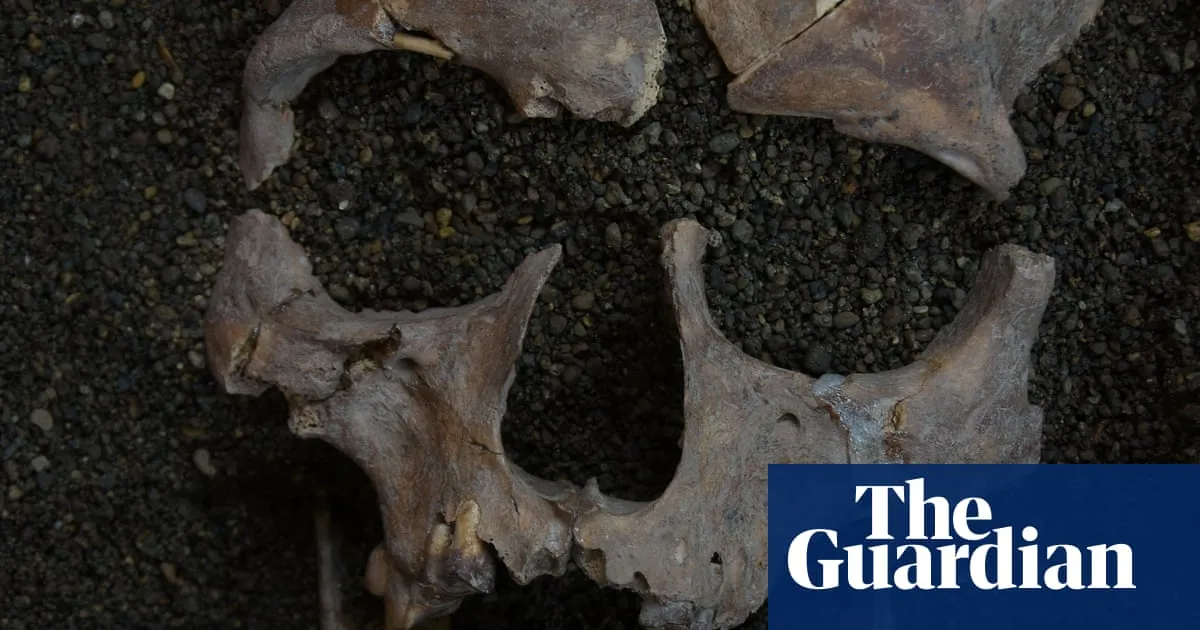
What may be the earliest known evidence for human drug taking has been traced to ancient Indonesian foragers who sucked on mind-altering nuts as long as 25,000 years ago.Analysis of two exceptionally rare skeletons from the Indonesian island of Sulawesi revealed dramatic tooth wear and traces of a psychoactive substance in the individuals’ remaining teeth, suggesting they routinely sucked on hard, abrasive betel nuts.Although little known in western societies, betel nuts are the world’s fourth most widely used psychoactive substance after alcohol, caffeine and nicotine, with an estimated tenth of the global population chewing the seeds.betel nuts.“We’ve found evidence for how this very common drug use habit, which is found throughout a lot of the Asia-Pacific region today, might have evolved,” said Prof Adam Brumm at Griffith University’s Australian Research Centre for Human Evolution in Brisbane.The work began when the team examined skeletal remains of two pre-agricultural foragers unearthed at two different sites on the island. One was dated to about 7,000 years old, the other more ancient at 16,000 to 25,000 to years old.Writing in Science Advances, the researchers describe how both adults had deep, rounded grooves in their teeth. Some went so deep they would have exposed the dental pulp. “I was thinking, what the hell were these people doing? It’s like someone had a drill head shaped like a gobstopper and wore away the inner part of the tooth,” said Brumm.betel nuts are actually the seeds of the Areca catechu palm, but are misnamed because they are often wrapped in betel vine leaves for chewing. Today, the nuts are typically chewed after being mixed with slaked lime made by grinding burnt shells to form a “quid”.Inferred positions of the nuts based on the dental wear patterns. Photograph:Brumm suspected the bizarre tooth wear was caused by the foragers holding hard, round and abrasive objects in their mouth, but what sort of object? “Imagine you kept a stone in your mouth and you moved it from one part of your mouth to another, and if you did that day after day, hour after hour. Eventually it would wear down your extremely hard dental tissue to form these grooves,” he said.The team wondered whether the grooves were the result of foragers sucking on betel nuts before people realised that mixing the nuts with slaked lime helped release more of the psychoactive drug and intensify the “high”.To test the hunch, the scientists soaked betel nuts in artificial saliva and found that it soon contained enough of the psychoactive compound arecoline to induce a high, albeit a milder one than when the nut is chewed. Analysis of the foragers’ teeth found traces of arecoline in the tissues.“I’ve sucked on a nut as an experiment and it’s a really bitter, astringent taste. It makes your mouth go numb and I think that’s what they were interested in,” Brumm said.“This might have been a traditional remedy for toothache, but if they did it for too long, sucking on the nut wore down their teeth so badly that it actually created much worse dental pain in the long term. These individuals were seemingly caught in a self-perpetuating cycle where they were continually sucking on the nuts to treat the tooth pain caused by this nut-sucking habit.”While humans probably began using mind-altering plants as soon as they encountered them, the oldest traditions of psychoactive drug use are thought to have arisen about 13,000 years ago with fermented drinks such as barley beer.Dr Elisa Guerra-Doce, an associate professor in European prehistory at the University of Valladolid in Spain, said the study provided “direct evidence of the antiquity of human drug use”.“These findings not only represent the earliest known evidence to date of the use of psychoactive plants anywhere in the world, but also demonstrate that the consumption of Areca nuts is a millennia-old tradition dating back to prehistoric times,” she added.
SRCThe Guardian - World News
LANGEN
LEANCenter-Left
WORDS644
ENT12
WED · 2026-09-09 · 18:00 GMTBRIEF NSR-2026-0909-110061
NSR-2026-0909-110061News Report·EN·Human Interest
Indonesian foragers may have sucked on mind-altering nuts 25,000 years ago, research finds
Research on two ancient skeletons from Sulawesi, Indonesia, suggests that prehistoric foragers may have used mind-altering nuts as early as 25,000 years ago. Analysis of the skeletons revealed significant tooth wear and traces of a psychoactive substance, arecoline, in their teeth.
Ian Sample Science editorThe Guardian - World NewsFiled 2026-09-09 · 18:00 GMTLean · Center-LeftRead · 3 min
The Guardian - World NewsFIG 01
Reading time
3min
Word count
644words
Sources cited
1cited
Entities identified
12entities
Quality score
100%
§ 01
Briefing Summary
AI-generatedNEWSAR · AI
Research on two ancient skeletons from Sulawesi, Indonesia, suggests that prehistoric foragers may have used mind-altering nuts as early as 25,000 years ago. Analysis of the skeletons revealed significant tooth wear and traces of a psychoactive substance, arecoline, in their teeth. This evidence points to the routine sucking of hard, abrasive betel nuts, a practice that may have been an early form of drug use. The researchers hypothesize that the foragers may have sucked on the nuts for their psychoactive effects, potentially as a remedy for toothache, even though this habit ultimately caused severe dental pain. This finding represents the earliest known evidence for human drug taking and demonstrates the ancient origins of betel nut consumption.
Confidence 0.90Sources 1Claims 5Entities 12
§ 02
Article analysis
Model · rule-basedFraming
Human Interest
Technology
Tone
Mixed Tone
AI-assessed
CalmNeutralAlarmist
Factuality
0.80 / 1.00
Factual
LowHigh
Sources cited
1
Limited
FewMany
§ 03
Key claims
5 extracted01
Analysis of ancient skeletons revealed dramatic tooth wear and traces of a psychoactive substance.
factual
Confidence
0.95
02
Betel nuts are the world's fourth most widely used psychoactive substance.
statistic
Confidence
0.90
03
Ancient Indonesian foragers may have consumed mind-altering nuts as early as 25,000 years ago.
factual
Confidence
0.90
04
The psychoactive substance found in teeth is likely arecoline from betel nuts.
factual
Confidence
0.85
05
The tooth wear patterns suggest foragers sucked on betel nuts before they were mixed with slaked lime.
factual
Confidence
0.80
§ 04
Full report
3 min read · 644 words§ 05
Entities
12 identifiedKey playerOppositionContextPositiveNeutralNegative
People1
Organizations3
Locations4
§ 06
Keywords & salience
9 termsbetel nuts
1.00
drug taking
0.90
ancient foragers
0.80
sulawesi
0.70
psychoactive substance
0.70
tooth wear
0.60
archaeological evidence
0.50
human drug use
0.50
asia-pacific region
0.40
§ 07
Topic connections
Interactive graph Network visualization showing 51 related topics
View Full Graph Person Organization Location Event|Click node to navigate|Edge numbers = shared articles