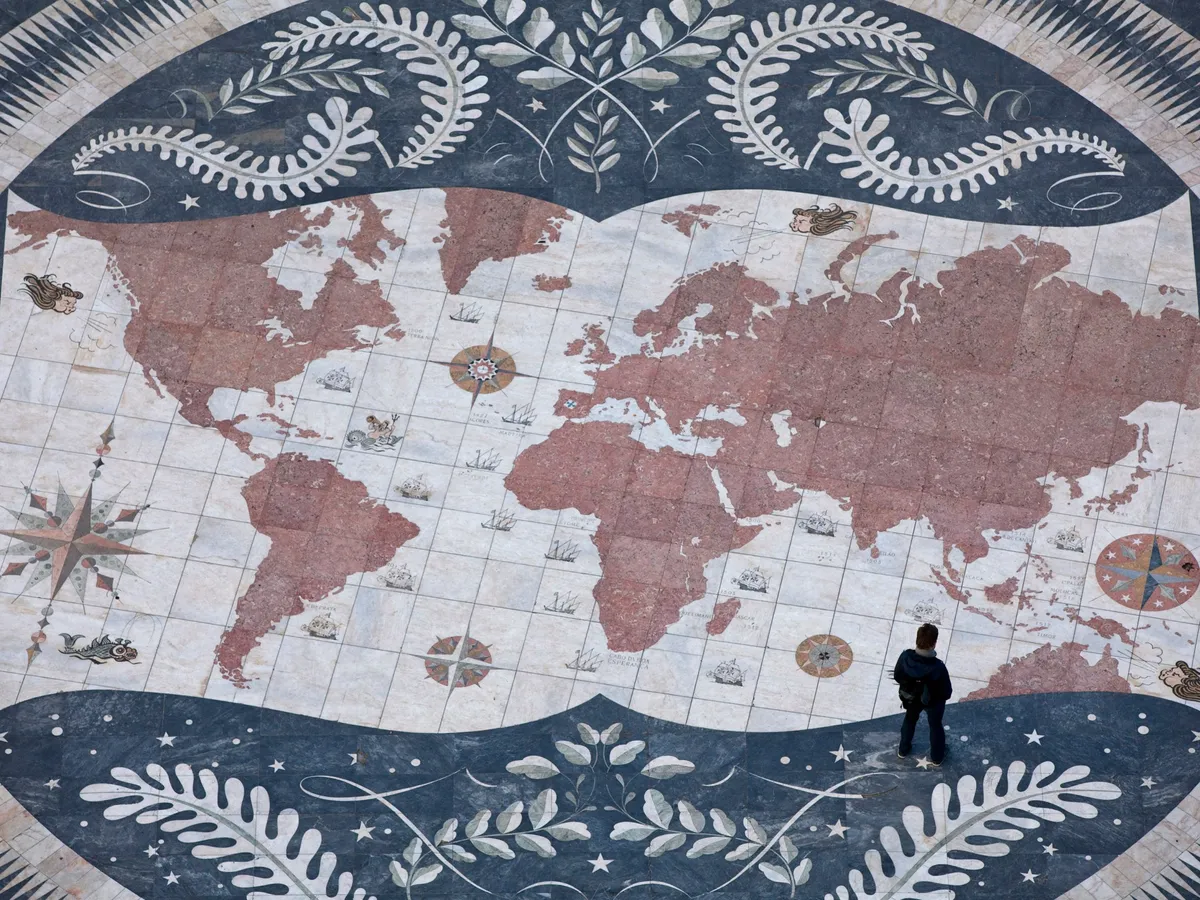
EXPLAINERThe countries are not opposed to a new map per se; they’re testy about the colour shades.A man stands on a world map in Lisbon on December 26, 2012 [File: AFP]Published On 11 Sep 2026In a historic move last week, the United Nations General Assembly voted overwhelmingly to encourage the use of new world maps which more accurately depict continents with their true sizes.The move followed months of lobbying by the African Union, which itself adopted a new map earlier in February. A total of 164 countries voted in favour while six abstained.Recommended Stories list of 4 itemslist 1 of 4UN approves new map showing Africa’s true sizelist 2 of 4Can you guess the real size of each country on the new world map?list 3 of 4The Map Was Lying To You: Why the UN Just Changed How We See Africalist 4 of 4In maps and charts: Russian and Ukrainian attacks on civilian targetsend of listThe United States was the only member to oppose it. US representative Yaryna Ferencevych said before the vote that the resolution was “the reason this institution is losing its credibility”.“Instead of focusing on genuine problems … this body is debating map projects from the 16th century,” she said.But since the resolution was approved, at least three other countries have voiced concerns about the changes: India, Ukraine and Japan.None are explicitly opposed to adopting a new projection. However, they are raising concerns about how certain disputed territories should be depicted.Here’s what we know:Why is there a new world map?The UN endorsed a resolution promoting the Equal Earth projection of the world map, rather than the Mercator projection, which is currently widely used.The resolution does not ban Mercator or impose a particular replacement – it merely encourages nations to adopt the Equal Earth version, which was created by three researchers in 2018.The Mercator projection, which was produced by Flemish cartographer Gerardus Mercator in 1569 when the West was busy “conquering” new territories, attempts to show a three-dimensional globe on a two-dimensional surface. That is why countries closer to the poles appear much larger than countries at the equator.For decades, map experts have pointed out that Mercator’s projection disproportionately shrinks the true size of the African continent and that of other developing regions, while making Europe and the US seem much larger by comparison.For example, Greenland is shown as roughly the same size as Africa, but, in reality, it could fit into the continent 14 times over. Europe, which is portrayed as bigger than South America, is actually half its size.Advocates from African countries pointed out that the map is problematic because of the size issues. Importantly, they argued, it reinforces negative perceptions of Africa.Several cartographers have attempted to develop equal area maps. However, African activists specifically pushed for the Equal Earth projection map, which significantly expands Africa and shrinks Europe and the US.Experts say while maps are inherently inaccurate because of the constraints of depicting a spherical world on a flat plane, the Equal Earth projection is as close as it gets.Why is Ukraine worried about the new map?Ukraine was one of six countries which abstained from the vote at the UNGA, along with Estonia, Georgia, Moldova, Serbia and Lithuania, who voted in solidarity with Ukraine.Kyiv has complained that the Equal Earth projection depicts the Russian-occupied Crimean peninsula in a distinctly lighter shade than mainland Ukraine.Russia illegally occupied and annexed Crimea in February 2014, a move the UN has denounced.Although the peninsula is also shaded differently from mainland Russia on the new map, its yellowish tint appears closer to the Russian shade than Ukraine’s.“Ukraine does not in principle oppose the core issue addressed in this draft resolution,” Andrii Melnyk, the country’s permanent representative to the UN, said in an address to the assembly.Melnyk said Kyiv had asked for corrections before the vote but had not received positive responses. The new map, he said, could be tantamount to opening a Pandora’s box, enabling the “abuse and distortion” of the world map.“It would be a truly fatal mistake for all of us, and for this General Assembly, to seek to correct a historical injustice in the geographical depiction of countries and continents by simultaneously allowing a deeply troubling interpretation of the text of this draft resolution,” he added.What is Japan demanding?Meanwhile, on Thursday, Tokyo, which voted in favour of the new map, said it had also asked for corrections to the Equal Earth projection because the map uses the same colours and shades for Russian territory as it does for the disputed Kuril Islands.Russia and Japan have long fought over control of the four islands, known in Russia as the Southern Kurils and in Japan as the Northern Territories. In 1945, during World War II, the Soviet Union invaded and annexed the islands as part of a pact with Western Allies that stipulated the Soviets would take the disputed territory. The islands’ Japanese inhabitants were removed.Subsequently, Japan and the US have claimed that the islands were not part of the original pact. The islands, however, remain under Russian administration.In August this year, Russia’s President Vladimir Putin paid his first-ever visit to the islands, drawing condemnation from Japan. Prime Minister Sanae Takaichi called the visit “absolutely unacceptable”, saying it “offends the sentiments of the Japanese people”.This week, Chief Cabinet Secretary Minoru Kihara said the Japanese embassy in the US has asked Equal Earth’s creators to change the map.“Displays that contradict the Japanese government’s position are seen [on the map],” Kihara said at a news conference. “We need to prevent incorrect perceptions regarding our country’s territories and geographical names from spreading.”Why is India uneasy about the map?India also voted in favour of the Equal Earth projection, but on Sunday, the Ministry of External Affairs published a caveat regarding depictions of the disputed border territory of Kashmir.Following the Indian partition of 1947, both Pakistan and India lay claim to the former state of Jammu and Kashmir, which had been controlled by the British through indirect rule. The region has subsequently been a flashpoint for tensions between the two rivals and has led to several wars.Parts of Kashmir are administered by Pakistan, while other parts are administered by India. China, which also disputes some Kashmir territory with India, administers its northeastern portion.In his statement, spokesperson Randhir Jaiswal noted that the UN vote was in favour of encouraging the use of equal area projections and that it had not made the use of any one map mandatory.“India’s sovereign territory, including the Union Territories of Jammu and Kashmir and Ladakh, must be depicted in accordance with India’s official map,” he said. “Any inaccurate or misleading depiction is unacceptable.”
SRCAl Jazeera
LANGEN
LEANCenter
WORDS1 103
ENT12
FRI · 2026-09-11 · 09:11 GMTBRIEF NSR-2026-0911-110480
NSR-2026-0911-110480Analysis·EN·Diplomatic
Japan, India, Ukraine: Why some countries are uneasy about new UN map
The UN General Assembly overwhelmingly voted to encourage the use of new world maps based on the Equal Earth projection, which more accurately depicts continent sizes than the widely used Mercator projection. This move, championed by the African Union, aims to correct historical distortions that made Africa appear smaller and Europe/US larger.
Al Jazeera StaffAl JazeeraFiled 2026-09-11 · 09:11 GMTLean · CenterRead · 5 min
Al JazeeraFIG 01
Reading time
5min
Word count
1 103words
Sources cited
2cited
Entities identified
12entities
Quality score
100%
§ 01
Briefing Summary
AI-generatedNEWSAR · AI
The UN General Assembly overwhelmingly voted to encourage the use of new world maps based on the Equal Earth projection, which more accurately depicts continent sizes than the widely used Mercator projection. This move, championed by the African Union, aims to correct historical distortions that made Africa appear smaller and Europe/US larger. While 164 countries voted in favor, the US opposed it, citing concerns about focusing on outdated map projects. However, India, Ukraine, and Japan have raised specific objections regarding the depiction of disputed territories. Ukraine abstained from the vote due to the new map's shading of the Russian-occupied Crimean peninsula, fearing it could legitimize Russian claims. Japan, which voted yes, also requested corrections because the map uses similar colors for Russian territory and the disputed Kuril Islands.
Confidence 0.90Sources 2Claims 4Entities 12
§ 02
Article analysis
Model · rule-basedFraming
Diplomatic
Social Justice
Tone
Measured
AI-assessed
CalmNeutralAlarmist
Factuality
0.70 / 1.00
Factual
LowHigh
Sources cited
2
Limited
FewMany
§ 03
Key claims
4 extracted01
The US opposed the resolution, with representative Yaryna Ferencevych stating it was causing the institution to lose credibility.
quoteYaryna Ferencevych
Confidence
0.95
02
The Equal Earth projection, promoted by the UN, aims to correct size distortions of the Mercator projection, where Africa appears smaller than Greenland.
factual
Confidence
0.90
03
UN General Assembly voted to encourage the use of new world maps that more accurately depict continents with their true sizes.
factual
Confidence
0.90
04
India, Ukraine, and Japan have voiced concerns about how disputed territories are depicted on the new maps.
factual
Confidence
0.85
§ 04
Full report
5 min read · 1 103 words§ 05
Entities
12 identifiedKey playerOppositionContextPositiveNeutralNegative
Organizations2
Locations7
§ 06
Keywords & salience
10 termsun map
1.00
equal earth projection
0.90
mercator projection
0.90
country size depiction
0.80
african union
0.70
disputed territories
0.60
united nations general assembly
0.50
japan
0.40
india
0.40
ukraine
0.40
§ 07
Topic connections
Interactive graph Network visualization showing 46 related topics
View Full Graph Person Organization Location Event|Click node to navigate|Edge numbers = shared articles