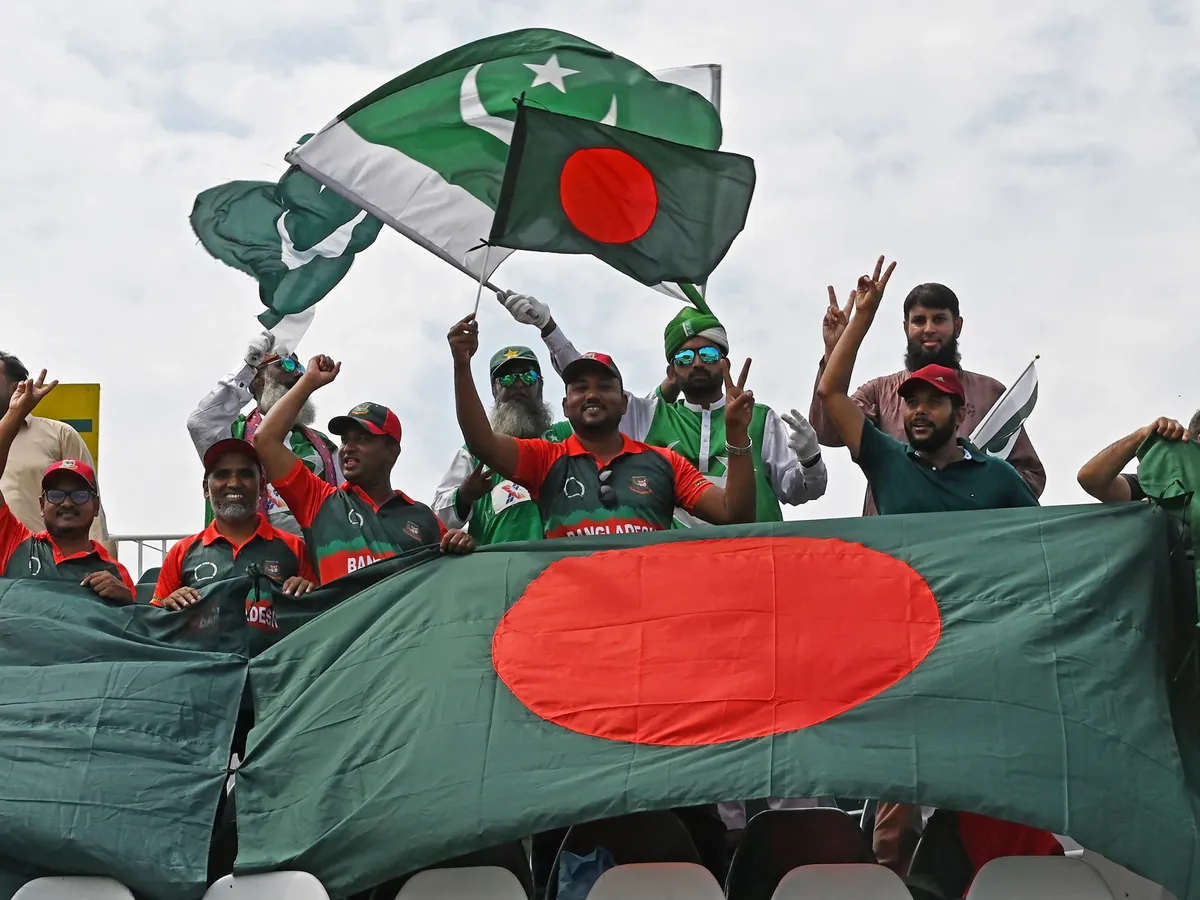
EXPLAINERRegional politics at the fore after Bangladesh ousted from the T20 World Cup in India.Bangladesh and Pakistan have mended their ties over the past year, and the Bangladeshi cricket team jas been touring Pakistan for bilateral and international cricket tournaments [File: Aamir Qureshi/AFP]Published On 27 Jan 2026Islamabad, Pakistan – Pakistan have cast doubts over their participation in the T20 World Cup after Bangladesh were kicked out of the tournament by the International Cricket Council (ICC).Bangladesh, whose spot in the upcoming global tournament was confirmed in June 2024, were expelled from it on Saturday after a weeks-long impasse with the ICC over the demanded relocation of their fixtures from India to Sri Lanka. The ICC gave Bangladesh’s berth to Scotland, the next best-ranked T20 team.Recommended Stories list of 4 itemslist 1 of 4‘Sad day for cricket’: ICC slammed for Bangladesh’s T20 World Cup ousterlist 2 of 4India-Bangladesh tensions rock cricket, as sport turns diplomatic weaponlist 3 of 4From 1996 to 2025: Pakistan’s long wait to host another major cricket eventlist 4 of 4‘Operation Sindoor’: How cricket became latest India-Pakistan weapon of warend of listThe ICC was accused of practising “double standards” in its extraordinary move to oust a full member nation on the basis of a logistical deadlock.The Pakistan Cricket Board (PCB) swiftly threw its weight behind Bangladesh and said it will not make a “final decision” on its team’s participation until next week.PCB Chairman Mohsin Naqvi met Pakistani Prime Minister Shehbaz Sharif on Monday to discuss the issue but did not clarify whether Pakistan would travel to the tournament, which begins on February 7.“It was agreed that the final decision will be taken either on Friday or next Monday,” Naqvi, who is also Pakistan’s interior minister, said in a post on X.All of Pakistan’s World Cup matches have been scheduled in Sri Lanka because of the fraught relations between New Delhi and Islamabad.What’s the Bangladesh-India T20 World Cup controversy all about?The controversy involving the three South Asian nations began three weeks ago when the Bangladesh Cricket Board (BCB) requested that all of its team’s matches scheduled to be played in India be shifted to Sri Lanka. It cited concerns over its players’ safety and security.It followed the abrupt removal of Bangladeshi fast bowler Mustafizur Rahman from his Indian Premier League (IPL) franchise, the Kolkata Knight Riders, upon a directive from the Board of Control for Cricket in India (BCCI).The reason the BCCI gave was “developments all around”. That might refer to the deteriorating ties between Dhaka and New Delhi since August 2024 when Bangladeshi Prime Minister Sheikh Hasina was ousted from power and fled to India, where she continues to live.Bangladesh reasoned that if one of their players was not safe in India, it could not jeopardise the safety of the entire squad and support staff.However, the ICC, currently led by Jay Shah, the son of Indian Home Minister Amit Shah and a close ally of Prime Minister Narendra Modi, rejected the relocation request. The governing body said there were no “credible” or “verifiable” threats to the Bangladeshi team.After a further back-and-forth between the BCB and the ICC – during which neither party moved from its original position – Bangladesh were ousted from the tournament and replaced by Scotland.Why has the ICC been accused of ‘hypocrisy’?In late 2024, the ICC brokered a three-year agreement between India and Pakistan that allowed both countries to play their matches at neutral venues whenever their neighbour hosted an international tournament.The decision came after India’s refusal to travel to Pakistan for the ICC Champions Trophy over security concerns raised by the Indian government. India played all their matches, including the final, in Dubai, United Arab Emirates.For the ICC Women’s World Cup 2025, cohosted by India and Sri Lanka, Pakistan played their fixtures in Sri Lanka and are scheduled to do the same at the ICC Men’s T20 World Cup 2026.BCB President Aminul Islam pointed at this agreement and accused the ICC of “hypocrisy” for dismissing a similar request from Bangladesh.While the BCB and the ICC were stuck in an impasse, the PCB decided to partake in the dispute by supporting Bangladesh’s request for a neutral venue.At an ICC board meeting called to discuss the issue last week, Pakistan were the only full member nation to support Bangladesh’s position. Other board members endorsed the idea of replacing Bangladesh if they refused to play in India.Why have Pakistan become involved in this affair?While the controversy has to do with sport, the underlying tensions are deeply political, and the three nations share decades-long fractured ties.After the 1947 partition of British India, India emerged as an independent state while a Muslim-majority Pakistan was created with eastern and western wings separated by more than 2,000km (1,300 miles).Less than 25 years later, the eastern wing broke away after a bloody war to become Bangladesh. Indian troops played a decisive role in supporting Sheikh Mujibur Rahman, Bangladesh’s founder and Hasina’s father.Fast forward to 2024 – the once-close ties between India and Bangladesh were fractured with Hasina’s ouster, and the ties between Bangladesh and Pakistan, previously near rock bottom, improved rapidly.So as Bangladesh were locked in negotiations with the ICC, Naqvi, Pakistan’s cricket chief, publicly criticised the governing body.“You can’t have double standards,” Naqvi said on Saturday.“You can’t say for one country [India] they can do whatever they want and for the others to have to do the complete opposite. That’s why we’ve taken this stand and made clear Bangladesh have had an injustice done to them. They should play in the World Cup. They are a major stakeholder in cricket.”How have Pakistan reacted, and what can they do next?Within days of the BCCI’s decision to remove Mustafizur from the IPL, the PCB reacted by offering the star Bangladeshi bowler an option to register for the Pakistan Super League, the country’s premier franchise T20 tournament.Despite reports in Pakistani media that the PCB may pull out of the T20 World Cup, Naqvi has not indicated that might be the case.There has also been speculation that Pakistan may forfeit their match against India on February 15 in Colombo as a symbolic gesture in support of Bangladesh.With a final decision expected on Friday or Monday, the ongoing uncertainty could disrupt Pakistan’s preparations for the tournament. They are scheduled to play the tournament’s opening game on February 7 against the Netherlands.Ehsan Mani, former chairman of the ICC and the PCB, has warned the PCB against withdrawing from the World Cup.“This brings politics into the game, and I have always advocated that the two should be kept strictly separate,” he told Al Jazeera.What happens if Pakistan withdraws from the T20 World Cup?The rivalry between Pakistan and India on the political pitch has long spilled over onto the cricket field, which has increasingly become a proxy battleground, especially since tensions escalated drastically after a four-day military confrontation between the two neighbours in May.India’s refusal to travel to Pakistan for the Champions Trophy, which they went on to win unbeaten in the UAE, further strained relations.When the teams met again at the Asia Cup in September, Indian players declined to shake hands with their Pakistani counterparts. After a tense final, which India won, the Indian team also refused to accept the trophy from Naqvi, who also heads the Asian Cricket Council.Ali Khan, a professor at Lahore University of Management Sciences and author of Cricket in Pakistan: Nation, Identity, and Politics, described Pakistan’s support of Bangladesh as “absolutely the principled stance to take”.“If India and Pakistan can both be accommodated in similar situations, then why not another full ICC member [Bangladesh]? It is also important for Pakistan to stand up for the way the ICC is operating now,” he told Al Jazeera.Khan cautioned, however, that threatening a boycott was a step too far.“It veers towards performative and petty point-scoring then. Pakistan should continue to bring up the inequity within the ICC at every meeting forcefully, persuade and shame others to speak up as well. That requires strong diplomacy rather than chest-thumping.”Meanwhile, veteran Indian cricket writer Sharda Ugra said Pakistan’s intervention appeared aimed at building an alliance.“If Pakistan does back out of the tournament, it will obviously disappoint the cricket community,” she said.Ugra believes Naqvi’s move is aimed at “annoying the ICC and the BCCI and putting them on the back foot”, especially as he is also Pakistan’s interior minister.Khan argued that while the ICC has taken principled positions in the past, including the reintegration of apartheid-era South Africa, its balance has shifted.“Sadly, India’s enormous financial clout in cricket has unbalanced the body so much that it has simply become a mouthpiece for the Indian government with other member nations also responsible for this through their timid acceptance of Indian diktat,” he said.Ugra also criticised the England and Wales Cricket Board and Cricket Australia for their respective silence on the matter.“Bangladesh is part of the ICC community and a full member, and these two boards should have played their part in making it more equitable,” she said. “It is like they are all pliant to BCCI and acting as if they have no power.”
SRCAl Jazeera
LANGEN
LEANCenter
WORDS1 512
ENT11
TUE · 2026-01-27 · 18:44 GMTBRIEF NSR-2026-0127-11087
NSR-2026-0127-11087News Report·EN·Political Strategy
Why is Pakistan backing Bangladesh in its T20 World Cup row with India?
Pakistan is considering boycotting the T20 World Cup after Bangladesh was controversially expelled from the tournament by the ICC due to a dispute over relocating their matches from India to Sri Lanka, citing safety concerns. The Pakistan Cricket Board (PCB) has expressed solidarity with Bangladesh, accusing the ICC of double standards, and has delayed a final decision on its participation until next week.
Abid HussainAl JazeeraFiled 2026-01-27 · 18:44 GMTLean · CenterRead · 7 min
Al JazeeraFIG 01
Reading time
7min
Word count
1 512words
Sources cited
3cited
Entities identified
11entities
Quality score
100%
§ 01
Briefing Summary
AI-generatedNEWSAR · AI
Pakistan is considering boycotting the T20 World Cup after Bangladesh was controversially expelled from the tournament by the ICC due to a dispute over relocating their matches from India to Sri Lanka, citing safety concerns. The Pakistan Cricket Board (PCB) has expressed solidarity with Bangladesh, accusing the ICC of double standards, and has delayed a final decision on its participation until next week. All of Pakistan's matches are scheduled in Sri Lanka due to strained relations with India. The controversy stems from Bangladesh's request to move its games out of India following the removal of a Bangladeshi player from the Indian Premier League. The T20 World Cup is scheduled to begin on February 7.
Confidence 0.90Sources 3Claims 5Entities 11
§ 02
Article analysis
Model · rule-basedFraming
Political Strategy
Diplomatic
Tone
Mixed Tone
AI-assessed
CalmNeutralAlarmist
Factuality
0.70 / 1.00
Factual
LowHigh
Sources cited
3
Well sourced
FewMany
§ 03
Key claims
5 extracted01
PCB Chairman Mohsin Naqvi met Pakistani Prime Minister Shehbaz Sharif on Monday to discuss the issue.
factualArticle
Confidence
1.00
02
The ICC gave Bangladesh’s berth to Scotland, the next best-ranked T20 team.
factualArticle
Confidence
1.00
03
Bangladesh were expelled from the T20 World Cup after a weeks-long impasse with the ICC over the demanded relocation of their fixtures from India to Sri Lanka.
factualArticle
Confidence
1.00
04
All of Pakistan’s World Cup matches have been scheduled in Sri Lanka because of the fraught relations between New Delhi and Islamabad.
factualArticle
Confidence
0.90
05
Pakistan have cast doubts over their participation in the T20 World Cup after Bangladesh were kicked out of the tournament.
factualArticle
Confidence
0.90
§ 04
Full report
7 min read · 1 512 words§ 05
Entities
11 identifiedKey playerOppositionContextPositiveNeutralNegative
Organizations2
Locations5
§ 06
Keywords & salience
10 termst20 world cup
1.00
bangladesh
0.90
pakistan
0.90
india
0.80
icc
0.80
cricket
0.70
tournament ouster
0.60
political tensions
0.60
fixtures relocation
0.50
double standards
0.40
§ 07
Topic connections
Interactive graph Network visualization showing 51 related topics
View Full Graph Person Organization Location Event|Click node to navigate|Edge numbers = shared articles