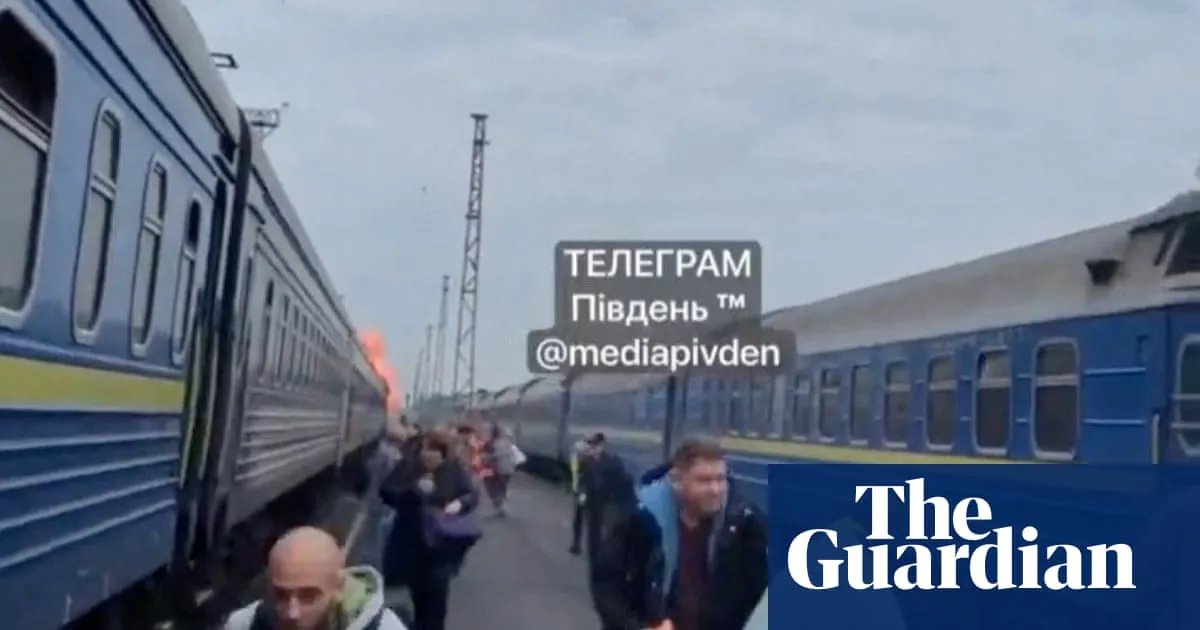
Europe needs to show it will not be “scared off” in supporting Ukraine, the EU’s chief diplomat said, after a Russian drone hit a passenger train on the country’s border with Poland shortly after a convoy of high-level diplomats and former leaders had passed through.The earlier train, which was carrying the former UK prime minister Boris Johnson and the former CIA chief David Petraeus and running ahead of schedule, may have been the target of the Russian drone strike, Ukrainian Railways has said.European leaders condemned the strikes on Monday. The French foreign minister, Jean-Noël Barrot, said the goal of the attacks was “to intimidate Europeans, discourage and above all divide them”.The EU’s high representative for foreign and security policy, Kaja Kallas, said the strike “was clearly a message to the western world”. Speaking on the sidelines of an Arctic conference in Finland, she said: “I think the question for us is what do we take from that message? I think we should act the opposite. We should show that we are there for Ukraine and we are not scared off, because otherwise, you know, Russia will just achieve what they want, which is the submission of Ukraine.”A spokesperson for Kallas added: “We strongly condemn the latest Russian strikes near the Ukraine-Poland border, including the attack against the passenger train,” and referenced a recent EU decision to approve a €6.1bn tranche of the €90bn loan for Ukraine. “We are acting on the front to equip Ukraine better to defend itself, and we will continue to stand firmly with Ukraine and its right to defend itself against Russian aggression,” the spokesperson said.Overnight attacks across Ukraine involving more than 450 Russian drones and missiles killed at least six people and injured more than 40. Ukraine’s air force said it had intercepted 405 drones and four missiles.Western Ukraine, which is typically quieter than Kyiv or the eastern frontline zones, was particularly badly hit.The strikes, which prompted air raid warnings in Poland, came as EU diplomats met in Brussels on Monday for last-ditch talks on the rollover of the bloc’s sanctions against more than 2,600 Russian individuals and entities involved in supporting Vladimir Putin’s war. The sanctions are due to expire on Tuesday but their prolongation is being held up by a dispute about whether to remove an individual from the list.Ukraine’s president, Volodymyr Zelenskyy, wrote on Telegram on Sunday: “Ukrainians are fighting every day to prevent these strikes from spreading further into Europe, giving their lives and preventing the aggression from expanding.”Ukrainian Railways, which operates the line, said a train carrying several security advisers from European countries as well as Johnson, Petraeus and the former Swedish prime minister Carl Bildt, had passed through the border crossing shortly before the drone strike.The diplomatic train, Ukrainian Railways said, had left ahead of schedule and could have been the target of the Russian drone.skip past newsletter promotionafter newsletter promotionThe Polish prime minister, Donald Tusk, warned on Sunday that intensifying Russian attacks in Ukraine in the coming weeks could affect Poland, as he chaired an emergency meeting after the Russian drone attacks near the border.“The coming weeks and months will be a period of very intensive actions on the Russian side,” he said, adding Poland “cannot rule out that this escalation will also affect our territory”.He added that Poland had been tipped off by its security services, and by intelligence agencies from allied countries, that an attack such as this was likely. “We knew that the Russian plan would include an attempt to disrupt, paralyse, and perhaps even destroy Ukrainian border crossings,” Tusk said.
SRCThe Guardian - World News
LANGEN
LEANCenter-Left
WORDS596
ENT12
MON · 2026-09-14 · 11:47 GMTBRIEF NSR-2026-0914-111151
NSR-2026-0914-111151News Report·EN·Diplomatic
‘We are not scared,’ says top EU diplomat after Russian strike on passenger train
The EU's chief diplomat, Kaja Kallas, stated that a Russian drone strike on a passenger train near the Ukraine-Poland border was a "message to the western world." This incident occurred shortly after a train carrying former UK Prime Minister Boris Johnson and former CIA Chief David Petraeus had passed through the area, leading Ukrainian Railways to suggest it may have been the intended target. European leaders condemned the attack, viewing it as an attempt to intimidate and divide Europe.
Jennifer Rankin in Brussels and Charlotte Higgins and Amy Hawkins in KyivThe Guardian - World NewsFiled 2026-09-14 · 11:47 GMTLean · Center-LeftRead · 3 min
The Guardian - World NewsFIG 01
Reading time
3min
Word count
596words
Sources cited
5cited
Entities identified
12entities
Quality score
100%
§ 01
Briefing Summary
AI-generatedNEWSAR · AI
The EU's chief diplomat, Kaja Kallas, stated that a Russian drone strike on a passenger train near the Ukraine-Poland border was a "message to the western world." This incident occurred shortly after a train carrying former UK Prime Minister Boris Johnson and former CIA Chief David Petraeus had passed through the area, leading Ukrainian Railways to suggest it may have been the intended target. European leaders condemned the attack, viewing it as an attempt to intimidate and divide Europe. Kallas emphasized that the EU must not be "scared off" from supporting Ukraine, as doing so would allow Russia to achieve its goals. The strike was part of broader overnight attacks across Ukraine that killed at least six people. The incident prompted Polish Prime Minister Donald Tusk to warn of potential Russian escalation affecting Polish territory.
Confidence 0.90Sources 5Claims 5Entities 12
§ 02
Article analysis
Model · rule-basedFraming
Diplomatic
Conflict
Tone
Mixed Tone
AI-assessed
CalmNeutralAlarmist
Factuality
0.70 / 1.00
Factual
LowHigh
Sources cited
5
Well sourced
FewMany
§ 03
Key claims
5 extracted01
The goal of the Russian attacks was 'to intimidate Europeans, discourage and above all divide them'.
quoteJean-Noël Barrot
Confidence
1.00
02
EU's chief diplomat stated Europe must not be 'scared off' from supporting Ukraine after a Russian drone strike on a passenger train.
quoteKaja Kallas
Confidence
1.00
03
The EU approved a €6.1bn tranche of a €90bn loan for Ukraine.
statisticEU spokesperson
Confidence
0.95
04
Overnight Russian attacks across Ukraine killed at least six people and injured more than 40.
statisticUkraine's air force
Confidence
0.95
05
A Russian drone struck a passenger train near the Ukraine-Poland border shortly after a train carrying high-level diplomats passed.
factualUkrainian Railways
Confidence
0.90
§ 04
Full report
3 min read · 596 words§ 05
Entities
12 identifiedKey playerOppositionContextPositiveNeutralNegative
People5
Organizations1
§ 06
Keywords & salience
10 termsrussian strike
1.00
support ukraine
1.00
eu diplomat
0.90
passenger train
0.80
russian aggression
0.80
eu sanctions
0.70
intimidate europeans
0.60
boris johnson
0.50
david petraeus
0.50
ukraine-poland border
0.40
§ 07
Topic connections
Interactive graph Network visualization showing 51 related topics
View Full Graph Person Organization Location Event|Click node to navigate|Edge numbers = shared articles