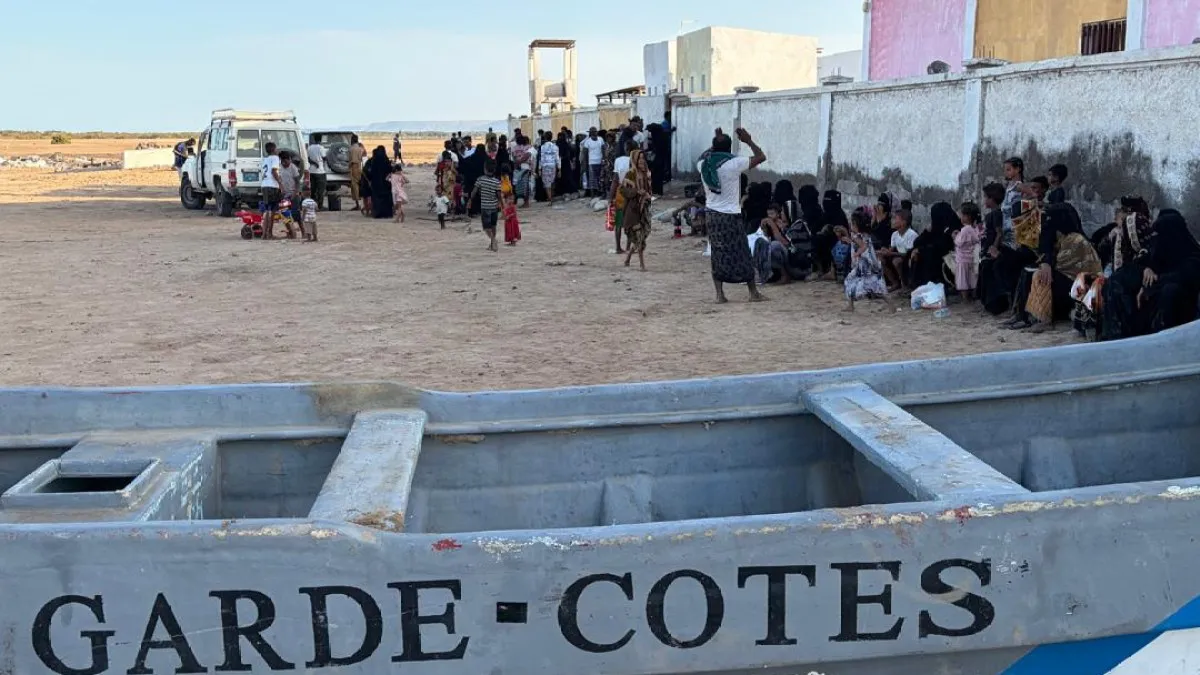
More than 3,400 people arrived in 48 hours as Djibouti prepares for more.People who fled fighting in Yemen gather after arriving in Obock, on Djibouti’s northern coast [Courtesy of International Organization for Migration]Published On 15 Sep 2026More than 3,400 people fleeing renewed fighting in Yemen have landed along Djibouti’s northern coast, according to Djiboutian authorities.The figure was reported by Djibouti’s state news agency on Sunday. It covers just 48 hours of arrivals, part of a surge that Djiboutian officials say began the previous weekend.Recommended Stories list of 2 itemslist 1 of 2Djibouti humanitarian situation worsens as Yemenis seek refugelist 2 of 2Why the Houthi advance towards Yemen’s Marib, Taiz mattersend of listThe crossings followed a Houthi offensive in which the group, which controls much of northern Yemen, seized the Red Sea port of Mocha and advanced along the coast towards the narrow strait separating Yemen from Djibouti.Djibouti has fewer than 1.2 million people and limited resources. The arrival of thousands of people within days is putting further strain on already stretched services, officials have warned.Footage aired on Djibouti’s state broadcaster RTD showed wooden dhows and larger vessels arriving near the town of Obock, crowded with women in black robes and children wearing life jackets.Obock lies on Djibouti’s northern coast, close to the narrowest stretch of the Bab al-Mandeb between the Horn of Africa and Yemen. The area is near a departure point for refugees making the journey in the opposite direction, through Yemen towards the Gulf.Those coming ashore could be seen carrying the belongings they had with them, including sacks of clothing, water containers, food and other personal items. In footage filmed after dark, soldiers unloaded the boats under floodlights.People have arrived on “all kinds of sea vessels, from small dhows to larger ships”, Alexandre Coissac, who heads the International Organization for Migration (IOM) in Djibouti, told Al Jazeera. One vessel alone carried hundreds of people recently, he said.The journey has also become increasingly difficult, Coissac said, with some families stranded on the Yemeni side due to fuel shortages.UNICEF said children making the crossing were exposed to extreme heat, dehydration and a lack of safe drinking water.The IOM said on Sunday that fighting had driven residents out of entire districts in Yemen, including Maqbanah and Jabal Habashi. It put the wider displacement inside Yemen at more than 85,000 people, most of it in just the first two weeks of September.After Houthi forces seized the strategic Yemeni island of Mayyun, also known as Perim, in the Bab al-Mandeb strait, Djibouti’s Ministry of Foreign Affairs said on September 11 it was following developments there “with increased attention”, while backing efforts to ease tensions and reach a political solution in Yemen.Djibouti’s Finance Minister Ilyas Dawaleh documented the accelerating arrivals in a series of posts on X, reporting about 500 people by September 11, 1,400 the following day and more than 2,000 by that evening.By September 13, he wrote that the pace was becoming “increasingly difficult for our country”.As arrivals increased, Djibouti’s coastguard, navy, army and health services were deployed to rescue people stranded at sea and receive them ashore, providing food and first aid at sites including Obock and the smaller coastal post of Khor Angar.On Sunday, Prime Minister Abdoulkader Kamil Mohamed travelled to Obock to meet officials from the United Nations Office of the High Commissioner for Refugees (UNHCR), the World Food Programme and the IOM.Djiboutian authorities said they were preparing to receive as many as 10,000 people if the pace continued.The pressure on Djibouti also has implications beyond the humanitarian response. The Bab al-Mandeb is one of the world’s most important shipping corridors, with an estimated one in eight tonnes of global seaborne trade passing through it each day.Djibouti’s location has also made it a hub for foreign militaries. The United States, China, France, Japan and Italy all operate bases in the country, several within a few miles of one another, in part because of the importance of protecting shipping through the increasingly contested waterway.“Djibouti, like many countries, depends heavily on international trade and the safety and security of sea lanes,” said Aden Omar Abdillahi, director of the Djibouti-based Institute of Political and Strategic Studies.“If this conflict impacts maritime security in the way some fear, it will have a massive impact.”Djibouti has spent two decades building its role as a stable base for foreign governments and shipping interests in an unstable region. The latest crisis puts further pressure on that role as instability around the Red Sea deepens.In a separate post on X, Dawaleh warned that the US-Israel war on Iran, which has disrupted traffic through the critical Strait of Hormuz waterway, is already deepening uncertainty for smaller economies such as Djibouti’s.In 2015, more than 15,700 Yemenis arrived after the war escalated, according to IOM and Djiboutian government figures.“We’ve received refugees for decades from across the region,” Abdillahi said.“When it comes to Yemen, many people settled here during the first big phase of the fighting in 2015, and we’ve got experience managing this. Yemenis are also not distant foreigners; there are Yemeni communities who have been here for centuries.”Djibouti already hosts more than 36,000 registered refugees and asylum seekers, according to UNHCR’s March figures. Most are from Somalia, Ethiopia and Yemen.The Markazi camp near Obock, which received thousands of Yemenis during the earlier exodus a decade ago, is again being used to accommodate new arrivals.“It is at this site that we’re trying to organise and that the authorities are trying to organise all the support in terms of housing, shelter and meals,” IOM’s Coissac told Al Jazeera.He added that many of the latest arrivals were being accommodated there, while others had been taken in by residents of Obock. “The generosity of the Obock population has been huge,” Coissac said.In a post on X on September 12, Dawaleh wrote that the UNHCR and other UN agencies on the ground “appear to be lacking resources to receive and protect these vulnerable people with dignity”, and urged the international community to “stand with us urgently”.A person familiar with the humanitarian response in the region said authorities in Puntland and Somaliland, two self-governing regions of Somalia across the Gulf of Aden, had already asked UN agencies for help preparing for larger numbers.They spoke on condition of anonymity because they were not authorised to discuss the matter publicly.Both regions could see arrivals at their own port towns, Bosaso and Berbera, if the exodus continues.The preparations come as humanitarian organisations are already facing deep funding pressures following sharp reductions in aid from the United States and, more recently, the United Kingdom.Coissac said many of those arriving were likely to remain in Djibouti rather than move on quickly. “The number of people arriving is large,” he said, “and if it continues at this rate, we’ll not be able to manage”.
SRCAl Jazeera
LANGEN
LEANCenter
WORDS1 132
ENT12
TUE · 2026-09-15 · 12:43 GMTBRIEF NSR-2026-0915-111442
NSR-2026-0915-111442News Report·EN·Human Interest
Thousands flee to Djibouti amid renewed Yemen fighting
Thousands of people are fleeing renewed fighting in Yemen, with over 3,400 arriving in Djibouti within 48 hours. These arrivals follow a Houthi offensive that seized the port of Mocha and advanced along the coast.
Faisal AliAl JazeeraFiled 2026-09-15 · 12:43 GMTLean · CenterRead · 5 min
Al JazeeraFIG 01
Reading time
5min
Word count
1 132words
Sources cited
3cited
Entities identified
12entities
Quality score
100%
§ 01
Briefing Summary
AI-generatedNEWSAR · AI
Thousands of people are fleeing renewed fighting in Yemen, with over 3,400 arriving in Djibouti within 48 hours. These arrivals follow a Houthi offensive that seized the port of Mocha and advanced along the coast. Djibouti, a small nation with limited resources, is preparing for potentially thousands more refugees, straining its services. The International Organization for Migration (IOM) reports that fighting has displaced residents from entire districts in Yemen, with over 85,000 displaced internally in early September. The influx of refugees highlights the growing instability in the Bab al-Mandeb strait, a crucial global shipping corridor, and puts pressure on Djibouti's role as a stable regional hub.
Confidence 0.90Sources 3Claims 5Entities 12
§ 02
Article analysis
Model · rule-basedFraming
Human Interest
Conflict
Tone
Measured
AI-assessed
CalmNeutralAlarmist
Factuality
0.80 / 1.00
Factual
LowHigh
Sources cited
3
Well sourced
FewMany
§ 03
Key claims
5 extracted01
More than 3,400 people fleeing renewed fighting in Yemen have landed along Djibouti’s northern coast in 48 hours.
statisticDjiboutian authorities
Confidence
1.00
02
Houthi forces seized the strategic Yemeni island of Mayyun, also known as Perim, in the Bab al-Mandeb strait.
factualDjibouti’s Ministry of Foreign Affairs
Confidence
0.90
03
Fighting has driven residents out of entire districts in Yemen, including Maqbanah and Jabal Habashi.
factualIOM
Confidence
0.90
04
The arrival of thousands of people is putting further strain on Djibouti's already stretched services.
factualDjiboutian officials
Confidence
0.90
05
Houthi forces seized the Red Sea port of Mocha and advanced along the coast towards the strait separating Yemen from Djibouti.
factualarticle
Confidence
0.90
§ 04
Full report
5 min read · 1 132 words§ 05
Entities
12 identifiedKey playerOppositionContextPositiveNeutralNegative
Organizations5
§ 06
Keywords & salience
10 termsyemen conflict
1.00
refugee crisis
0.90
djibouti
0.80
humanitarian situation
0.70
displacement
0.60
houthi offensive
0.60
bab al-mandeb
0.50
red sea
0.50
iom
0.40
unicef
0.40
§ 07
Topic connections
Interactive graph Network visualization showing 51 related topics
View Full Graph Person Organization Location Event|Click node to navigate|Edge numbers = shared articles