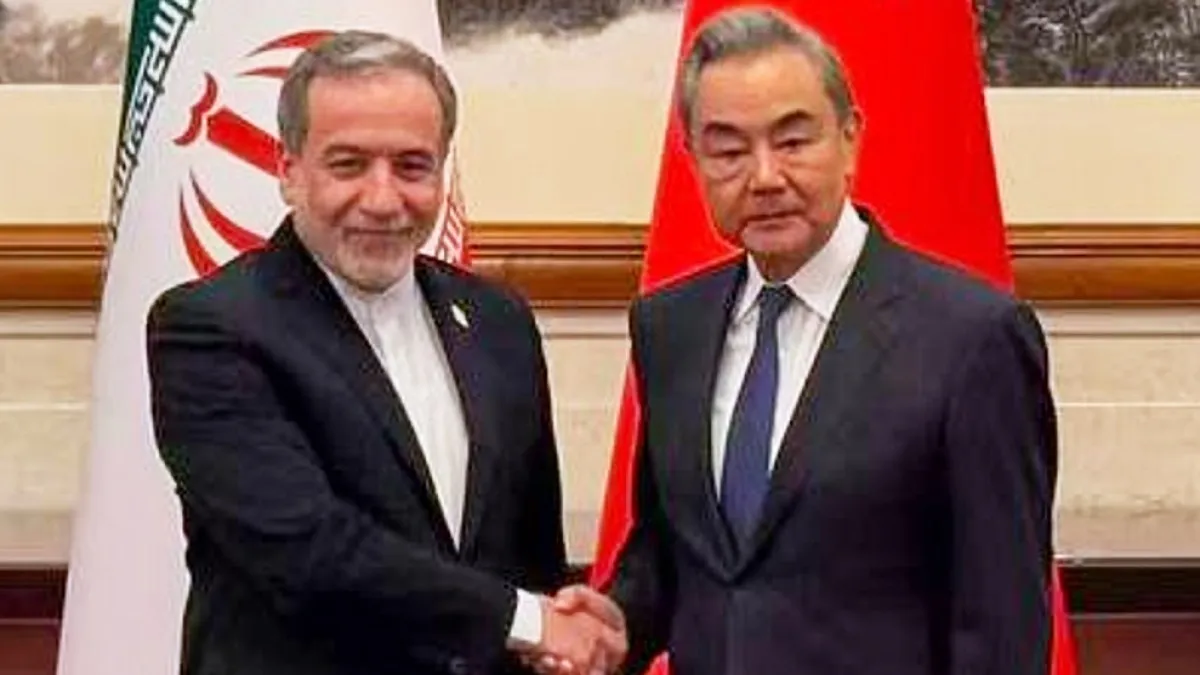
Tehran and Beijing explore diplomatic paths amid escalating tensions between Iran and the United States.Iran's Foreign Minister Abbas Araghchi and China's Foreign Minister Wang Yi meet in Beijing, China on May 6, 2026 [Telegram channel of the Iranian Foreign Minister via AP]Published On 15 Sep 2026Tehran, Iran – When Iran’s Foreign Minister Abbas Araghchi last visited China in May, it came shortly before a trip by United States President Donald Trump to the same country.Araghchi is expected to be back in Beijing on Wednesday, his second visit to the Chinese capital since the Iran" class="entity-link entity-event" data-entity-id="38678" data-entity-type="event">US-Israel war on Iran began at the end of February. Once again, the trip comes shortly ahead of a planned meeting between Trump and Chinese President Xi Jinping, this time in Washington later in SeptemberRecommended Stories list of 3 itemslist 1 of 3China does not need to replace the US in the Gulflist 2 of 3Who is Robert Kraft, pro-Israel billionaire who cancelled Macklemore?list 3 of 3Carney visits Europe: Can Canada seek refuge with the EU amid US trade war?end of listAraghchi’s own meeting on Wednesday will be with his Chinese counterpart, Wang Yi.The meetings in May and now in September highlight the role China has played during the war, framing itself as a neutral party that wants an end to the conflict.Xi urged the BRICS bloc of Global South powers during his address to a summit of member countries in New Delhi earlier this week to act as peacemakers in the Middle East conflict, and said China was willing to work with them towards that goal.War diplomacyWhile Xi hinted at interest in potentially playing an explicit US-Iran mediation role in his BRICS speech, he did not explicitly announce any such imminent diplomatic initiative.Instead, the Chinese president once again promoted a broad four-point plan for de-escalation in the Middle East, which is centred on peaceful coexistence, respect for national sovereignty, adherence to international law, and balancing development and security.Analysts have pointed out that while China wants to see an end to a war that has brought tumult to financial and energy markets, it has traditionally avoided deeply entangling itself in third-party conflicts and potentially failed diplomatic initiatives.Inside Iran, there have been varied opinions on the significance of Xi’s latest remarks.Former Foreign Minister Mohammad Javad Zarif said on Sunday that Xi’s “constructive initiatives offer timely openings to de-escalate tensions” and show that multilateral diplomacy “is the only viable path to stability”.But Hamed Vafaei, professor of Chinese literature at the University of Tehran and a China researcher, said that perceiving Xi’s remarks as an offer to mediate between Iran and the US was more of a “free interpretation” of his words than reality.Nuclear file, sanctions and military cooperationAraghchi is also expected to discuss Iran’s nuclear programme with China, as Washington attempts to renew focus on Tehran’s activities.Last week, the US and its European allies, including France, Germany and the United Kingdom, successfully pushed the board of the United Nations nuclear watchdog, the International Atomic Energy Agency (IAEA), to refer Iran to the UN Security Council.The last such referral came 20 years ago and was followed by six UN Security Council resolutions being passed against Iran, and sweeping sanctions that hit the country’s economy hard.This time, however, the move is expected to be largely symbolic. China and Russia have strongly opposed it, and can veto any new Security Council measures.Western pressure on Tehran is continuing elsewhere. Iran’s nuclear chief Mohammad Eslami was barred from attending this week’s IAEA General Conference in Vienna under “snapback” sanctions reimposed by European powers last year.The US has continued to build on its own sanctions against Iran, launching “Operation Economic Outcast” to further isolate the Iranian government from the international community as it also tries to choke off the country through a naval blockade of Iran’s southern ports.A large number of China-linked refineries, companies and financial channels allegedly facilitating dealings with Iran have also been targeted as part of the sanctions, although larger Chinese banks have not been hit so far.But on Monday, the US Treasury designated Russia’s VTB Bank under the Iran sanctions. It did not name China in its statements, but the second-largest Russian bank is the only one with a licensed branch in mainland China, with direct access to China’s national payment system.China remains the largest buyer of Iranian crude oil and has vowed to protect its own interests despite the sanctions. It has continued purchasing Iranian oil stored beyond the reach of the US blockade.China’s links to Iran’s military capabilities also drew attention in the US this week, after the Wall Street Journal reported that Iran had obtained high-resolution satellite images from Chinese entities before carrying out an attack on a US military base in Jordan that killed three American soldiers.Trump downplayed the incident when he was asked about it by reporters, saying that the Chinese were “basically doing what we do”.“I think he’s behaved reasonably well,” Trump separately said about Xi. “When they say that China spies on us, I say you’re right, and we spy on them, too”.
SRCAl Jazeera
LANGEN
LEANCenter
WORDS839
ENT12
TUE · 2026-09-15 · 16:15 GMTBRIEF NSR-2026-0915-111490
NSR-2026-0915-111490News Report·EN·Diplomatic
Can China play peacemaker as Iran’s foreign minister heads to Beijing?
Iran's Foreign Minister Abbas Araghchi is visiting Beijing for the second time since February 2026 to meet with Chinese Foreign Minister Wang Yi. These meetings occur ahead of a planned meeting between US President Trump and Chinese President Xi Jinping, highlighting China's role as a self-proclaimed neutral party seeking an end to the US-Iran war.
Maziar MotamediAl JazeeraFiled 2026-09-15 · 16:15 GMTLean · CenterRead · 4 min
Al JazeeraFIG 01
Reading time
4min
Word count
839words
Sources cited
3cited
Entities identified
12entities
Quality score
100%
§ 01
Briefing Summary
AI-generatedNEWSAR · AI
Iran's Foreign Minister Abbas Araghchi is visiting Beijing for the second time since February 2026 to meet with Chinese Foreign Minister Wang Yi. These meetings occur ahead of a planned meeting between US President Trump and Chinese President Xi Jinping, highlighting China's role as a self-proclaimed neutral party seeking an end to the US-Iran war. President Xi has promoted a four-point plan for de-escalation in the Middle East and urged BRICS nations to act as peacemakers. Araghchi will also discuss Iran's nuclear program, which the UN nuclear watchdog has referred to the UN Security Council, though China and Russia oppose new measures. The US continues to impose sanctions on Iran, targeting entities facilitating dealings with the country, including some China-linked refineries, though major Chinese banks have not been directly sanctioned. China remains Iran's largest crude oil buyer and has vowed to protect its interests.
Confidence 0.90Sources 3Claims 5Entities 12
§ 02
Article analysis
Model · rule-basedFraming
Diplomatic
Conflict
Tone
Measured
AI-assessed
CalmNeutralAlarmist
Factuality
0.60 / 1.00
Mixed
LowHigh
Sources cited
3
Well sourced
FewMany
§ 03
Key claims
5 extracted01
Former Foreign Minister Mohammad Javad Zarif stated that Xi’s initiatives offer timely openings to de-escalate tensions.
quoteMohammad Javad Zarif
Confidence
0.90
02
Xi Jinping urged BRICS nations to act as peacemakers in the Middle East conflict and expressed China's willingness to work towards that goal.
quoteXi Jinping
Confidence
0.90
03
Iran's Foreign Minister Abbas Araghchi is visiting Beijing for the second time since the US-Israel war on Iran began.
factual
Confidence
0.90
04
Professor Hamed Vafaei believes interpreting Xi's remarks as a mediation offer is a 'free interpretation' rather than reality.
quoteHamed Vafaei
Confidence
0.80
05
China has framed itself as a neutral party seeking an end to the conflict between Iran and the United States.
factual
Confidence
0.80
§ 04
Full report
4 min read · 839 words§ 05
Entities
12 identifiedKey playerOppositionContextPositiveNeutralNegative
People5
Organizations1
Locations5
§ 06
Keywords & salience
10 termschina diplomacy
1.00
iran-us tensions
1.00
middle east conflict
0.90
peacemaker role
0.80
de-escalation plan
0.70
brics bloc
0.60
us-iran war
0.50
abbas araghchi
0.40
wang yi
0.40
xi jinping
0.40
§ 07
Topic connections
Interactive graph Network visualization showing 51 related topics
View Full Graph Person Organization Location Event|Click node to navigate|Edge numbers = shared articles