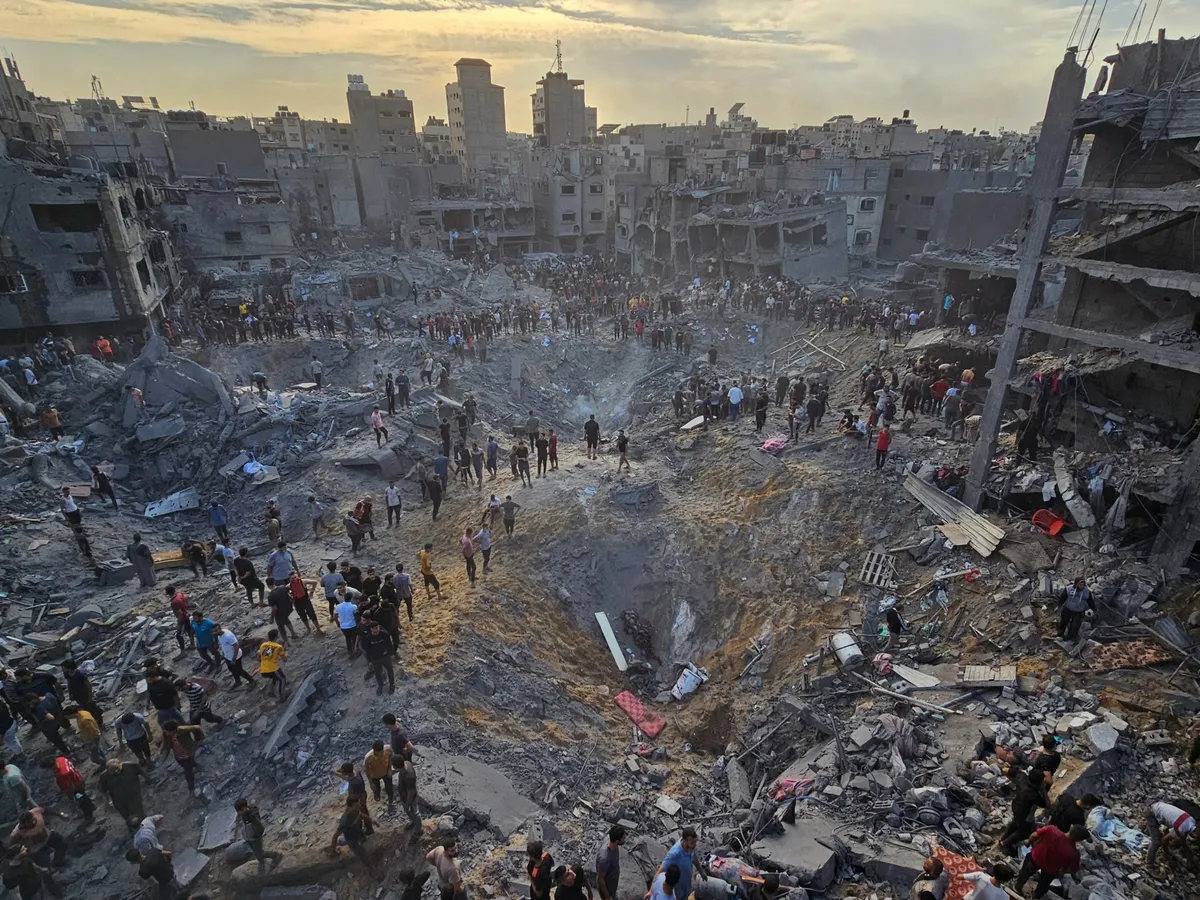
EXPLAINERThe US taxpayer-funded package of 2,000-pound bombs comes amid Israel’s genocidal war on Gaza and its occupation of southern Lebanon.Palestinians search for casualties amid deep craters filled with broken concrete and twisted metal, after Israeli air strikes on the Jabalia refugee camp in the northern Gaza Strip, on October 31, 2023 [Anas al-Shareef/Reuters]Published On 16 Sep 2026United States President Donald Trump’s administration is preparing to sell 60,000 highly destructive, 2,000-pound (907kg) bombs to Israel in a multibillion-dollar package which will be funded by American taxpayers.US media has reported that the Trump administration has approved the sale, which features some of the most destructive munitions in Western arsenals, and has informally notified Congress.This is one of the biggest US munition packages to Israel and comes after nearly three years of genocidal war on Gaza, ongoing pogroms by Israeli settlers in the occupied West Bank and a mighty assault on southern Lebanon – which together have killed tens of thousands and displaced millions in the region.It also comes as the US’s own munitions stockpile has been depleted due to its war on Iran, with the crisis worsened by Russia’s war on Ukraine.So, what bombs are the US sending to Israel, and what can Israel do with them?An Israeli military site is seen in the background behind destroyed residential buildings in the Sheikh Radwan neighbourhood, east of Gaza City, Gaza Strip, on September 10, 2026 [Mohammad Saber/EPA]What weapons are the US planning to sell to Israel?The Trump administration has not officially confirmed this sale yet. A senior administration official told AFP news agency that “all foreign arms sales are moving through the appropriate process”, but refused to comment on pending transactions.Meanwhile, a State Department spokesperson told AFP that “as a matter of policy, the Department does not confirm or comment on proposed arms sales until they have been formally notified to Congress”.However, Washington is reported to be on track to deliver a munitions package to Israel that is believed to include 60,000 warheads, including 20,000 MK-84s, 20,000 BLU-117s and 20,000 I-2000 Penetrator.The sale is worth $2.8bn, the majority of which will be paid for by the US’s Foreign Military Financing scheme, wherein Washington pays Israel from its own taxpayers’ funds to buy American-made weapons and military equipment.The three types of bomb are: MK-84: The largest among the Mark 80 series of bombs, this unguided, 2,000-pound (907kg) general-purpose bomb is designed primarily for maximum blast and fragmentation against buildings and moderately protected targets. It can destroy buildings and kill or injure people hundreds of metres from the bomb site. BLU-117: A 2,000-pound (907kg) general-purpose bomb which looks very similar to the MK-84 but has a different explosive filler and can also be fitted with precision-guidance kits. It also has a thermal protective coating, designed for safer storage, particularly by the US Navy. I-2000 Penetrator: Also referred to as a “bunker buster”, this roughly 2,000-pound-class, hard-target penetrator is designed to punch through hardened structures before detonating; its casing is substantially thicker and harder than an MK-84. In 2024, then-President Joe Biden’s administration paused the delivery of some 2,000-pound-class bombs to Israel amid growing international criticism by rights groups about the disproportionate number of civilians being killed in attacks.Trump ended the pause when he returned to the presidency the following year – and bypassed a usual congressional review process to approve a nearly $3bn arms sale to Israel that included more than 35,500 of these powerful bombs. In January this year, Washington approved a further package of arms sales to Israel worth $6.67bn.(Al Jazeera)When has Israel used 2,000-pound US bombs before?Israel had been using 2,000-pound-class bombs, especially in the occupied Palestinian territory and in Lebanon, for at least four decades prior to the Hamas-led attack on southern Israel on October 7, 2023, which triggered Israel’s war on Gaza.In 1981, Israel used this bomb during the Osirak bombing, known as Operation Opera, in an air strike which destroyed an unfinished Iraqi nuclear reactor near Baghdad. The next year, Israel dropped these bombs in Lebanon and Syria, accounting for a high civilian toll during attacks.According to the Project on Defense Alternatives (PDA), which conducts defence policy research and analysis, a 2,000-pound blast will severely damage, injure or kill everything or anyone within 35 metres (115 feet).Averaged across different types of surfaces, a 2000-pound bomb will carve out a crater 50 feet (15 metres) across and 16 feet (5 metres) deep.Since Israel’s genocidal war on Gaza began in October 2023, preliminary research suggests that Israel has used these powerful and destructive bombs more frequently.For instance, on October 31, 2023, Israel dropped a 2,000-pound bomb on the Jabalia refugee camp in a densely populated area of Gaza City, leaving a giant crater amid bombed-out buildings, and killing dozens of civilians. The UN human rights office said the Israeli air attack could amount to a war crime.The International Criminal Court (ICC) in The Hague issued an arrest warrant for Israeli Prime Minister Benjamin Netanyahu for alleged war crimes and crimes against humanity in November 2024. Washington has ridiculed the court’s jurisdiction.Thick smoke rises following an Israeli air strike on a residential area in the al-Jalaa neighbourhood despite the ceasefire in Gaza City, Gaza, Palestine, on July 23, 2026 [Saeed Jaras/Anadolu Agency]How lethal are these bombs?According to an Al Jazeera investigation, The Rest of the Story, civil defence teams in Gaza have documented 2,842 Palestinians who witnesses say in effect “evaporated” in the blast of bombs since the war began in October 2023, leaving behind no remains other than blood spray or small fragments of flesh.Experts and witnesses have attributed this phenomenon to Israel’s systematic use of internationally prohibited thermal and thermobaric weapons, often referred to as vacuum or aerosol bombs, capable of generating temperatures exceeding 3,500 degrees Celsius (6,332 degrees Fahrenheit).The investigation detailed how specific chemical compositions in Israeli munitions turn human bodies into ash in seconds – and identified specific US-manufactured munitions used in Gaza that are linked to these disappearances, including MK-84 and BLU series bunker busters.Vasily Fatigarov, a Russian military expert, explained that these weapons do not just kill; they obliterate matter. Unlike conventional explosives, these weapons disperse a cloud of fuel that ignites to create an enormous fireball and a vacuum effect.“To prolong the burning time, powders of aluminium, magnesium and titanium are added to the chemical mixture,” Fatigarov said. “This raises the temperature of the explosion to between 2,500 and 3,000 degrees Celsius [4,532F to 5,432F].”How significant are 60,000 bombs?Very. Together, 60,000 2,000-pound-class bombs weigh 54,400 tonnes.That is about the weight of the entire steel skeleton of New York’s Empire State Building. Or seven times the weight of the iron structure of the Eiffel Tower.Its mass also far exceeds the most infamous single conventional air raid of the 20th century. The March 1945 Tokyo firebombing, which killed more than 80,000 people in one night, used roughly 1,600 tonnes of bombs.On a broader scale, 54,400 tonnes is nearly the total weight of bombs dropped on Berlin throughout World War II, and also roughly one-third of all bombs that fell on Japan’s home islands.Isn’t the US running short on munition stockpiles?Yes, a Pentagon watchdog report released on Monday confirmed earlier media reports that the war on Iran is burning through Washington’s munitions – especially the costly Patriot surface-to-air missile defence system – and creating “bottlenecks” in supply chains.
SRCAl Jazeera
LANGEN
LEANCenter
WORDS1 220
ENT12
WED · 2026-09-16 · 12:09 GMTBRIEF NSR-2026-0916-111741
NSR-2026-0916-111741Analysis·EN·Conflict
US set to approve 60,000 heavy bombs for Israel: What that means
The Trump administration is reportedly set to approve a multibillion-dollar sale of 60,000 highly destructive 2,000-pound bombs to Israel, funded by US taxpayers. This package, which includes MK-84, BLU-117, and I-2000 Penetrator bombs, is one of the largest US munition sales to Israel.
Yashraj SharmaAl JazeeraFiled 2026-09-16 · 12:09 GMTLean · CenterRead · 5 min
Al JazeeraFIG 01
Reading time
5min
Word count
1 220words
Sources cited
2cited
Entities identified
12entities
Quality score
100%
§ 01
Briefing Summary
AI-generatedNEWSAR · AI
The Trump administration is reportedly set to approve a multibillion-dollar sale of 60,000 highly destructive 2,000-pound bombs to Israel, funded by US taxpayers. This package, which includes MK-84, BLU-117, and I-2000 Penetrator bombs, is one of the largest US munition sales to Israel. The sale comes amid ongoing Israeli military operations in Gaza and southern Lebanon, and follows previous pauses and approvals of similar arms sales by the Biden and Trump administrations. These powerful bombs have been used by Israel for decades, including in past conflicts in Lebanon and Syria, and their use has been linked to significant civilian casualties.
Confidence 0.90Sources 2Claims 5Entities 12
§ 02
Article analysis
Model · rule-basedFraming
Conflict
Human Rights
Tone
Sensational
AI-assessed
CalmNeutralAlarmist
Factuality
0.60 / 1.00
Mixed
LowHigh
Sources cited
2
Limited
FewMany
§ 03
Key claims
5 extracted01
The sale is funded by American taxpayers through the Foreign Military Financing scheme.
factual
Confidence
0.95
02
The MK-84 bomb is designed for maximum blast and fragmentation against buildings and moderately protected targets.
factual
Confidence
0.90
03
The US is preparing to sell 60,000 2,000-pound bombs to Israel in a multibillion-dollar package.
factualUS media reports
Confidence
0.90
04
The package includes 20,000 MK-84s, 20,000 BLU-117s, and 20,000 I-2000 Penetrator bombs.
factualReported information
Confidence
0.85
05
The US taxpayer-funded package comes amid Israel’s genocidal war on Gaza and its occupation of southern Lebanon.
factual
Confidence
0.70
§ 04
Full report
5 min read · 1 220 words§ 05
Entities
12 identifiedKey playerOppositionContextPositiveNeutralNegative
Locations7
Topics1
§ 06
Keywords & salience
10 termsheavy bombs
1.00
arms sale
0.90
israel
0.80
gaza
0.70
us taxpayer-funded
0.70
genocidal war
0.60
munitions package
0.50
trump administration
0.50
occupied west bank
0.40
southern lebanon
0.40
§ 07
Topic connections
Interactive graph Network visualization showing 51 related topics
View Full Graph Person Organization Location Event|Click node to navigate|Edge numbers = shared articles