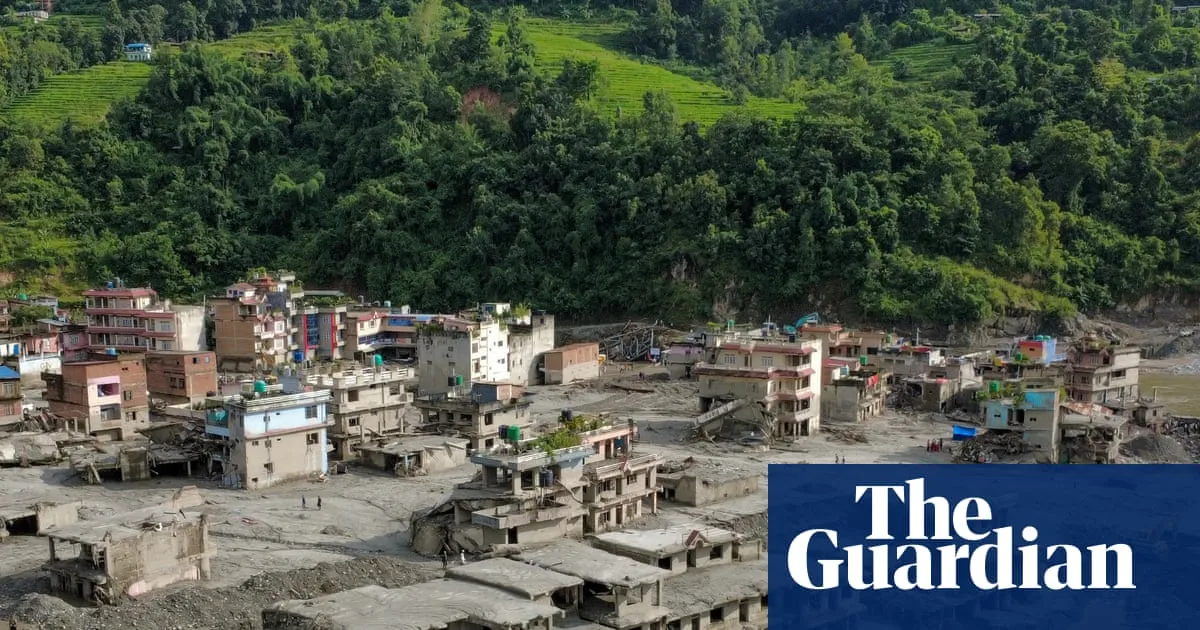
Climate breakdown probably weakened the glacier that collapsed causing catastrophic Floods and killing hundreds of people in Nepal and Tibet last month, the first scientific study of the disaster has found.Researchers identified unusually warm conditions before the glacier’s collapse, which sent an avalanche of 110m cubic metres (3,885 cu ft) of snow and ice into the valley below. This triggered flash Floods on an almost unprecedented scale, hitting communities downstream without warning.“Communities in Nepal are paying with their lives for a crisis driven by Fossil fuel emissions thousands of miles away,” said Dr Friederike Otto, a climate science professor at Imperial College London, which carried out the study.“When warming destabilises the roof of the world, no amount of local adaptation can fully shield vulnerable people downstream from this scale of destruction. Without much faster action to transition to zero Fossil fuel emissions we will inevitably see more disasters of this scale occurring in the years to come.”A impromptu memorial in Kathmandu commemorates some of the people killed in the flooding. Photograph: Narendra Shrestha/EPAMore than 1,300 people were killed and more than 5,000 people remain missing after a massive section of overhanging glacier and rock measuring roughly 200,000 sq metres (2,153,000 sq ft) fell from Langtang Lirung mountain on 26 August.It dropped about 1,400 metres (4,660ft), slamming into the valley floor with such intensity that it registered as an earthquake, liquidising ice and sparking a freezing flood that careened downriver at speeds exceeding 110 mph.The devastating flood of water, ice, rock and sediment swept away families, homes, settlements, roads, bridges and other infrastructure, leaving survivors stranded and cut off.“Rock avalanches of this size are rare, with annual frequency estimates of approximately one event this size every 1,000–10,000 years,” the study said. “This event shows that limits to adaptation are already being reached.”The research was unlike previous studies by Otto and her team at World Weather Attribution (WWA) – a collaborative project between Imperial and other climate specialists worldwide – in that the role of Climate breakdown could not be ascribed to one particular weather event.Instead, the researchers found the disaster was the result of a compound crisis, with a number of factors made worse by decades of atmospheric heating as a result of Greenhouse gas pollution.Dr Ben Clarke, who researches extreme weather and climate change at Imperial, said the “fingerprints of climate change” were clear in the long-term changes that happened around the glacier before its catastrophic collapse.‘Communities in Nepal are paying with their lives for a crisis driven by Fossil fuel emissions thousands of miles away,’ said Dr Friederike Otto. Photograph: Suryams Upreti/AAPAmong the study’s key findings were:skip past newsletter promotionafter newsletter promotion In the region where the collapse happened, Climate breakdown has caused about 2C of warming since pre-industrial times, and about 1.5C of warming in July and August specifically; July and August 2026 were the warmest on record locally, reaching 5C above the 30-year average in the days before the collapse; The freezing threshold in the Himalayas has risen by about 100 metres per decade since the 1980s, with higher and longer thaw temperatures weakening mountain slopes shaped by permafrost; The warming temperature had already driven substantial glacier recession, removing stabilising ice from around the site where the collapse occurred and contributing meltwater; A 7.8 magnitude earthquake in 2015 further contributed to slope failure, though its specific contribution to the disaster in August could not be confirmed. Otto, Clarke and the WWA team said their study did not directly ascribe Climate breakdown as the fundamental cause of the catastrophe. Instead, it was best understood as a destabilising factor on the existing geology.Clarke said: “We found that climate change is transforming the high mountain environment, influencing many of the possible drivers of this collapse.”A major earthquake in Nepal in 2015 may also have contributed to the glacier’s collapse. Photograph: Ishwar Rauniyar/The GuardianNepal has filed a formal request with the UN loss and damage fund for financial support to address the destruction caused by the flood, a process that requires proof of a link to the climate crisis. The country’s foreign minister, Shisir Khanal, has also demanded that top emitting nations such as China and India “wake up” and accept shared responsibility for the disaster.Madhab Uprety, senior technical advisor for the Red Cross Red Crescent Climate Centre, which is part of WWA, said only aggressive cuts to global emissions could begin to address the “losses and damages faced by vulnerable frontline communities”.He added: “In addition to the human tragedy on an unimaginable scale, the cost of recovery for this disaster is substantial. For a nation that’s done virtually nothing to contribute to this problem, it underlines the need to find fairness in helping climate vulnerable nations cope with the problems they have not unleashed.”
SRCThe Guardian - World News
LANGEN
LEANCenter-Left
WORDS794
ENT12
WED · 2026-09-16 · 23:01 GMTBRIEF NSR-2026-0917-111870
NSR-2026-0917-111870News Report·EN·Environmental
Climate crisis likely behind devastating Nepal-Tibet floods that killed more than 1,300, first study finds
A recent study suggests that climate breakdown was a destabilizing factor in the August collapse of a 200,000 sq meter glacier in Nepal and Tibet, which caused catastrophic floods and killed over 1,300 people. Researchers identified unusually warm conditions preceding the event, which sent a massive avalanche of snow and ice into a valley, triggering flash floods.
Damien GayleThe Guardian - World NewsFiled 2026-09-16 · 23:01 GMTLean · Center-LeftRead · 4 min
The Guardian - World NewsFIG 01
Reading time
4min
Word count
794words
Sources cited
2cited
Entities identified
12entities
Quality score
100%
§ 01
Briefing Summary
AI-generatedNEWSAR · AI
A recent study suggests that climate breakdown was a destabilizing factor in the August collapse of a 200,000 sq meter glacier in Nepal and Tibet, which caused catastrophic floods and killed over 1,300 people. Researchers identified unusually warm conditions preceding the event, which sent a massive avalanche of snow and ice into a valley, triggering flash floods. The study found that regional warming, including record high temperatures in July and August, contributed to weakening mountain slopes and glacier recession. While a 2015 earthquake may have also played a role, the primary finding is that climate change transformed the mountain environment, influencing factors that led to the collapse. This disaster highlights the vulnerability of communities to climate-driven events, with Nepal seeking UN support and emphasizing the need for global emissions reductions.
Confidence 0.90Sources 2Claims 5Entities 12
§ 02
Article analysis
Model · rule-basedFraming
Environmental
Human Interest
Tone
Mixed Tone
AI-assessed
CalmNeutralAlarmist
Factuality
0.70 / 1.00
Factual
LowHigh
Sources cited
2
Limited
FewMany
§ 03
Key claims
5 extracted01
Communities in Nepal are paying with their lives for a crisis driven by fossil fuel emissions thousands of miles away.
quoteDr Friederike Otto
Confidence
1.00
02
More than 1,300 people were killed and more than 5,000 people remain missing after a massive section of glacier and rock fell from Langtang Lirung mountain.
statistic
Confidence
0.95
03
Rock avalanches of this size are rare, with annual frequency estimates of approximately one event this size every 1,000–10,000 years.
statisticthe study
Confidence
0.90
04
Without much faster action to transition to zero fossil fuel emissions we will inevitably see more disasters of this scale occurring in the years to come.
predictionDr Friederike Otto
Confidence
0.85
05
Climate breakdown probably weakened the glacier that collapsed causing catastrophic floods and killing hundreds of people in Nepal and Tibet.
factualfirst scientific study
Confidence
0.80
§ 04
Full report
4 min read · 794 words§ 05
Entities
12 identifiedKey playerOppositionContextPositiveNeutralNegative
Locations4
§ 06
Keywords & salience
10 termsclimate crisis
1.00
devastating floods
0.90
glacier collapse
0.90
tibet
0.80
nepal
0.80
fossil fuel emissions
0.70
climate breakdown
0.70
atmospheric heating
0.60
limits to adaptation
0.50
greenhouse gas pollution
0.40
§ 07
Topic connections
Interactive graph Network visualization showing 41 related topics
View Full Graph Person Organization Location Event|Click node to navigate|Edge numbers = shared articles