The US Federal Reserve raised interest rates for the first time in three years in an effort to quell inflation partly caused by the war on Iran helping to drive up fuel prices.Policymakers voted unanimously on Wednesday to lift rates by 25 basis points to between 3.75 and 4.00 per cent. Sixteen of 18 committee members also said that they anticipate another rate hike this year.The increase will help inflation make a “timelier return” to a 2 per cent target, according to a statement, as new Fed Chairman Kevin Warsh disappointed President Donald Trump’s hopes for rate cuts. Policymakers acted after the central bank’s preferred measure of price increases came in at 3.7 per cent in July, a fifth month above 3 per cent, amid tariffs and rising costs for petrol and diesel.“Today’s action starts to show that we’re serious about this,” Warsh told reporters after a two-day meeting of the committee.Related news: Hong Kong’s three note-issuing banks all held lending rates, even after the city’s de facto central bank followed the Fed in announcing a 25 basis-point increase. HSBC and China" class="entity-link entity-organization" data-entity-id="26029" data-entity-type="organization">Bank of China (Hong Kong) both kept their prime lending rate at 5 per cent, while Standard Chartered held at 5.25 per cent. The Hong Kong Monetary Authority adjusts its base rate in line with the Fed because of a currency peg. Higher Fed rates could spark short-term volatility in Hong Kong stocks, according to China-international-capital-corporation" class="entity-link entity-organization" data-entity-id="146774" data-entity-type="organization">China International Capital Corporation. Gold prices rose on Thursday after slumping to near a six-week low following the Fed rate hike. Domestic oil prices in China hit a record high after Iran-backed militias launched drone attacks that forced the closure of Saudi Arabia’s East-West pipeline, a key alternative to the disrupted Strait of Hormuz. Oil futures traded in Shanghai jumped to 929.40 yuan (US$138.50) a barrel, the highest since the contract was launched in 2018, according to Bloomberg. Chinese Foreign Minister Wang Yi on Wednesday told his Iranian counterpart Abbas Araghchi that China was ready to play a constructive role in resolving the Middle East conflict. The US and Iran should also return to a June memorandum of understanding, which paused military operations, and resume talks, Wang said. It was Araghchi’s second trip to China since the start of the war. President Trump could soon sign a bill paving the way for tariffs as high as 100 per cent on China for buying Russian oil. The House of Representatives passed a bill on Wednesday authorising sanctions on the five largest importers of Russian oil and gas – that includes both China and India. The Senate has already approved the measure. Separately, China’s direct fell to an 18-year low of US$618 billion in July amid a global bond sell-off. The country has also probably shifted to buying US government debt via third parties. How others reported it Rock, hard place: “The Fed had no choice but to give the market a hike or risk a much bigger bond market selloff,” said Byron Anderson, head of fixed income at Laffer Tengler Investments. “The market narrative is on a collision course with the Fed from here on out, which means more volatility. A single rate cut is not going to placate this bond market for long and will not solve inflation.” (Bloomberg News) Opposite problems: The world’s two biggest economies are confronting almost opposite savings-investment problems. America must finance unusually strong public and private appetites for capital; China must find productive uses for excess savings amid deficient private demand. Bond yields are increasingly becoming a barometer not simply of sovereign risk, but of where global capital is scarce, where it is abundant and whether economies are generating enough productive investment to use it well. (Business Times) Outflow risks: “The risk is that if interest rate differentials become wider and wider then that will draw capital away from China,” said Mansoor Mohi-uddin, chief economist at Bank of Singapore. Chinese bond yields have been grinding lower as the country grapples with a chronic lack of credit demand and deflationary pressures from slowing economic growth. (Financial Times) Divergent cycles: “The widening yield gap reflects increasingly divergent macro and policy cycles,” said Wee Khoon Chong, senior APAC market strategist at BNY. For Treasuries, “persistent inflation, rising commodity prices, fiscal concerns and heavy government and corporate issuance” have led to yields spiking. By contrast, Chinese government bond yields declined “amid weak domestic demand, lingering disinflation and greater demand for defensive assets.” (Nikkei Asia) Direct approach: Drawn by a prolonged low-rate environment, Chinese companies are increasingly shifting their borrowing from commercial banks to direct financing. In the first eight months, direct financing via corporate bonds and equities accounted for 14 per cent of newly added TSF, doubling its share from the previous year. The economics heavily favor the bond market over traditional lending. High-grade, non-financial corporations can now issue five-year debt at yields of around 1.8 per cent. In contrast, the weighted average interest rate for newly issued corporate bank loans remains near 3 per cent. (Caixin Global) The SCMP Plus takeawayChina’s economy is increasingly split between surging growth in tech sectors and stagnation at best in other areas. Higher interest rates in the US and elsewhere have the potential to worsen that divide.The risk is that higher borrowing costs may do little to dampen the artificial intelligence (AI) investment boom that is stoking demand for Chinese-made data-centre equipment, such as chips and cooling systems. At the same time, rate hikes could slow consumer spending on items such as furniture or clothes by pushing up the cost of mortgages and credit-card debt.AI hyperscalers, such as Amazon and Microsoft, are unlikely to pare construction plans just because of Federal Reserve policymakers. Companies in the sector are racking up huge revenue increases from AI investments and forecasting even bigger returns ahead. They aren’t going to slow down just because of a little bump in debt costs, especially given the context of AI competition with China.Furthermore, from a longer-term perspective, borrowing costs aren’t really that high. The US 10-year Treasury yield is about 5 per cent, which is a jump of 105 basis points since late February. Still, the yield averaged about 5.8 per cent in nominal terms from about 1990 through 2007, according to Bloomberg News. That suggests that a 5 per cent yield is just a reflection of strong economic growth rather than a flashing warning light.The AI boom has fuelled China’s exports this year. Chip shipments have more than doubled in dollar terms, while exports of computers and servers are up about 50 per cent. Demand is likely to weather higher interest rates. Bigger risks may come from growing industry calls to slow AI development, profit-sapping competition or growing opposition to data-centre construction plans.Higher interest rates are probably more of an issue for US consumers than AI companies, especially when coupled with petrol prices around US$4.35 per gallon due to wars in the Middle East and Ukraine. Consumer confidence was already falling ahead of the rate hike, with a closely watched University of Michigan sentiment index dropping more than expected in September.The impact of higher borrowing costs is most clearly seen in the mortgage market, where rates on 30-year deals have surpassed 7 per cent for the first time since January 2025. That will do little to boost the weak US housing market, which is bad news for Chinese makers of items such as furniture and white goods. China’s global exports in both categories have grown less than 10 per cent this year, far behind the pace seen by AI suppliers. Makers have also suffered in China’s own real-estate crash. Companies shifting production overseas to avoid tariffs has also weighed on exports.The good news from the rate hike is that it’s probably a case of a little pain now in order to avoid a bigger headache in future. Bonds pared declines on Thursday and Asian stocks were little changed, partly because investors were reassured about the Federal Reserve’s commitment to fighting inflation. Chairman Kevin Warsh has certainly regained some credibility since his disastrous July meeting, where unclear answers sparked a bond-market rout.Investors are now anticipating a steady series of small rate increases that may keep inflation in check. That’s preferable to the Federal Reserve doing nothing until forced into sudden action by a crisis. Warsh himself committed to action, with the Fed’s preferred inflation gauge having been above a 2 per cent target for more than five years.“The plain fact is that inflation is too high, and has been for too long,” he said. “This summer’s inflation readings do not tell me that underlying trends have meaningfully improved.”Other central banks are likely in agreement. The European Central Bank raised rates last week and gave an unexpectedly hawkish outlook. The Bank of Japan may raise rates to a 31-year high on Friday. The Bank of England was expected to hold rates on Thursday. Still, traders are predicting as many as four increases in the next 12 months, with August inflation at a five-month high and 30-year yields at the highest since 1998.Higher rates worldwide bode ill for Chinese exporters, especially when coupled with the threat of more trade barriers – European Commission President Ursula von der Leyen fanned the flames of a potential trade war with China in her annual State of the EU address on Wednesday. Domestic oil prices in China have also hit a record, creating another economic drag.Still, the pain from these challenges will fall unequally across Chinese manufacturers. Low-tech exporters will bear the brunt of any slowdown; the booming AI sector may not even notice.
SRCSouth China Morning Post
LANGEN
LEANCenter-Right
WORDS1 595
ENT12
FRI · 2026-09-18 · 01:00 GMTBRIEF NSR-2026-0918-112152
NSR-2026-0918-112152News Report·EN·Economic Impact
Hong Kong’s new chapter
The US Federal Reserve raised interest rates by 25 basis points to combat inflation, which has been exacerbated by rising fuel prices due to the war on Iran. Policymakers anticipate further hikes this year.
SCMPSouth China Morning PostFiled 2026-09-18 · 01:00 GMTLean · Center-RightRead · 7 min
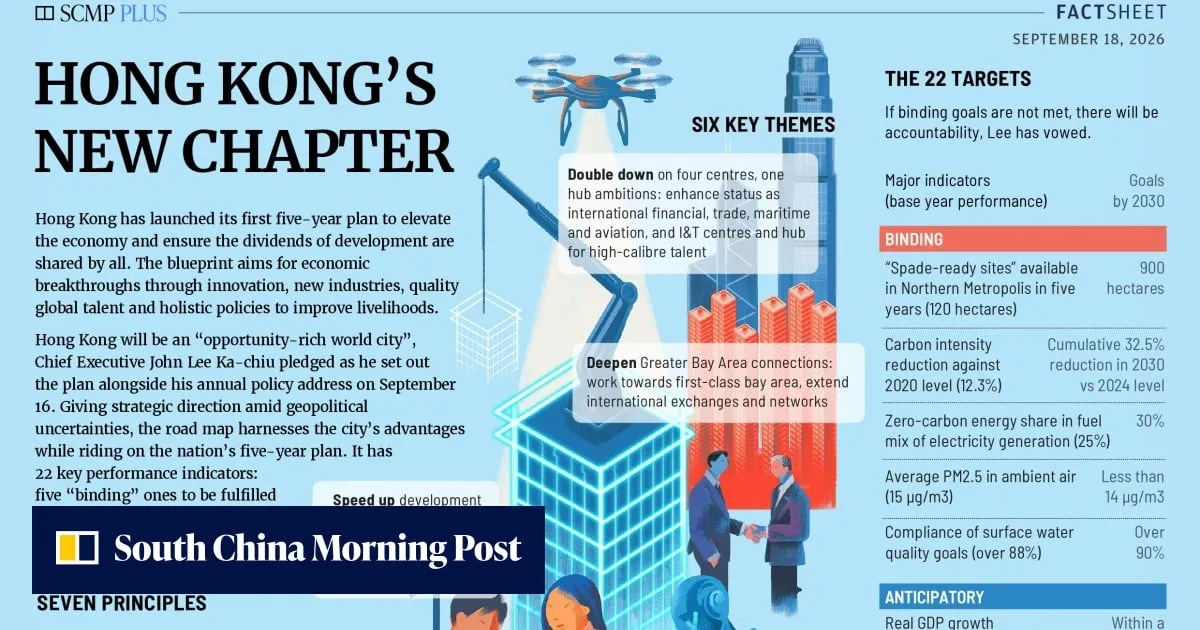
South China Morning PostFIG 01
Reading time
7min
Word count
1 595words
Sources cited
4cited
Entities identified
12entities
Quality score
100%
§ 01
Briefing Summary
AI-generatedNEWSAR · AI
The US Federal Reserve raised interest rates by 25 basis points to combat inflation, which has been exacerbated by rising fuel prices due to the war on Iran. Policymakers anticipate further hikes this year. Hong Kong's Monetary Authority followed suit with a 25-basis point adjustment due to its currency peg, though local banks maintained lending rates. The US rate hike could cause short-term volatility in Hong Kong stocks. Meanwhile, domestic oil prices in China reached a record high following drone attacks on Saudi Arabia's pipeline. China's Foreign Minister expressed readiness to play a constructive role in resolving the Middle East conflict. Additionally, a US bill authorizing sanctions on major importers of Russian oil, including China, passed the House of Representatives.
Confidence 0.90Sources 4Claims 5Entities 12
§ 02
Article analysis
Model · rule-basedFraming
Economic Impact
Conflict
Tone
Measured
AI-assessed
CalmNeutralAlarmist
Factuality
0.70 / 1.00
Factual
LowHigh
Sources cited
4
Well sourced
FewMany
§ 03
Key claims
5 extracted01
The House of Representatives passed a bill authorizing sanctions on the five largest importers of Russian oil and gas, including China and India.
factual
Confidence
1.00
02
China’s direct fell to an 18-year low of US$618 billion in July amid a global bond sell-off.
statistic
Confidence
1.00
03
Domestic oil prices in China hit a record high after Iran-backed militias launched drone attacks that forced the closure of Saudi Arabia’s East-West pipeline.
factual
Confidence
1.00
04
Hong Kong’s three note-issuing banks held lending rates even after the city’s de facto central bank followed the Fed in announcing a 25 basis-point increase.
factual
Confidence
1.00
05
The US Federal Reserve raised interest rates by 25 basis points to between 3.75 and 4.00 per cent to quell inflation.
factual
Confidence
1.00
§ 04
Full report
7 min read · 1 595 words§ 05
Entities
12 identifiedKey playerOppositionContextPositiveNeutralNegative
Organizations6
§ 06
Keywords & salience
10 termsinflation
1.00
interest rates
1.00
us federal reserve
0.90
hong kong
0.80
oil prices
0.70
iran
0.60
currency peg
0.50
tariffs
0.40
china
0.40
sanctions
0.40
§ 07
Topic connections
Interactive graph Network visualization showing 51 related topics
View Full Graph Person Organization Location Event|Click node to navigate|Edge numbers = shared articles