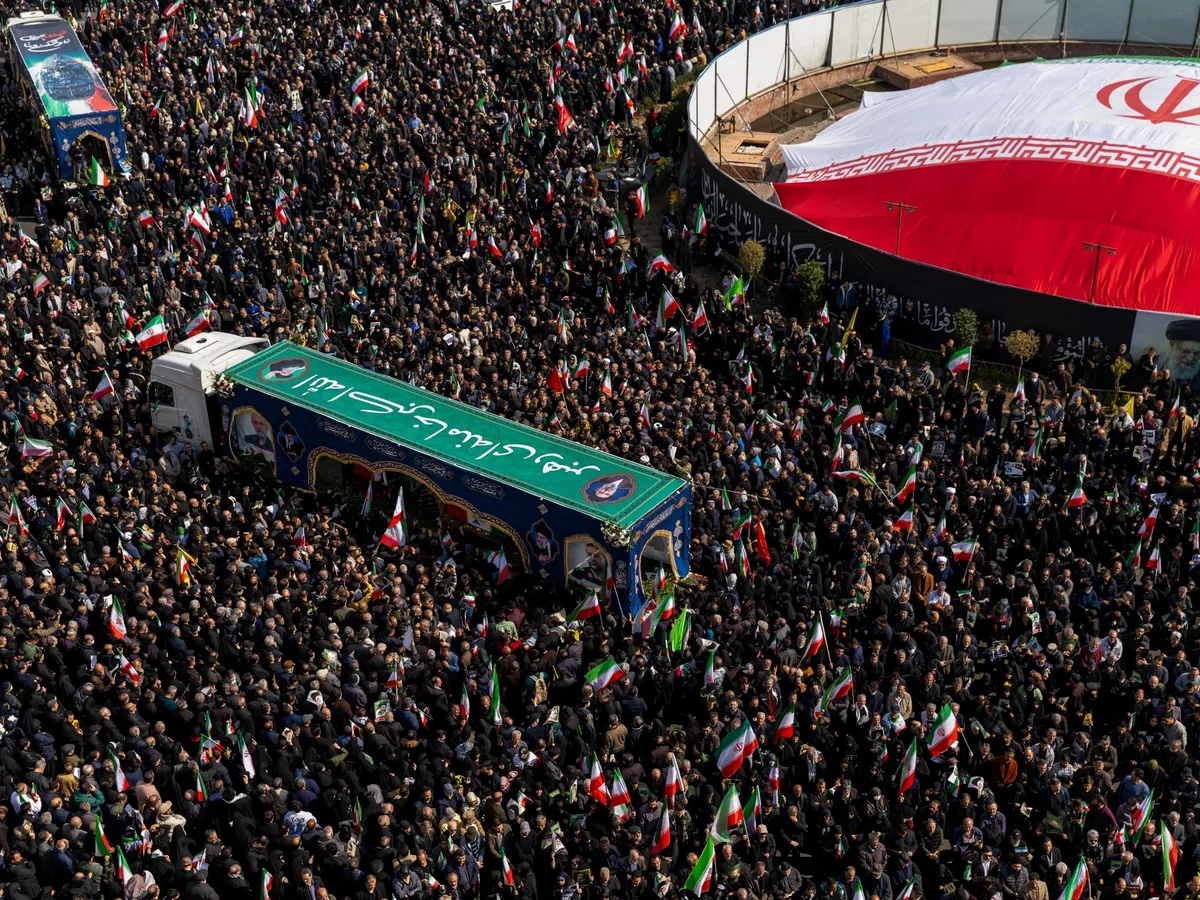
From Iran to Gaza and Lebanon, assassinations have repeatedly removed figures capable of negotiating an end to conflict.Academic and senior political analyst specializing in Iran and Middle East Politics.Published On 18 Sep 2026Large crowds gather during a joint funeral held for Ali Larijani, Secretary of Iran's Supreme National Security Council, Basij commander Major General Gholam Soleimani, and 84 sailors from the Iranian Navy frigate IRIS Dena, on March 18, 2026 in Tehran, Iran. [Majid Saeedi/Getty Images]In international politics, it is often assumed that wars end when the fighting becomes unbearable and the parties turn to diplomacy. But diplomacy requires interlocutors — figures with the standing to negotiate and the authority to deliver. Remove them, and a war loses not only its potential mediators but the very possibility of a settlement.This is worth keeping in mind after a striking recent assessment. In early September 2026, Sir John Sawers, the former head of Britain’s foreign intelligence service, told The Financial Times that Israel had deliberately killed Ali Larijani. In his reading, Larijani was targeted not because he ran Iran’s war effort, but because he was among the few Iranian figures capable of reaching a deal both sides could accept.Coming from a career intelligence officer rather than an advocate, the judgement invites a larger question: does the killing of Larijani belong to a pattern in which Israel removes, at moments of possible negotiation, the very people through whom a war might have been ended?A pattern, not an incidentConsider what such killings actually produce. Assassinating the head of a government or an army opens a vacuum that others rush to fill. Assassinating a designated negotiator opens a narrower and more damaging one: a vacuum of moderation.The successor to a killed negotiator is rarely more flexible than the person removed. More often, he is harder, because the hardliners are the ones who survive and inherit. The channel loses its author, and the hardening that follows is then read, on both sides, as proof that diplomacy was never possible in the first place. The tactic becomes self-fulfilling: it does not merely interrupt a negotiation; it manufactures the evidence that negotiation was futile.The precedent is old. In September 1948, Count Folke Bernadotte, the United Nations mediator for Palestine, was assassinated in Jerusalem by members of Lehi, the Zionist underground whose leaders included the future Israeli prime minister, Yitzhak Shamir. Bernadotte had been shuttling between the parties with truce and partition proposals. His killers regarded any compromise as betrayal.The same logic reappeared in November 2020, when Mohsen Fakhrizadeh, the leading figure in Iran’s nuclear programme, was killed near Tehran in an operation widely attributed to Israel. The timing — weeks after Joe Biden was elected president of the United States, having committed to reviving the 2015 nuclear agreement — led many to read it less as counterproliferation than as an obstacle deliberately placed in the path of diplomacy.Larijani’s killing in March 2026 fits the same template. He had been Iran’s nuclear negotiator two decades earlier and had defended the 2015 deal as speaker of parliament. After the assassination of Supreme Leader Ali Khamenei on the war’s opening day, he had become the country’s effective decision-maker. Western diplomats who dealt with him described him as tough but pragmatic — precisely the kind of counterpart with whom an American off-ramp might have been negotiated.This is not a method confined to states. Israel applies the same logic to the non-state actors it fights, and the results reveal both the strategy and its ambiguities.In February 1992, Israel killed Hezbollah’s secretary-general, Abbas al-Musawi. His successor was Hassan Nasrallah, who, over three decades, built the movement into the most capable non-state armed force in the region — a vacuum filled by a far harder man. In July 2024, Israel assassinated Ismail Haniyeh, the head of Hamas’s political bureau and its lead negotiator in the Gaza ceasefire talks, while that diplomacy was still under way; authority passed to Yahya Sinwar, and the negotiating track never recovered. Weeks later, Israel killed Nasrallah himself.In each case, the target was the point of coordination — the figure through whom the adversary organised and, at times, negotiated. Removing him produced the same short-term disarray and, at least twice, a successor even less inclined to a deal.Seen through Israel’s own strategic lens, this is coherent rather than merely vindictive. For a state that regards Iran’s system as an existential threat, the preferred outcome is that system’s collapse, not a negotiated accommodation with it. A durable deal brokered by a credible pragmatist would stabilise the very order Israel wants to see fall, and it would foreclose the American military pressure on which the hope of collapse depends.The effect is visible inside Iran itself. External pressure has tended to harden the very indecision it claims to break, widening the split between a political leadership that acknowledges the war’s costs and a security establishment that treats every strike as vindication of defiance. Removing the pragmatists tilts that balance further towards the second camp — and towards the conclusion that there is nothing left to negotiate.Israel’s stated rationale, in each case, has been military and preventive: the decapitation of a hostile leadership. That claim is not baseless. Larijani was no dove — he helped run a war effort and presided over harsh repression at home. Haniyeh led a movement responsible for the October 2023 attack. The intent to foreclose diplomacy is inferred, not proven, and the returns are uncertain: as the al-Musawi killing showed, removing a leader can produce a stronger and more implacable successor rather than a pliable one.Uncertain strategyYet something more consistent runs beneath these cases. Eliminating politicians whose trajectories threaten Israel is not new; their complete removal has become almost a priority, on a par with waging the full-scale military war in which Israel believes it holds a decisive advantage over any adversary in the region and perhaps beyond.But military superiority alone has not been enough. In the Iranian case, despite the devastation Israel and the United States have inflicted, Tehran has not raised the white flag. And this is where a second definition of victory takes shape: the manufacture of internal political chaos capable of driving the Iranian system towards complete political collapse. That, more than any single assassination, is the essence of Israel’s strategy in its war on Iran.How that strategy ends is still uncertain. But if the figures capable of closing a deal are removed as fast as they emerge, and the centres through which adversaries govern and negotiate are hollowed out by design, one question becomes unavoidable: who is left to make peace with — and does a strategy that keeps winning on the battlefield by emptying the negotiating table eventually run out of anyone able to end the war at all?The views expressed in this article are the author’s own and do not necessarily reflect Al Jazeera’s editorial stance.
SRCAl Jazeera
LANGEN
LEANCenter
WORDS1 143
ENT12
FRI · 2026-09-18 · 10:29 GMTBRIEF NSR-2026-0918-112251
NSR-2026-0918-112251Analysis·EN·Diplomatic
Israel is killing the people who could end its wars
The article argues that Israel has a pattern of assassinating key figures in Iran, Gaza, and Lebanon who possess the capability to negotiate an end to conflicts. Examples cited include the 2026 killing of Ali Larijani, Iran's effective decision-maker after Supreme Leader Khamenei's death, who was seen as pragmatic and capable of reaching a deal.
Mahjoob ZweiriAl JazeeraFiled 2026-09-18 · 10:29 GMTLean · CenterRead · 5 min
Al JazeeraFIG 01
Reading time
5min
Word count
1 143words
Sources cited
3cited
Entities identified
12entities
Quality score
100%
§ 01
Briefing Summary
AI-generatedNEWSAR · AI
The article argues that Israel has a pattern of assassinating key figures in Iran, Gaza, and Lebanon who possess the capability to negotiate an end to conflicts. Examples cited include the 2026 killing of Ali Larijani, Iran's effective decision-maker after Supreme Leader Khamenei's death, who was seen as pragmatic and capable of reaching a deal. The article also points to the 1948 assassination of UN mediator Count Folke Bernadotte, the 2020 killing of Iran's Mohsen Fakhrizadeh, and the assassinations of Hezbollah's Abbas al-Musawi and Hamas's Ismail Haniyeh. The author suggests this tactic removes potential mediators, often leading to harder-line successors and creating a vacuum of moderation, thereby hindering diplomatic resolution and potentially fulfilling a self-fulfilling prophecy that negotiation was never possible.
Confidence 0.90Sources 3Claims 4Entities 12
§ 02
Article analysis
Model · rule-basedFraming
Diplomatic
Political Strategy
Tone
Mixed Tone
AI-assessed
CalmNeutralAlarmist
Factuality
0.30 / 1.00
Opinion-Heavy
LowHigh
Sources cited
3
Well sourced
FewMany
§ 03
Key claims
4 extracted01
Mohsen Fakhrizadeh, key to Iran's nuclear program, was killed in 2020, widely attributed to Israel.
factual
Confidence
0.90
02
The assassination of UN mediator Count Folke Bernadotte in 1948 by Lehi is a precedent.
factual
Confidence
0.90
03
Assassinating negotiators creates a vacuum of moderation, leading to harder successors.
factual
Confidence
0.90
04
Israel has deliberately killed Ali Larijani, who was capable of negotiating a deal.
quoteSir John Sawers (via The Financial Times)
Confidence
0.80
§ 04
Full report
5 min read · 1 143 words§ 05
Entities
12 identifiedKey playerOppositionContextPositiveNeutralNegative
People3
Organizations5
§ 06
Keywords & salience
10 termsassassination strategy
1.00
conflict resolution
0.90
diplomacy
0.80
negotiation
0.80
middle east politics
0.70
vacuum of moderation
0.60
iran
0.50
ali larijani
0.50
israel
0.50
count folke bernadotte
0.40
§ 07
Topic connections
Interactive graph Network visualization showing 6 related topics
View Full Graph Person Organization Location Event|Click node to navigate|Edge numbers = shared articles