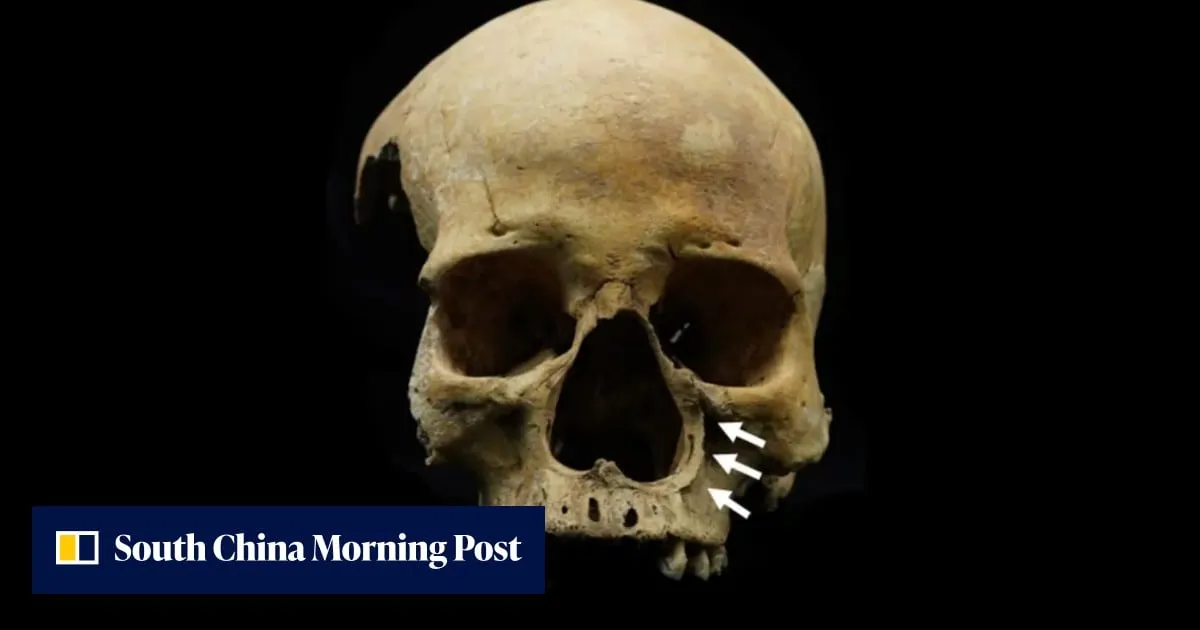
Stealing someone’s cattle is a serious crime, and in many places, the thief would end up in jail. However, ancient Chinese justice could result in a truly horrific form of mutilation: the amputation of the nose.This harsh consequence has been well-documented by historians as one of the infamous “five punishments” from the penal system of the Xia dynasty (2070 BC–1600 BC). Until now, no physical evidence of this punishment had been discovered.A team of researchers from China and the US recently announced the finding of a female skeleton dated between 1298 and 1404 (from either the Yuan or Ming dynasties) that showed clear evidence of nose removal as part of a criminal sentence.“It wasn’t a surgery for disease or trauma,” stated Qian Wang, a professor at the College of Dentistry at Texas A&M University in the US and one of the authors of the study.Wang explained to the SCMP that one major takeaway from the skeleton is the strong evidence of post-injury care. The team believes that procedures were implemented to stop the bleeding, prevent infection, and alleviate the woman’s pain.The thief survived for years after the punishment – a remarkable achievement given the substandard medical practices of the time. She died at the age of 40 to 45.In ancient Chinese farming societies, stealing or illegally slaughtering cattle was a major crime punishable by nose amputation or even death. Photo: Universal History Archive/Universal Images Group via Getty ImagesThe research team hypothesised that the woman might have worn a prosthetic to conceal her mutilation. This theory is supported by the healing of the bones around the wound, suggesting adaptation to a foreign object.After her death, the body was buried face down, and hers was the only skeleton interred in that position. This unique treatment likely served as a form of social ostracisation, a way to separate her from the rest of society in death.“She had a normal diet for her time as a commoner and might have worn a nasal prosthetic to cover the scar, indicating that she attempted to return to normal life,” said Wang.“However, given that she was buried face down in an isolated area, she may have experienced discrimination from the community at large, if not from her immediate family.”Upon investigating the skull more closely, the team discovered that the pear-shaped opening where the nose would have been was much wider than normal. The nasal bones had been severed, and bone spurs indicated trauma in the region.Yet, there was no evidence of blunt force trauma, such as indications of a severely broken nose. Additionally, there were no signs of diseases like leprosy that would have caused such disfigurement.Theoretically, the nose was sliced off from the bottom up.On May 28, 2021, an archaeological team uncovered a massive cluster of 42 ancient tombs at a construction site within Changsha’s Hunan Dizhi Middle School. Photo: Yang Huafeng/China News Service via Getty ImagesTextual records support the widespread use of this punishment. In the notorious 81 BC debate known as the “Theory of Salt and Iron,” there is an account that describes the gruesome scale of such penalties:“During the reign of the King of Qin, severed noses were piled up like mountains, and severed feet filled carts.”Wang stated that other skeletons would likely show evidence of nasal amputations, but such findings may have been overlooked.“Many skulls found are often broken or fragmentary, which could lead to nasal amputations being missed,” explained Wang.This particular skeleton was unearthed as part of a project called the Global History of Health Project Asia Module, initiated by Wang. The project aims to analyse skeletons spanning tens of thousands of years to understand how health is influenced by the environment, economics, climate change, and interpersonal conflicts.Her remains were initially flagged during routine screening but received special attention due to their unique and revealing characteristics, ultimately shedding new light on the realities of ancient justice and survival.Further Reading
SRCSouth China Morning Post
LANGEN
LEANCenter-Right
WORDS648
ENT10
SAT · 2026-09-19 · 02:00 GMTBRIEF NSR-2026-0919-112441
NSR-2026-0919-112441News Report·EN·Human Interest
Chinese scientists find first evidence of ancient nose-chopping punishment for cattle thieves
Chinese and US researchers have found the first physical evidence of nose amputation as a punishment for cattle theft in ancient China. The discovery, made on a female skeleton dated between 1298 and 1404, provides concrete proof of this historical penalty, previously only documented in texts.
Kevin McSpaddenSouth China Morning PostFiled 2026-09-19 · 02:00 GMTLean · Center-RightRead · 3 min
South China Morning PostFIG 01
Reading time
3min
Word count
648words
Sources cited
1cited
Entities identified
10entities
Quality score
100%
§ 01
Briefing Summary
AI-generatedNEWSAR · AI
Chinese and US researchers have found the first physical evidence of nose amputation as a punishment for cattle theft in ancient China. The discovery, made on a female skeleton dated between 1298 and 1404, provides concrete proof of this historical penalty, previously only documented in texts. The skeleton shows clear signs of the nose being severed, but also indicates post-injury care to stop bleeding and prevent infection, suggesting the individual survived for years. Researchers hypothesize she may have worn a prosthetic to conceal the mutilation and attempted to reintegrate into society, though her face-down burial suggests social ostracization. This finding offers a tangible glimpse into the harsh realities of ancient Chinese justice systems.
Confidence 0.90Sources 1Claims 5Entities 10
§ 02
Article analysis
Model · rule-basedFraming
Human Interest
Legal & Judicial
Tone
Mixed Tone
AI-assessed
CalmNeutralAlarmist
Factuality
0.80 / 1.00
Factual
LowHigh
Sources cited
1
Limited
FewMany
§ 03
Key claims
5 extracted01
A recently discovered female skeleton shows physical evidence of nose removal as a criminal sentence.
factual
Confidence
0.95
02
The woman survived for years after the punishment and died between the ages of 40 to 45.
factual
Confidence
0.90
03
The skeleton indicates evidence of post-injury care, suggesting attempts to stop bleeding, prevent infection, and alleviate pain.
factualQian Wang
Confidence
0.90
04
Ancient Chinese justice during the Xia dynasty included nose amputation as a punishment for cattle thieves.
factual
Confidence
0.90
05
The burial position (face down) and isolated location suggest social ostracization and discrimination.
factualQian Wang
Confidence
0.85
§ 04
Full report
3 min read · 648 words§ 05
Entities
10 identifiedKey playerOppositionContextPositiveNeutralNegative
Organizations3
§ 06
Keywords & salience
10 termsnose amputation
1.00
ancient chinese justice
1.00
cattle theft punishment
0.90
xia dynasty
0.80
yuan dynasty
0.70
ming dynasty
0.70
archaeological evidence
0.60
post-injury care
0.50
prosthetic
0.50
social ostracisation
0.40
§ 07
Topic connections
Interactive graph Network visualization showing 51 related topics
View Full Graph Person Organization Location Event|Click node to navigate|Edge numbers = shared articles