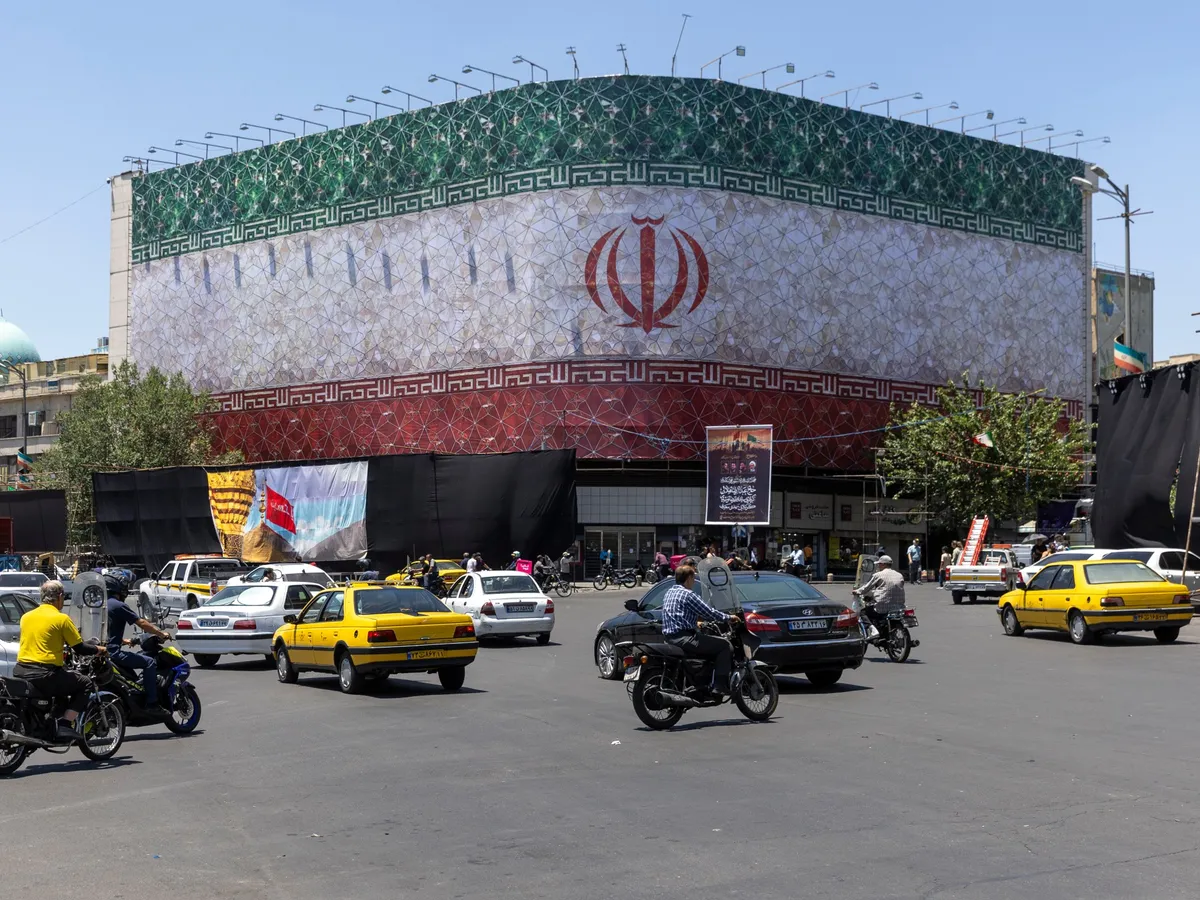
Some officials and state media have long openly described the industry as a ‘mafia’ system that transfers costs to households.Cars and motorcycles are seen in front of a billboard displaying the Iranian flag on June 15, 2026 in Tehran [Majid Saeedi/Getty Images]Published On 19 Sep 2026Tehran, Iran – Hossein, a 32-year-old marketing specialist based in Tehran, has been thinking of replacing his 13-year-old Iranian-made car with a newer model.Even though he earns about four-and-a-half times the minimum wage after a recent pay rise – his salary is now close to 900 million rials (about $390 at the current exchange rate) – imported vehicles are not even remotely affordable for him.Recommended Stories list of 4 itemslist 1 of 4Turkiye revokes operating licence of Iran’s Bank Mellat in Istanbullist 2 of 4Iran stages show of force during mobilisation campaign in Tehranlist 3 of 4The cost of Iran’s regional leveragelist 4 of 4In Yemen, war at home and in the region drives up pricesend of listEven finding a locally made car might be out of his budget, with an economic crisis gripping the country since the United States and Israel launched a surprise war on Iran on February 28 and later enacted a crippling siege and sanctions on the country.“I’m losing hope of ever being able to buy a new domestic production car too, unless the country opens up and becomes a bit more normal again,” Hossein, who asked to keep his full name confidential for security reasons, told Al Jazeera.His old manual Peugeot 206 model, an originally French-made car but now produced domestically after foreign counterparts left Iran due to sanctions, can fetch up to 10 billion rials ($4,350) if he sells it towards making a new purchase. However, his replacement options are limited.Upgrading to a slightly improved Peugeot 207 with an automatic gearbox could cost him 28 billion rials ($12,170) now. This means that, after selling his car, he would need more than 20 months of his entire salary.A domestic sedan Shahin model costs more than 31 billion rials ($13,480), and a crossover Reera is priced at more than 43 billion rials ($18,700).With these options, he would need to save about 24 months and 37 months of his whole salary, respectively, and that is if prices remain stable and he does not spend a rial on anything else. But the reality of the fast-rising living costs and lagging incomes in Iran means he can barely put aside any money, let alone afford a new car.Domestic car prices have mostly risen 40 to 80 percent since the start of the war, while some vehicles sell for more than 130 percent of their September 2025 costs.The costs of maintaining the vehicles are also rising much faster than people’s salaries. Domestically produced tyres, motor oil, brake pads and clutch kits have at least doubled since last year, with some car parts having more than tripled in price.Domestic vehicles have generally low safety standards, meaning that they contribute to staggering road accident deaths. At least 1,609 Iranians have been killed so far on intercity roads in the current month of Shahrivar of the solar Hijri calendar, which ends on September 22. More than 20,000 people lose their lives on the roads every year. In comparison, fewer people in the whole of the European Union, nearly five times Iran’s population, died on roads last year.Iran’s fuel-guzzling cars also contribute to smoke-congested city streets, degrade vehicles faster and increase fuel costs, just as petrol prices have risen for users.How did we get here?Experts say, due to a combination of protected state-linked businesses, privileged access, economic isolation and a curtailing of imports, Iranian households have no choice but to pay exorbitant prices – compared with their salaries – to buy low-quality cars.The damage from the war, including the extensive bombing of multiple steel giants by Israel and the US, has only added insult to injury. The naval blockade of Iran’s southern ports has prevented goods coming in from popular neighbouring markets like the United Arab Emirates.Under such circumstances, domestic vehicle manufacturers have little incentive to improve.End customers are also beset by government charges, currency and financing costs, margins levied by murky intermediaries – and in numerous documented cases, industry corruption.“People are forced to buy expensive low-quality cars whose real prices should be a quarter of global prices, and this is a direct harm done to them,” Mohammad Rashidi, a member of the presiding board of Iran’s parliament, told local media on Saturday. “The traces of a mafia system are visible throughout the process.”His claims echo those of other officials and state-linked media, who have openly described the industry as resembling an organised crime operation.According to the latest figures released by state media, about 233,000 cars were manufactured or assembled in Iran in the first five months of 2026, compared with 366,000 the year before. Only about 25,000 vehicles were imported in that period.Only a handful of state-linked companies or intermediaries are allowed to import vehicles, with duties plus value-added tax increasing final prices up to 200 percent.The government and parliament have discussed lowering import tariffs this year, with no agreement announced so far.Cars leave a ferry as ships remain anchored on May 16, 2026 in the Strait of Hormuz near Larak Island, Iran [File: Majid Saeedi/Getty Images]The premiums are more visible for high-end cars, with a 2026 Toyota Land Cruiser VXR going for approximately 660 billion rials ($287,000) in Iran at the moment, while the same model is available for about $86,000 in the UAE. The same story applies to most other models, at different rates depending on the rarity of the vehicle and the availability of parts.The price of a mid-range Chinese-designed SUV sold as Exeed VX in international markets is listed at about $32,000 in China, while it is priced at about $42,000 in the UAE. The same car, assembled from imported parts by a state-linked company in Iran under a different name, currently costs Iranian customers the equivalent of $53,000.The bizarre situation was on full display during a three-day “international” car exhibition in Tehran last week that mostly featured Chinese-manufactured vehicles. These remain available in Iran despite the US sanctions, since Tehran exports almost all of its oil to China and barters this for goods, including cars.Some domestic manufacturers and importers were absent, either because they had no products to offer or because they had angry customers who registered months ago to get vehicles they never received. Spare parts for some of the vehicles on display are currently either not available in the Iranian market or cost several times their price in international markets.Even the cheapest vehicles offered at the exhibition were completely unaffordable to the average Iranian. It would take a worker on the minimum wage with standard allowances 50 years to buy an XPENG G9, a Chinese-made electric SUV priced at 120 billion rials ($52,150), on his or her salary, without spending a rial on food, housing or clothing.Still, there were huge queues outside the exhibition centre each of the three days.“It was sad because most people just came to take pictures with the cars they knew they could never afford,” a young man who attended the exhibition told Al Jazeera. “The doors of the cars were locked too.”
SRCAl Jazeera
LANGEN
LEANCenter
WORDS1 206
ENT12
SAT · 2026-09-19 · 13:21 GMTBRIEF NSR-2026-0919-112513
NSR-2026-0919-112513News Report·EN·Economic Impact
An unaffordable car market highlights Iran’s cost-of-living crisis
In Iran, a severe cost-of-living crisis is making cars unaffordable for many citizens. Despite recent pay raises, individuals like Hossein, a marketing specialist in Tehran, find both imported and domestically produced vehicles priced far beyond their reach.
Maziar MotamediAl JazeeraFiled 2026-09-19 · 13:21 GMTLean · CenterRead · 5 min
Al JazeeraFIG 01
Reading time
5min
Word count
1 206words
Sources cited
1cited
Entities identified
12entities
Quality score
100%
§ 01
Briefing Summary
AI-generatedNEWSAR · AI
In Iran, a severe cost-of-living crisis is making cars unaffordable for many citizens. Despite recent pay raises, individuals like Hossein, a marketing specialist in Tehran, find both imported and domestically produced vehicles priced far beyond their reach. Domestic car prices have surged by 40-80% since the start of a war in February 2026, with some vehicles costing over 130% more than the previous year. This is attributed to economic isolation, sanctions, protected state-linked businesses, and corruption within the industry, which some officials describe as a "mafia system." The war has also damaged key industries, and a naval blockade hinders imports, leaving consumers with limited, expensive, and low-quality options.
Confidence 0.90Sources 1Claims 5Entities 12
§ 02
Article analysis
Model · rule-basedFraming
Economic Impact
Human Interest
Tone
Measured
AI-assessed
CalmNeutralAlarmist
Factuality
0.70 / 1.00
Factual
LowHigh
Sources cited
1
Limited
FewMany
§ 03
Key claims
5 extracted01
A Peugeot 207 with an automatic gearbox costs 28 billion rials ($12,170), requiring over 20 months of the specialist's salary after selling his current car.
statisticHossein
Confidence
0.95
02
A 32-year-old marketing specialist in Tehran earns approximately 900 million rials ($390) per month, which is about four-and-a-half times the minimum wage.
statisticHossein
Confidence
0.95
03
The cost of essential car maintenance parts like tires and motor oil has at least doubled, with some tripling in price since last year.
statistic
Confidence
0.90
04
Domestic car prices have significantly increased, making even locally produced vehicles unaffordable for many Iranians.
factual
Confidence
0.90
05
The cost of new domestic cars in Iran has risen by 40-80% since the start of the war, with some prices increasing by over 130%.
statistic
Confidence
0.90
§ 04
Full report
5 min read · 1 206 words§ 05
Entities
12 identifiedKey playerOppositionContextPositiveNeutralNegative
Locations6
Events1
§ 06
Keywords & salience
9 termsunaffordable car market
1.00
cost-of-living crisis
1.00
economic crisis
0.90
sanctions
0.80
domestic car prices
0.70
lagging incomes
0.60
iran
0.50
mafia system
0.40
peugeot
0.40
§ 07
Topic connections
Interactive graph Network visualization showing 51 related topics
View Full Graph Person Organization Location Event|Click node to navigate|Edge numbers = shared articles