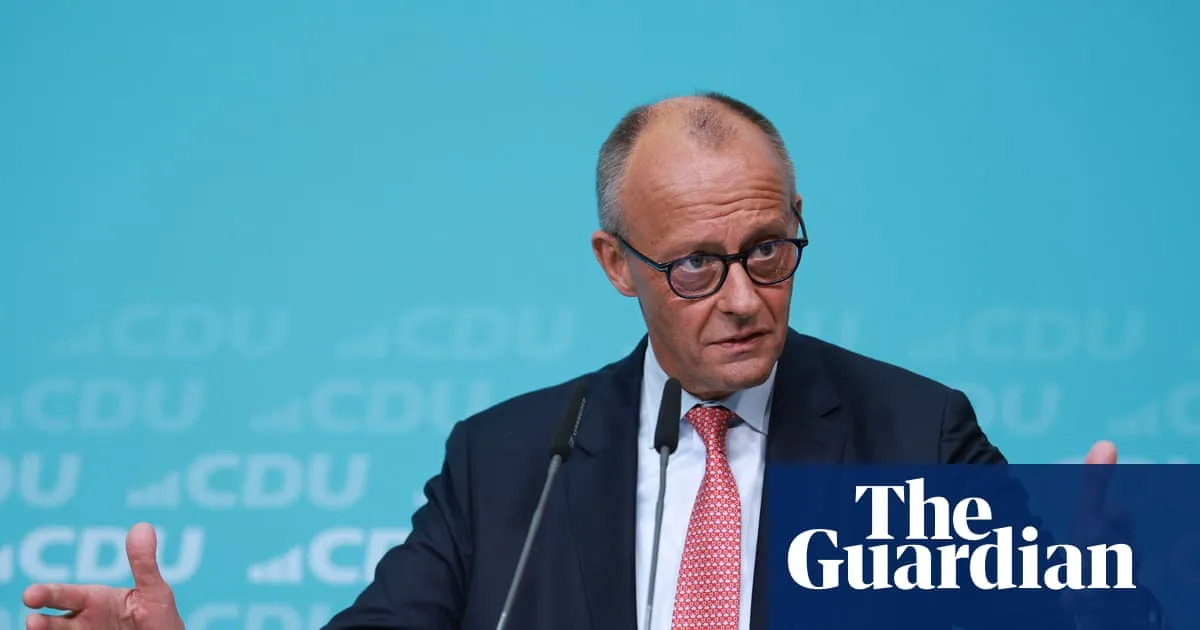
Voters in two German states are going to the polls with the political future of the embattled chancellor, Friedrich Merz, hanging in the balance and an emboldened far right targeting further gains.Coming two weeks after a seismic election in Saxony-Anhalt in which the anti-Immigration, pro-Kremlin Alternative für Deutschland (AfD) scored its highest ever result in a regional poll, the nativist party is expected to drain support again from Merz’s conservative Christian Democratic Union (CDU).Just how brutal the outcome is could affect Merz’s ability to hang on as leader after only 16 months in power, possibly setting wheels in motion for his replacement or even snap elections – currently regarded as unlikely but not ruled out.A campaign poster for Kristin Brinker and Julian Adrat, candidates of the AfD, in Berlin. Photograph: Liesa Johannssen/ReutersAbout 2.5 million people are eligible to vote in the capital Berlin and nearly 1.3 million in the Baltic coast state of Mecklenburg-Western Pomerania. Polling booths open at 8am local time on Sunday and will close at 6pm, when Merz and his allies will be watching exit polls on tenterhooks.The luckless chancellor has resisted calls to quit and vowed to fight for a signature package of economic and social welfare changes he argues are crucial to Germany’s future.“We as a government were elected for four years, I was elected for four years,” he told an industry group. “And I want to use these four years to lead the country out of this difficult period.”Merz, whose personal approval ratings have nosedived to 10%, cancelled a plan to speak at the UN General Assembly in New York because “his presence is required in Berlin” after the elections, a government official said.His credibility has been tarnished by broken campaign promises to return Europe’s largest economy to growth and cut the AfD, the biggest opposition party in parliament and number one in opinion polls, down to size.Protesters attend a demonstration against the AfD in Berlin earlier this week. Photograph: Liesa Johannssen/ReutersThe AfD fell just short of an absolute majority in former communist Saxony-Anhalt, which would have allowed it to govern on its own. It is looking for defectors from other parties to make it the first far-right force to run a German state since the Nazi period.However, polls indicate the AfD will fall well short of such a prospect in both of Sunday’s elections, even with its palpable sense of momentum.In Berlin, which is one of Germany’s 16 federal states, the incumbent CDU is vying for first place against the far-left Die Linke, which has called for expropriation of corporate landlords to fight rising housing costs.About 85% of Berlin households rent their homes and advertised rents have nearly doubled since 2014, when the city was still labelled “poor but sexy” by its then mayor, Klaus Wowereit.The AfD is polling strongly in third or fourth place, even in the cosmopolitan capital.The current mayor, Kai Wegner of the CDU, abandoned his re-election bid in July after getting tangled in contradictions explaining a decision to play tennis while large parts of the German capital were hit by an arson-triggered power blackout last winter.Stefan Evers, Berlin’s chief finance official, replaced him as the candidate but has failed to lift the party’s polling scores.Campaign posters for the Mecklenburg-Western Pomerania state elections in Schwerin, Germany. Photograph: Annegret Hilse/ReutersIn Mecklenburg-Western Pomerania, the situation looks even dicier for Merz, whose weakness regional leaders have blamed for their poor showing. The AfD and the Social Democrats are locked in a neck-and-neck race while the CDU risks its first single-digit result in 75 years.If it crashes out of parliament entirely by falling below the 5% bar to representation, it would be unprecedented in the postwar period and mark a stinging setback for Merz’s quest to stay in office.The AfD’s triumph in Saxony-Anhalt sent shock waves through Germany and beyond and has left Merz’s back to the wall, with speculation rampant he could be replaced by another Christian Democrat as chancellor well before the next general election, due in 2029.Holger Schmieding, the chief economist at Berenberg bank, said he still expected Merz to serve out his full term.“But the risk that the CDU may revolt against him and replace the unpopular chancellor seems to have risen from 20% 10 days ago to roughly 35% now, in my view,” he said in a research note, underlining the impact of a global rise in petrol prices on already angry voters.Although some economic indicators have improved on Merz’s watch, soaring living costs and deindustrialisation in core sectors such as automaking in the face of Chinese competition have taken a heavy toll.Meanwhile a significant reduction in new arrivals at the border has failed to win back AfD voters, who are responding to the party’s strong focus on economic anxiety, fears around crime, and resistance to Merz’s staunch support for Ukraine.The AfD built its victory in Saxony-Anhalt in large part by mobilising non-voters.Its opponents are hoping the spectre of a far-right juggernaut across Germany will get voters to the polls in support of mainstream democratic parties, after tens of thousands joined anti-AfD street protests in the wake of the Saxony-Anhalt rout.
SRCThe Guardian - World News
LANGEN
LEANCenter-Left
WORDS852
ENT12
SUN · 2026-09-20 · 02:00 GMTBRIEF NSR-2026-0920-112614
NSR-2026-0920-112614News Report·EN·Political Strategy
Future of German chancellor hangs in the balance as two states go to polls
Voters in Berlin and Mecklenburg-Western Pomerania are heading to the polls, with the political future of Chancellor Friedrich Merz hanging in the balance. The far-right Alternative für Deutschland (AfD) party is expected to gain further support, potentially draining votes from Merz's conservative Christian Democratic Union (CDU).
Deborah Cole in BerlinThe Guardian - World NewsFiled 2026-09-20 · 02:00 GMTLean · Center-LeftRead · 4 min
The Guardian - World NewsFIG 01
Reading time
4min
Word count
852words
Sources cited
2cited
Entities identified
12entities
Quality score
100%
§ 01
Briefing Summary
AI-generatedNEWSAR · AI
Voters in Berlin and Mecklenburg-Western Pomerania are heading to the polls, with the political future of Chancellor Friedrich Merz hanging in the balance. The far-right Alternative für Deutschland (AfD) party is expected to gain further support, potentially draining votes from Merz's conservative Christian Democratic Union (CDU). These elections follow a strong showing by the AfD in a previous regional poll. Merz, whose approval ratings have fallen significantly, has vowed to remain in office and implement economic and social welfare changes. The outcomes in these two states could impact Merz's leadership and potentially lead to calls for his replacement or even snap elections. The AfD is polling strongly, though not expected to win outright in either state.
Confidence 0.90Sources 2Claims 5Entities 12
§ 02
Article analysis
Model · rule-basedFraming
Political Strategy
Economic Impact
Tone
Mixed Tone
AI-assessed
CalmNeutralAlarmist
Factuality
0.70 / 1.00
Factual
LowHigh
Sources cited
2
Limited
FewMany
§ 03
Key claims
5 extracted01
Merz stated, 'We as a government were elected for four years, I was elected for four years. And I want to use these four years to lead the country out of this difficult period.'
quoteFriedrich Merz
Confidence
1.00
02
Advertised rents in Berlin have nearly doubled since 2014.
statistic
Confidence
0.95
03
The anti-immigration, pro-Kremlin Alternative für Deutschland (AfD) scored its highest ever result in a regional poll in Saxony-Anhalt.
factual
Confidence
0.95
04
Merz's personal approval ratings have nosedived to 10%.
statistic
Confidence
0.90
05
Voters in two German states are going to the polls with the political future of the embattled chancellor, Friedrich Merz, hanging in the balance.
factual
Confidence
0.90
§ 04
Full report
4 min read · 852 words§ 05
Entities
12 identifiedKey playerOppositionContextPositiveNeutralNegative
People3
Organizations3
Locations5
Topics1
§ 06
Keywords & salience
10 termsfriedrich merz
1.00
alternative für deutschland (afd)
1.00
german chancellor
1.00
state elections
0.90
political future
0.80
far right
0.70
christian democratic union (cdu)
0.60
economic and social welfare
0.50
approval ratings
0.40
broken campaign promises
0.40
§ 07
Topic connections
Interactive graph Network visualization showing 51 related topics
View Full Graph Person Organization Location Event|Click node to navigate|Edge numbers = shared articles