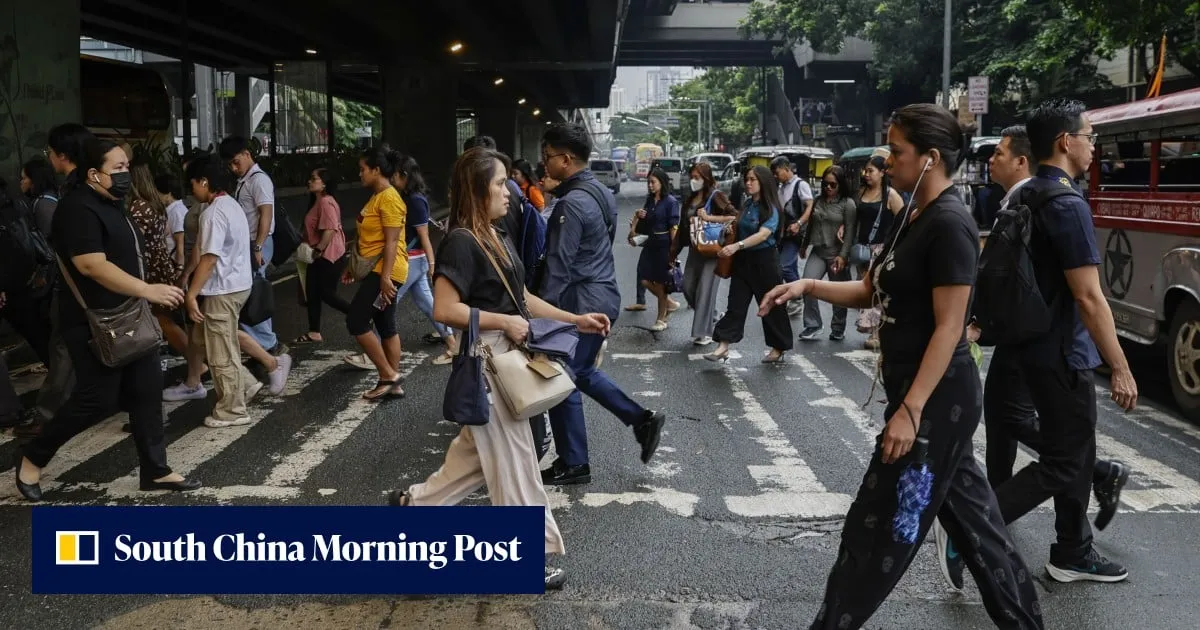
The Philippines’ rise to upper-middle-income status was supposed to mark a new phase for one of Southeast Asia’s most closely watched emerging economies.Instead, analysts say the milestone has done little to shield the country from short-term pressures weighing on growth: sluggish public spending, delayed infrastructure, high living costs and the fallout from investigations into alleged irregularities in flood control projects.Those strains have left the Philippines looking like a regional laggard. Bank of America is forecasting gross domestic product growth of 2.5 per cent for 2026 – tying with Thailand for the slowest pace in the region – even as it raised its overall Asean growth forecast to 5 per cent, up from 4.7 per cent at the end of the second quarter.“The Philippines is expected to see a sharp slowdown relative to 2025,” the bank said in its September report, comparing that to Singapore’s projected 5.1 per cent growth, Malaysia’s 5.2 per cent, Indonesia’s 5.3 per cent and Vietnam’s 8.2 per cent.
SRCSouth China Morning Post
LANGEN
LEANCenter-Right
WORDS162
ENT12
MON · 2026-09-21 · 00:00 GMTBRIEF NSR-2026-0921-112790
NSR-2026-0921-112790Analysis·EN·Economic Impact
Upgraded but underperforming: Philippines’ growth lags behind
Despite achieving upper-middle-income status, the Philippines' economic growth is underperforming compared to its Southeast Asian neighbors. Analysts attribute this slowdown to several factors, including sluggish public spending, delayed infrastructure projects, high living costs, and ongoing investigations into alleged irregularities in flood control projects.
Sam BeltranSouth China Morning PostFiled 2026-09-21 · 00:00 GMTLean · Center-RightRead · 1 min
South China Morning PostFIG 01
Reading time
1min
Word count
162words
Sources cited
1cited
Entities identified
12entities
Quality score
100%
§ 01
Briefing Summary
AI-generatedNEWSAR · AI
Despite achieving upper-middle-income status, the Philippines' economic growth is underperforming compared to its Southeast Asian neighbors. Analysts attribute this slowdown to several factors, including sluggish public spending, delayed infrastructure projects, high living costs, and ongoing investigations into alleged irregularities in flood control projects. Bank of America forecasts the Philippines' GDP growth to be 2.5% in 2026, placing it among the slowest in the region. This projection indicates a sharp slowdown from 2025, contrasting with higher growth rates anticipated for countries like Vietnam, Indonesia, Malaysia, and Singapore.
Confidence 0.90Sources 1Claims 4Entities 12
§ 02
Article analysis
Model · rule-basedFraming
Economic Impact
Political Strategy
Tone
Measured
AI-assessed
CalmNeutralAlarmist
Factuality
0.70 / 1.00
Factual
LowHigh
Sources cited
1
Limited
FewMany
§ 03
Key claims
4 extracted01
Other ASEAN economies like Singapore, Malaysia, Indonesia, and Vietnam are projected to have higher growth rates than the Philippines in 2026.
statisticBank of America
Confidence
0.95
02
Bank of America forecasts the Philippines' GDP growth at 2.5% for 2026, the slowest in the region.
predictionBank of America
Confidence
0.95
03
The Philippines' upgrade to upper-middle-income status has not shielded it from short-term economic pressures.
factual
Confidence
0.90
04
Factors weighing on Philippine growth include sluggish public spending and delayed infrastructure.
factualanalysts
Confidence
0.85
§ 04
Full report
1 min read · 162 words§ 05
Entities
12 identifiedKey playerOppositionContextPositiveNeutralNegative
Locations7
§ 06
Keywords & salience
9 termseconomic growth
1.00
philippines
1.00
emerging economies
0.80
southeast asia
0.70
delayed infrastructure
0.60
sluggish public spending
0.60
gross domestic product
0.50
high living costs
0.50
regional laggard
0.40
§ 07
Topic connections
Interactive graph Network visualization showing 51 related topics
View Full Graph Person Organization Location Event|Click node to navigate|Edge numbers = shared articles