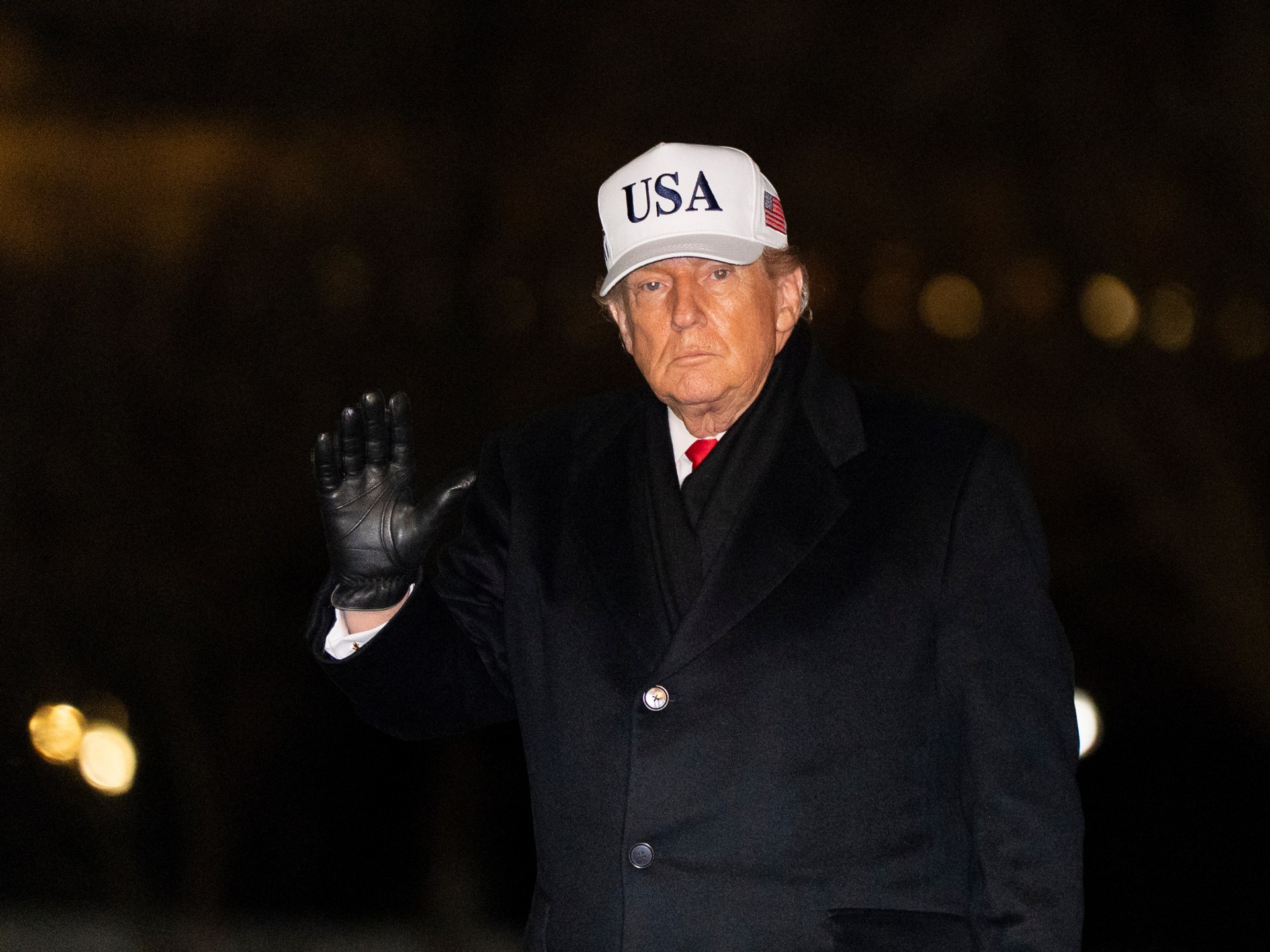
Fears of US attack rise as president says Tehran can either negotiate ‘a fair and equitable deal’ or face a US ‘armada’.Published On 28 Jan 2026President Donald Trump has revived the threat that the United States is ready to launch a military attack against Iran as he demanded that Tehran make a deal over its nuclear programme.“A massive Armada is heading to Iran. It is moving quickly, with great power, enthusiasm, and purpose,” he said in a lengthy post on Truth Social on Wednesday.Recommended Stories list of 3 itemslist 1 of 3As US ‘armada’ approaches, Iran warns of dire consequences if attackedlist 2 of 3Iran’s president warns of regional instability amid US threatslist 3 of 3Top Turkish diplomat says Iran ready to negotiate, warns against US attackend of listThe US president added that “hopefully Iran will quickly ‘Come to the Table’ and negotiate a fair and equitable deal – NO NUCLEAR WEAPONS – one that is good for all parties. Time is running out, it is truly of the essence! As I told Iran once before, MAKE A DEAL!”In an apparent reference to the US bombing of three of Iran’s nuclear facilities in June, the US president warned that should Tehran fail to agree a deal, the next attack would be “far worse”.Trump’s outburst came shortly after Iran’s Foreign Minister Abbas Araghchi said that his country would not restart negotiations amid the threat of an attack.Tehran’s top diplomat insisted that his country has not sought to restart negotiations and would not do so while the threats persist.‘Menaces and demands’Trump has repeatedly indicated that he is considering ordering military action in response to Tehran’s crackdown on antigovernment protests earlier this month, raising tension across the region.“There was no contact between me and [US envoy Steve] Witkoff in recent days and no request for negotiations was made from us,” Araghchi told state media.“Our stance is clear: Negotiations don’t go along with threats, and talks can only take place when there are no longer menaces and excessive demands,” the diplomat said.Earlier this month, Araghchi had said his country was ready for war if Washington wanted to “test” it.The comments came after Iranian President Masoud Pezeshkian hit out against US “threats”, saying they were “aimed at disrupting the security of the region and will achieve nothing other than instability”.The bullish riposte appears to contradict remarks from Turkiye’s foreign minister. Speaking to Al Jazeera on Wednesday, Hakan Fidan suggested “Iran is ready to negotiate a nuclear file again”.In June, as indirect negotiations on the nuclear programme were under way, the US joined Israel in its 12-day war on Iran by bombing three of its main nuclear facilities. The attacks killed 430 people.Iranian officials have promised to launch a “comprehensive and regret-inducing response” if attacked again.Trump has repeatedly claimed that the US attack in June “obliterated” the Iranian nuclear programme, which Western nations and international institutions worry is aimed at developing nuclear weapons.However, Tehran insists the programme has strictly civilian purposes and it has the right to carry out the enrichment of uranium.The whereabouts of the country’s highly enriched uranium have remained unknown since the June attacks.Tension stalks the regionMeanwhile, the US continues to ramp up the pressure on Iran by focusing its rhetoric on the protests, in which thousands of people are reported to have been killed.The US-based Human Rights Activists News Agency (HRANA) said it has confirmed at least 6,221 deaths, including at least 5,858 protesters, and is investigating 12,904 others.The United Nations special rapporteur on Iran, Mai Sato, has said the death toll could reach 20,000 or more as reports from doctors from inside Iran emerge.Iran’s government has put the death toll at 3,117, saying 2,427 were civilians and security forces and labelling the rest as “terrorists”.Al Jazeera has been unable to independently verify the figures.Trump has in the past laid down two red lines for launching an attack: the killing of peaceful demonstrators and the possible mass execution of detainees.Regional tensionThe threat of military action has raised tension across the region. Iran has pledged to retatiliate to any US strike with attacks on bases in the region that host US forces.Both Tehran and the US Air Force have announced military drills near the Strait of Hormuz while Iran’s Islamic Revolutionary Guard Corps has warned that neighbouring countries would be “considered hostile” if their territory is used by the US during any attack.In June last year, Tehran responded to the bombing of its nuclear facilities with an attack on US forces stationed at the Al Udeid airbase in Qatar.Saudi Arabia and the United Arab Emirates, both of which host US forces, have signaled they will not allow their airspace to be used for any attack.The tension has also provoked a diplomatic whirlwind in the region.On Wednesday, Egypt’s Foreign Ministry said its top diplomat, Badr Abdelatty, has spoken with Araghchi and Witkoff seperately in a bid to “work toward achieving calm, in order to avoid the region slipping into new cycles of instability”.
SRCAl Jazeera
LANGEN
LEANCenter
WORDS829
ENT8
WED · 2026-01-28 · 12:37 GMTBRIEF NSR-2026-0128-11293
NSR-2026-0128-11293News Report·EN·Conflict
Trump reiterates threat of military action with demand for Iran deal
In January 2026, Donald Trump threatened military action against Iran if it does not negotiate a new nuclear deal. Trump stated that a U.S.
By News AgenciesAl JazeeraFiled 2026-01-28 · 12:37 GMTLean · CenterRead · 4 min
Al JazeeraFIG 01
Reading time
4min
Word count
829words
Sources cited
4cited
Entities identified
8entities
Quality score
100%
§ 01
Briefing Summary
AI-generatedNEWSAR · AI
In January 2026, Donald Trump threatened military action against Iran if it does not negotiate a new nuclear deal. Trump stated that a U.S. "armada" is heading to Iran and urged Tehran to negotiate a deal without nuclear weapons. This threat follows Iran's rejection of negotiations under duress, with Foreign Minister Abbas Araghchi stating that talks cannot occur with ongoing threats. Trump's statement also follows Iranian President Masoud Pezeshkian's criticism of U.S. threats and warnings from a Turkish diplomat against a U.S. attack. Tensions are high in the region due to the potential for military action and Iran's firm stance against negotiating under pressure.
Confidence 0.90Sources 4Claims 5Entities 8
§ 02
Article analysis
Model · rule-basedFraming
Conflict
National Security
Tone
Mixed Tone
AI-assessed
CalmNeutralAlarmist
Factuality
0.70 / 1.00
Factual
LowHigh
Sources cited
4
Well sourced
FewMany
§ 03
Key claims
5 extracted01
A massive Armada is heading to Iran.
quoteDonald Trump
Confidence
1.00
02
In June, the US joined Israel in its 12-day war on Iran by bombing three of its main nuclear facilities.
factualArticle
Confidence
0.90
03
Iran's Foreign Minister Abbas Araghchi said that his country would not restart negotiations amid the threat of an attack.
factualArticle
Confidence
0.90
04
Donald Trump has revived the threat that the United States is ready to launch a military attack against Iran.
factualArticle
Confidence
0.90
05
Hakan Fidan suggested Iran is ready to negotiate a nuclear file again.
quoteHakan Fidan
Confidence
0.80
§ 04
Full report
4 min read · 829 words§ 05
Entities
8 identifiedKey playerOppositionContextPositiveNeutralNegative
People4
§ 06
Keywords & salience
8 termsiran deal
0.90
military action
0.80
nuclear programme
0.70
us attack
0.70
negotiations
0.60
regional instability
0.50
anti-government protests
0.40
abbas araghchi
0.40
§ 07
Topic connections
Interactive graph Network visualization showing 51 related topics
View Full Graph Person Organization Location Event|Click node to navigate|Edge numbers = shared articles