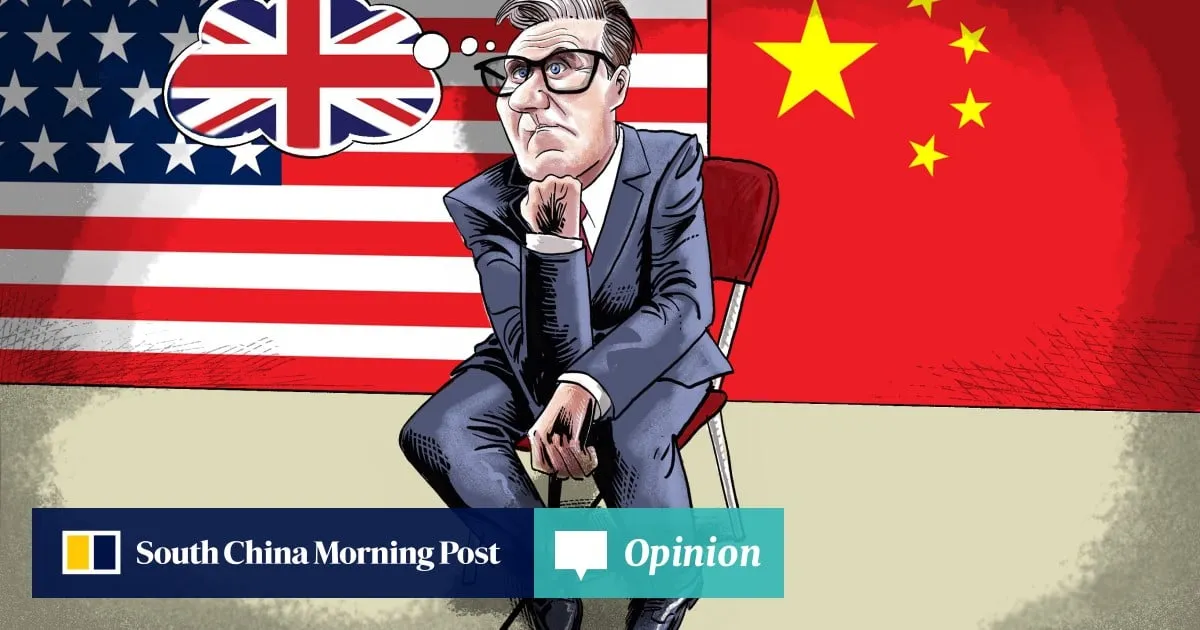
“I’m often invited to simply choose between countries. I don’t do that,” UK Prime Minister Keir Starmer said on Monday ahead of his China trip. The visit – after Canadian Prime Minister Mark Carney’s Beijing trip drew US tariff threats – is an attempt to drag British foreign policy into alignment with 21st century realities: a world of strategic rivalry but deep economic interdependence.Starmer’s remarks are not diplomatic wordplay, but a declaration the United Kingdom will no longer be a simple passenger in a contest defined in Washington and Beijing.For most of the post-Cold War era, British foreign policy treated alignment with the United States as a principle, its China policy largely influenced by Washington’s choices. When the US leaned into engagement with Beijing, London talked up a “golden era”; when Washington pivoted to rivalry, the UK banned Huawei Technologies from 5G networks, toughened investment screenings and spoke of “de-risking”.Starmer’s message that Britain will not be forced to choose is in effect an admission this model has reached its limits. Heading to China is his way of signalling a new posture: the UK as a balancer, not just a loyal follower.“We’ve got very close relations with the US – of course, we want to – and we will maintain that business, alongside security and defence,” Starmer said. “Equally, just sticking your head in the sand and ignoring China when it’s the second-biggest economy in the world and there are business opportunities wouldn’t be sensible.”Clearly, the UK wants to stay firmly inside the US security camp while reopening economic and political channels with Beijing. This means trying to separate where it automatically follows Washington from areas it demands room for manoeuvre.
SRCSouth China Morning Post
LANGEN
LEANCenter-Right
WORDS280
ENT6
WED · 2026-01-28 · 12:30 GMTBRIEF NSR-2026-0128-11329
NSR-2026-0128-11329Analysis·EN·Political Strategy
With China visit, Starmer makes clear he’s putting Britain first
Keir Starmer's trip to China signals a shift in UK foreign policy, prioritizing British interests in a world of both strategic rivalry and economic interdependence. Starmer declared the UK will no longer be a passive participant in a contest defined by the US and China, moving away from automatically aligning with Washington's China policy.
Jianxi LiuSouth China Morning PostFiled 2026-01-28 · 12:30 GMTLean · Center-RightRead · 2 min
South China Morning PostFIG 01
Reading time
2min
Word count
280words
Sources cited
2cited
Entities identified
6entities
Quality score
100%
§ 01
Briefing Summary
AI-generatedNEWSAR · AI
Keir Starmer's trip to China signals a shift in UK foreign policy, prioritizing British interests in a world of both strategic rivalry and economic interdependence. Starmer declared the UK will no longer be a passive participant in a contest defined by the US and China, moving away from automatically aligning with Washington's China policy. The UK aims to balance its close relationship with the US, particularly in security, with the economic opportunities presented by China's position as the world's second-largest economy. This new approach seeks to create room for independent maneuver, separating areas of alignment with the US from those where the UK will pursue its own course. The visit is an attempt to re-open economic and political channels with Beijing.
Confidence 0.90Sources 2Claims 5Entities 6
§ 02
Article analysis
Model · rule-basedFraming
Political Strategy
Economic Impact
Tone
Measured
AI-assessed
CalmNeutralAlarmist
Factuality
0.60 / 1.00
Mixed
LowHigh
Sources cited
2
Limited
FewMany
§ 03
Key claims
5 extracted01
Starmer stated that ignoring China, the second-biggest economy, wouldn't be sensible.
quoteKeir Starmer
Confidence
1.00
02
Starmer said the UK will maintain business, security and defence relations with the US.
quoteKeir Starmer
Confidence
1.00
03
Canadian Prime Minister Mark Carney's Beijing trip drew US tariff threats.
factualnull
Confidence
0.90
04
The UK wants to stay firmly inside the US security camp while reopening economic and political channels with Beijing.
factualnull
Confidence
0.90
05
Keir Starmer visited China to signal a new posture: the UK as a balancer, not just a loyal follower of the US.
factualnull
Confidence
0.80
§ 04
Full report
2 min read · 280 words§ 05
Entities
6 identifiedKey playerOppositionContextPositiveNeutralNegative
§ 06
Keywords & salience
8 termsbritish foreign policy
0.90
china
0.80
united states
0.70
united kingdom
0.70
economic interdependence
0.60
keir starmer
0.60
strategic rivalry
0.50
de-risking
0.40
§ 07
Topic connections
Interactive graph Network visualization showing 51 related topics
View Full Graph Person Organization Location Event|Click node to navigate|Edge numbers = shared articles