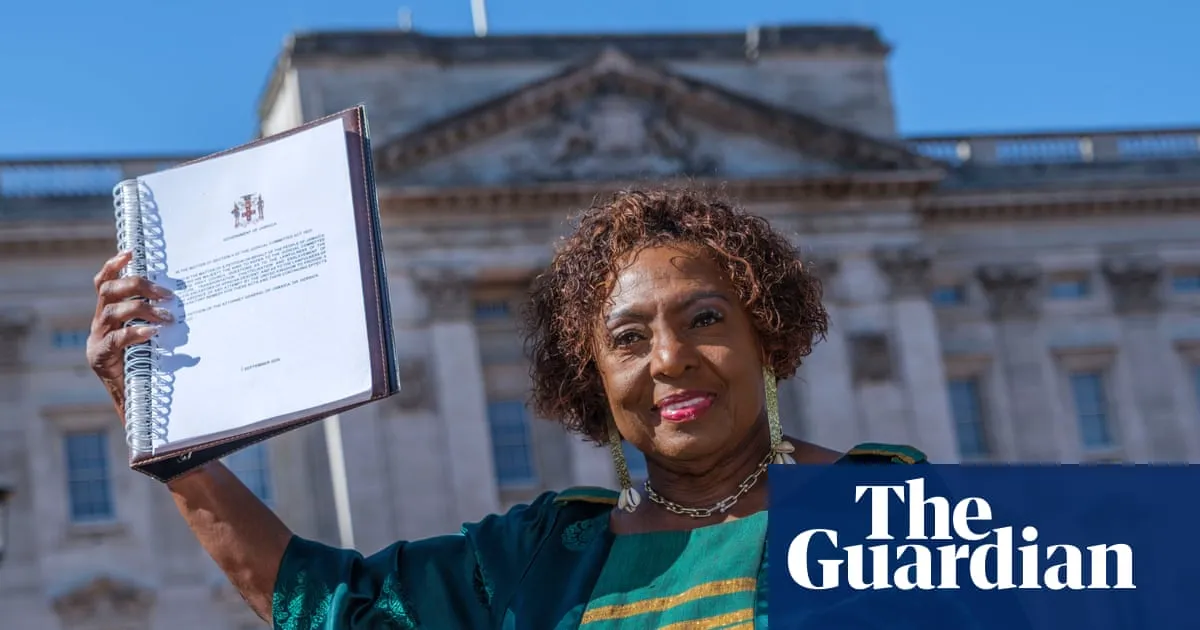
King Charles has referred a landmark Slavery Reparations petition from Jamaica to a high-level UK appeals court for legal advice, Jamaica’s culture minister announced in parliament on Tuesday.Referring to the move as a “really big deal”, Olivia Grange told Jamaica’s MPs the monarch had confirmed that their legal questions have been passed on to the London-based Privy Council – the final court of appeal for UK overseas territories and some Commonwealth countries.The petition seeks guidance on three questions: whether the forced transport of Africans to Jamaica was lawful; whether it constituted a crime against humanity; and whether Britain is under an obligation to provide restitution for slavery and its enduring consequences.“Indeed we went fearless and boldly into this chapter when we petitioned the king on Monday, September 7, 2026 – one day after the 245th anniversary of the commemoration of the Zong massacre, an event that captures the barbarity of chattel enslavement,” Grange said in parliament.“The king could have ignored us. The king could have delayed responding to us. The king could have made a decision not to refer the questions to the Privy Council, or he could make a decision to refer the questions,” she said, before adding “King Charles has referred the petition filed on the 7th of September, 2026, on behalf of the people of Jamaica to the Judicial Committee of the Privy Council.”Jamaica had activated a rarely used mechanism in the Judicial Committee Act 1833, which allows the king to refer questions of “legal or constitutional nature” to the Privy Council when they cannot be resolved through ordinary courts, according to the country’s legal counsels.The minister said that taking the matter to the International Court of Justice, was not an option for Jamaica.“The United Kingdom has placed specific reservations on the compulsory jurisdiction of the ICJ which prevent the Court from adjudicating on disputes between the United Kingdom and the government of any other country which is or has been a Member of the Commonwealth”.A Privy Council opinion would not compel the UK government to pay reparations, but Jamaican officials believe it could shape negotiations and legal options and set a precedent for other Commonwealth nations seeking reparations.Earlier this month, Grange led a Jamaican delegation to London to officially lodge the petition. While in the UK, the group, lawyers and members of the country’s national council on reparation met diaspora communities, MPs, church leaders and cultural institutions – among them the British Museum, from which Jamaica is seeking the return of artefacts taken during colonial rule.Tuesday’s announcement follows the Caricom Regional Conference on Reparations, which took place in Barbados last week. Officials at the conference said that Caribbean nations are drawing up a multi-pronged “action plan” with legal options to push the UK into negotiating a decades-long Slavery Reparations deal.Leaders in the region are hoping the UK would agree to targeted and constructive negotiation talks at upcoming Commonwealth and UN summits, but they are ready to take the matter to international courts if Britain continues to resist diplomatic options.Speaking at the conference, Prof Sir Hilary Beckles, the chair of the CRC, said reparations was a matter of justice, adding that countries in the region were forced to create viable democracies “out of the mess” of colonialism, which was still having an impact today.He said: “When Jamaica took its petition to the UK, we had to surround that petition with the fact that when Jamaica became independent in 1962, 80% of the black people in Jamaica could not read or write. After 300 years of British colonisation, they moved into independence with 80% illiteracy. How do you build a modern nation, not even a competitive economy, with 80% illiteracy?”Earlier this month, a spokesperson for Andy Burnham reiterated the British government’s long‑held position that “the UK does not and will not pay reparations”.Grange told parliament that the country is “awaiting directions from the Judicial Committee of the Privy Council as to the next steps to be taken in the case. And the attorney general is preparing to deal with the case”.
SRCThe Guardian - World News
LANGEN
LEANCenter-Left
WORDS673
ENT10
WED · 2026-09-23 · 01:15 GMTBRIEF NSR-2026-0923-113335
NSR-2026-0923-113335News Report·EN·Social Justice
Jamaica hails King’s decision to refer slavery reparations petition to privy council as ‘really big deal’
Jamaica's Culture Minister, Olivia Grange, announced that King Charles has referred a landmark slavery reparations petition from Jamaica to the Judicial Committee of the Privy Council for legal advice. This move, described as a "really big deal," follows Jamaica's petition on September 7, 2026, seeking guidance on the legality of forced African transport, its classification as a crime against humanity, and Britain's obligation to provide restitution.
Natricia Duncan Caribbean correspondentThe Guardian - World NewsFiled 2026-09-23 · 01:15 GMTLean · Center-LeftRead · 3 min
The Guardian - World NewsFIG 01
Reading time
3min
Word count
673words
Sources cited
2cited
Entities identified
10entities
Quality score
100%
§ 01
Briefing Summary
AI-generatedNEWSAR · AI
Jamaica's Culture Minister, Olivia Grange, announced that King Charles has referred a landmark slavery reparations petition from Jamaica to the Judicial Committee of the Privy Council for legal advice. This move, described as a "really big deal," follows Jamaica's petition on September 7, 2026, seeking guidance on the legality of forced African transport, its classification as a crime against humanity, and Britain's obligation to provide restitution. Jamaica utilized a rarely used mechanism allowing the King to refer legal or constitutional questions to the Privy Council. While a Privy Council opinion is not binding, Jamaican officials believe it could influence negotiations and legal options. This development occurs as Caribbean nations are developing a multi-pronged plan to push for reparations negotiations with the UK.
Confidence 0.90Sources 2Claims 5Entities 10
§ 02
Article analysis
Model · rule-basedFraming
Social Justice
Legal & Judicial
Tone
Measured
AI-assessed
CalmNeutralAlarmist
Factuality
0.80 / 1.00
Factual
LowHigh
Sources cited
2
Limited
FewMany
§ 03
Key claims
5 extracted01
A Privy Council opinion would not compel the UK government to pay reparations but could shape negotiations and legal options.
factualJamaican officials
Confidence
1.00
02
Taking the matter to the International Court of Justice was not an option for Jamaica due to UK reservations.
factualJamaica's culture minister
Confidence
1.00
03
Jamaica activated a rarely used mechanism in the Judicial Committee Act 1833 to refer the questions to the Privy Council.
factualJamaica's legal counsels
Confidence
1.00
04
The petition seeks guidance on whether the transport of Africans to Jamaica was lawful, constituted a crime against humanity, and if Britain is obligated to provide restitution.
factualJamaica's culture minister
Confidence
1.00
05
King Charles has referred Jamaica's slavery reparations petition to the Privy Council for legal advice.
factualOlivia Grange
Confidence
1.00
§ 04
Full report
3 min read · 673 words§ 05
Entities
10 identifiedKey playerOppositionContextPositiveNeutralNegative
Organizations4
§ 06
Keywords & salience
8 termsslavery reparations
1.00
privy council
0.90
jamaica
0.80
king charles
0.70
legal advice
0.60
petition
0.50
commonwealth
0.40
zong massacre
0.40
§ 07
Topic connections
Interactive graph Network visualization showing 51 related topics
View Full Graph Person Organization Location Event|Click node to navigate|Edge numbers = shared articles