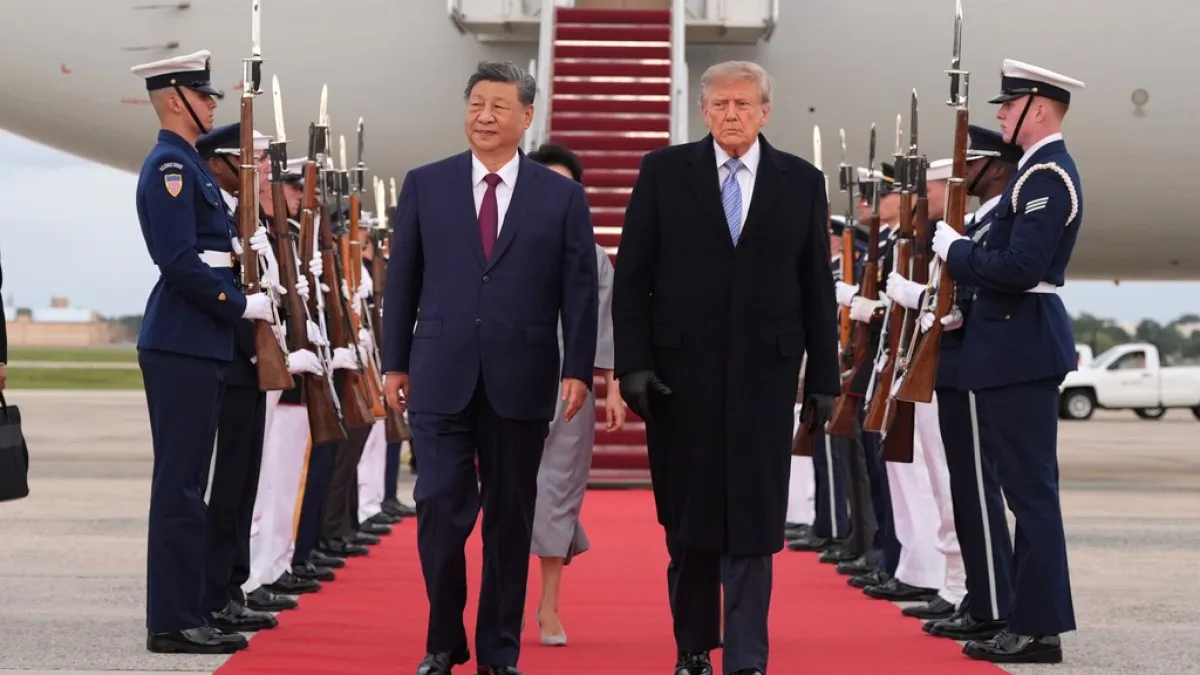
EDITOR'S ANALYSISExperts say the summit may not achieve many relevant announcements but is needed to re-establish trust.US President Donald Trump meets Chinese President Xi Jinping at Joint Base Andrews in Maryland, United States, in a rare personal welcome [File: Alex Brandon/AP]Published On 24 Sep 2026As United States President Donald Trump rolled out the red carpet for Chinese President Xi Jinping with a rare personal welcome at the airport, to be followed by a state banquet and a military flyover, experts warn to temper expectations as the summit is more focused on “re-establishing trust” rather than having any meaningful deals announced at the end of it.The US and China have been locked in a trade war since Trump’s first term as president when he introduced levies on imports of certain industrial goods, and Beijing retaliated with tariffs on a range of US exports including soya beans, pork and electric vehicles. Some of those policies continued under Trump’s successor, President Joe Biden, who also introduced other measures, including curbs on chip exports.Recommended Stories list of 4 itemslist 1 of 4Harvey Weinstein sentenced to 15 years in New York sexual assault retriallist 2 of 4Trump administration invites Putin to attend G20 summit in Miamilist 3 of 4US aviation sanctions disrupt Iran flights, push travellers overlandlist 4 of 4FBI investigates alleged theft of ‘very sensitive’ employee dataend of listBut relations really nosedived with Trump’s second term when he unleashed new tariffs on China, including threatening levies of 200 percent at one point last year, with Beijing promising to hit back at similar levels and throttling exports of critical minerals that are used in manufacturing a range of products from laptops and cellphones to cars and renewable energy infrastructure.While both sides have since stepped back from that cliff after the two leaders met in late October in Busan on the sidelines of the APEC summit in South Korea, US tariffs are still at a hefty average of 36.5 percent, while China’s tariffs on US goods average out to 31 percent.“This is not a bargaining summit,” Reza Hasmath, academic faculty adviser at The China Institute at the University of Alberta, told Al Jazeera. “It’s a stabilising summit.”Apart from tariffs, other items on the agenda include cooperation on artificial intelligence safety, Iran and Taiwan.“The point of the summit is to set up a continuation of the truce” that was arrived at in Busan, said Mary E Lovely, senior fellow at the Peterson Institute of International Economics.It was after that meeting that China resumed its supply of critical minerals. The US wants those deliveries to be sped up and “for that reason alone, the US will want a continuation of the truce”, Lovely added.With that goal, Lovely says there may be an announcement of a Board of Trade mechanism where both sides would reduce their respective tariffs on $30bn worth of goods each.For Lovely, the best-case scenario from the summit will be the two countries actually do begin to liberalise trade of some non-sensitive goods and that the flow of critical minerals is indeed sped up, all of which will show “a little bit of normalisation of relations”. The worst case, on the other hand, is if they don’t find common ground, she said.Tricky areasSafety rules around AI and a coordinated slowdown in that sector, for instance, could be tricky topics, experts agree.While US Treasury Secretary Scott Bessent has proposed a US-China dialogue and an AI hotline to report AI incidents that could threaten national security, the lack of mutual trust will limit any real deliverables in this area, says Dexter Tiff Roberts, nonresident senior fellow at the Atlantic Council’s Global China Hub.The distrust is fuelled by US restrictions on the sale of advanced chips to China, as well as repeated rhetoric from the US government, including from Trump, that there is a battle for supremacy in AI that the US must win.At the same time, “China wants to push global governance on its own terms and sees AI as a soft power tool that they can offer to other countries”, said Tiff Roberts.Similarly, on Iran, while China does not sell weapons to Tehran, it does sell dual-use components. It also has historically bought significant quantities of oil from Iran, revenues from which have helped the latter’s economy stay afloat.Although it has held off those purchases in the past few months of the US-Iran war – thus helping stabilise global oil prices – as it has dipped into its strategic reserves, experts say that could change in the near future.Beijing “is delighted that the US is distracted with its war in Iran”, said Tiff Roberts, “and is not going to do anything to help the US with that”.Then there is Taiwan.Taiwan is democratically governed, but China views it as its own territory and wants to see the US moving closer to its policy. Taiwan, which rejects unification, has been waiting for months for Washington, DC, to approve the sale of $14bn in arms.“We don’t expect Trump to sell Taiwan down the river … but Trump is a bit of a wild card, and Taiwan is nervously watching,” said Tiff Roberts.Even though no real deals are expected from the three-day summit, experts agree that it is important for the two leaders to meet.“There’s a whole lot at stake given the huge trade relationship, including for the rest of the world,” Tiff Roberts said.Also, as Trump heads into the US midterm elections, he “wants a big state visit to show he’s an international leader of standing and wants the bright lights of TV on him to show him as a leader”, while China needs a better trade relationship, especially as its domestic economy sags, said Tiff Roberts.But at the end of the day, “it will be a horse and pony show, with a few not very meaningful announcements. But it will be about re-establishing trust”, said the China Institute’s Hasmath.
SRCAl Jazeera
LANGEN
LEANCenter
WORDS980
ENT12
THU · 2026-09-24 · 05:55 GMTBRIEF NSR-2026-0924-113680
NSR-2026-0924-113680Analysis·EN·Diplomatic
Trump and Xi summit will focus on ‘stalibising’ ties, experts say
US President Donald Trump is meeting Chinese President Xi Jinping for a summit focused on "stabilizing" ties, according to experts. While trade, AI, and security are on the agenda, the primary goal is to re-establish trust rather than achieve major new deals.
Megha BahreeAl JazeeraFiled 2026-09-24 · 05:55 GMTLean · CenterRead · 4 min
Al JazeeraFIG 01
Reading time
4min
Word count
980words
Sources cited
2cited
Entities identified
12entities
Quality score
100%
§ 01
Briefing Summary
AI-generatedNEWSAR · AI
US President Donald Trump is meeting Chinese President Xi Jinping for a summit focused on "stabilizing" ties, according to experts. While trade, AI, and security are on the agenda, the primary goal is to re-establish trust rather than achieve major new deals. The meeting follows a period of escalating trade war tariffs and other restrictive measures between the two nations. Experts suggest the summit aims to continue a truce established in late October, potentially leading to a mechanism for reducing tariffs on specific goods and speeding up the flow of critical minerals. However, areas like AI safety and China's role concerning Iran and Taiwan remain complex issues due to a lack of mutual trust.
Confidence 0.90Sources 2Claims 5Entities 12
§ 02
Article analysis
Model · rule-basedFraming
Diplomatic
Economic Impact
Tone
Measured
AI-assessed
CalmNeutralAlarmist
Factuality
0.60 / 1.00
Mixed
LowHigh
Sources cited
2
Limited
FewMany
§ 03
Key claims
5 extracted01
US tariffs on China average 36.5 percent, while China's tariffs on US goods average 31 percent.
statistic
Confidence
1.00
02
The US and China have been engaged in a trade war since Trump's first term, involving reciprocal tariffs.
factual
Confidence
1.00
03
The summit aims to set up a continuation of the truce agreed upon in Busan.
quoteMary E Lovely
Confidence
0.90
04
The Trump-Xi summit is focused on 're-establishing trust' rather than announcing meaningful deals.
quoteexperts
Confidence
0.90
05
A potential announcement could involve a Board of Trade mechanism to reduce tariffs on $30bn worth of goods each.
predictionMary E Lovely
Confidence
0.70
§ 04
Full report
4 min read · 980 words§ 05
Entities
12 identifiedKey playerOppositionContextPositiveNeutralNegative
People3
Locations5
§ 06
Keywords & salience
10 termsus-china relations
1.00
trade war
0.90
stabilizing summit
0.80
tariffs
0.70
re-establishing trust
0.70
artificial intelligence safety
0.60
xi jinping
0.50
summit
0.50
donald trump
0.50
iran
0.40
§ 07
Topic connections
Interactive graph Network visualization showing 51 related topics
View Full Graph Person Organization Location Event|Click node to navigate|Edge numbers = shared articles