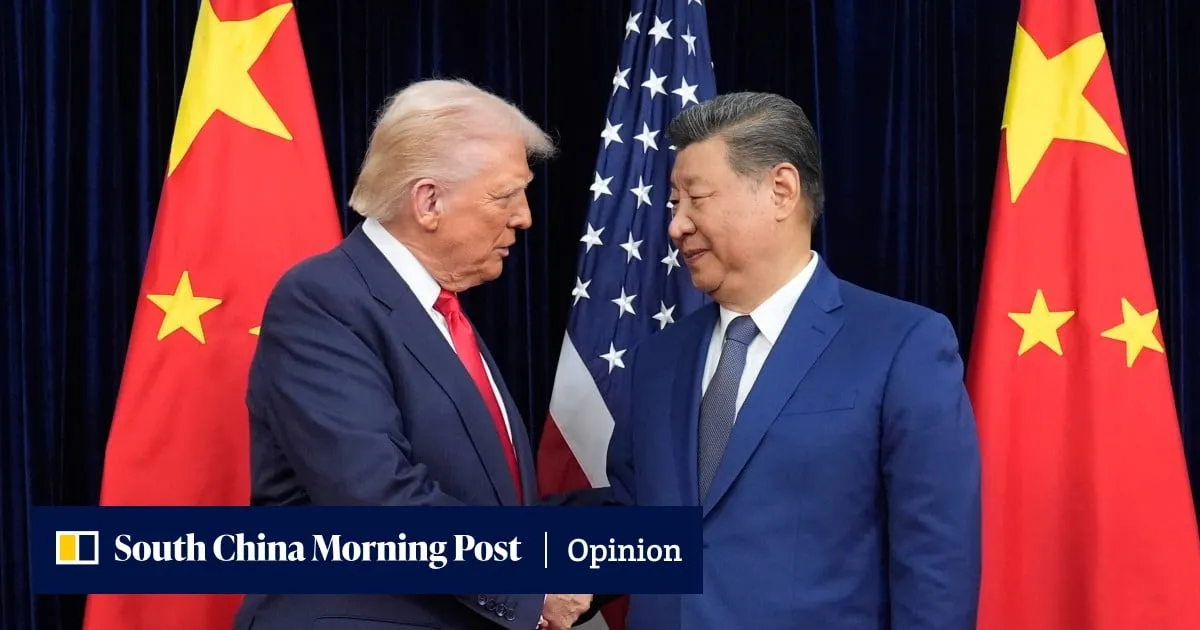
Washington and Beijing have spent nearly a decade trading tariffs, export controls and blacklists, with each round threatening rupture. Yet they keep recovering from the brink.Tensions soared before summits and plunged immediately after. For example, in 2019 at Osaka, Trump walked back threats to impose tariffs on US$300 billion of Chinese goods and eased curbs on Huawei after Beijing reportedly agreed to buy American farm goods. In Busan last October, he lowered tariffs and shelved export controls on thousands of Chinese companies after Xi Jinping suspended some rare earth restrictions and resumed soybean purchases.As the two presidents met at the White House this week, that pattern was repeating. Simply put, decoupling is proving ruinously expensive on both sides: two-way goods and services trade fell 25.1 per cent last year to an estimated US$494.6 billion, with American goods exports to China down 26 per cent.The effective tariff rate on many Chinese goods remains close to 30 per cent – the highest of any country – yet it comes at a mutual cost.Beijing’s leverage explains much of Washington’s current restraint. China controls roughly 70 per cent of global rare earth mining and about 90 per cent of processing capacity; that dependence cannot be engineered away quickly. The administration has notably refrained from threatening steep new tariffs or technology bans before this summit, in contrast to earlier meetings. The US is, after all, vulnerable to Chinese pressure and tacitly admits the need to maintain stable and secure access to critical minerals.US Trade Representative Jamieson Greer said in April that the president seeks stability and is not looking for “massive confrontation” or “full-on conflict” with China. The administration’s November 2025 National Security Strategy declined to name China a competitor, speaking instead of “maintaining a genuinely mutually advantageous economic relationship with Beijing”.This is not friendship, and no one should pretend otherwise. Washington’s grievances – Chinese subsidies, forced technology transfer, opaque ownership, procurement rules that squeeze foreign firms – are here to stay. But don’t expect China to change.
SRCSouth China Morning Post
LANGEN
LEANCenter-Right
WORDS333
ENT12
FRI · 2026-09-25 · 21:30 GMTBRIEF NSR-2026-0925-114149
NSR-2026-0925-114149Analysis·EN·Economic Impact
China and the US can make nice, if not peace
Despite a decade of trade disputes, including tariffs and export controls, the US and China have repeatedly avoided complete rupture. This pattern continued with the recent White House meeting between the presidents, as decoupling has proven economically costly for both nations, with bilateral trade declining significantly.
Alex LoSouth China Morning PostFiled 2026-09-25 · 21:30 GMTLean · Center-RightRead · 2 min
South China Morning PostFIG 01
Reading time
2min
Word count
333words
Sources cited
1cited
Entities identified
12entities
Quality score
100%
§ 01
Briefing Summary
AI-generatedNEWSAR · AI
Despite a decade of trade disputes, including tariffs and export controls, the US and China have repeatedly avoided complete rupture. This pattern continued with the recent White House meeting between the presidents, as decoupling has proven economically costly for both nations, with bilateral trade declining significantly. China's leverage, particularly in rare earth minerals, influences US restraint, leading Washington to prioritize stability over confrontation. While the US seeks a mutually advantageous economic relationship, underlying grievances regarding Chinese trade practices remain unresolved, and China is not expected to change its policies.
Confidence 0.90Sources 1Claims 5Entities 12
§ 02
Article analysis
Model · rule-basedFraming
Economic Impact
Diplomatic
Tone
Measured
AI-assessed
CalmNeutralAlarmist
Factuality
0.60 / 1.00
Mixed
LowHigh
Sources cited
1
Limited
FewMany
§ 03
Key claims
5 extracted01
Washington's grievances include Chinese subsidies, forced technology transfer, opaque ownership, and procurement rules that squeeze foreign firms.
factual
Confidence
1.00
02
US Trade Representative Jamieson Greer stated the president seeks stability and not "massive confrontation" or "full-on conflict" with China.
quoteJamieson Greer
Confidence
1.00
03
China controls roughly 70% of global rare earth mining and about 90% of processing capacity.
statistic
Confidence
1.00
04
Two-way goods and services trade between the US and China fell 25.1% last year to an estimated US$494.6 billion.
statistic
Confidence
1.00
05
US and China have been trading tariffs, export controls, and blacklists for nearly a decade.
factual
Confidence
1.00
§ 04
Full report
2 min read · 333 words§ 05
Entities
12 identifiedKey playerOppositionContextPositiveNeutralNegative
People3
Organizations1
Locations4
§ 06
Keywords & salience
10 termsus-china relations
1.00
trade war
0.90
tariffs
0.80
decoupling
0.70
rare earth minerals
0.70
export controls
0.60
economic relationship
0.50
technology transfer
0.40
huawei
0.40
summit
0.40
§ 07
Topic connections
Interactive graph Network visualization showing 51 related topics
View Full Graph Person Organization Location Event|Click node to navigate|Edge numbers = shared articles