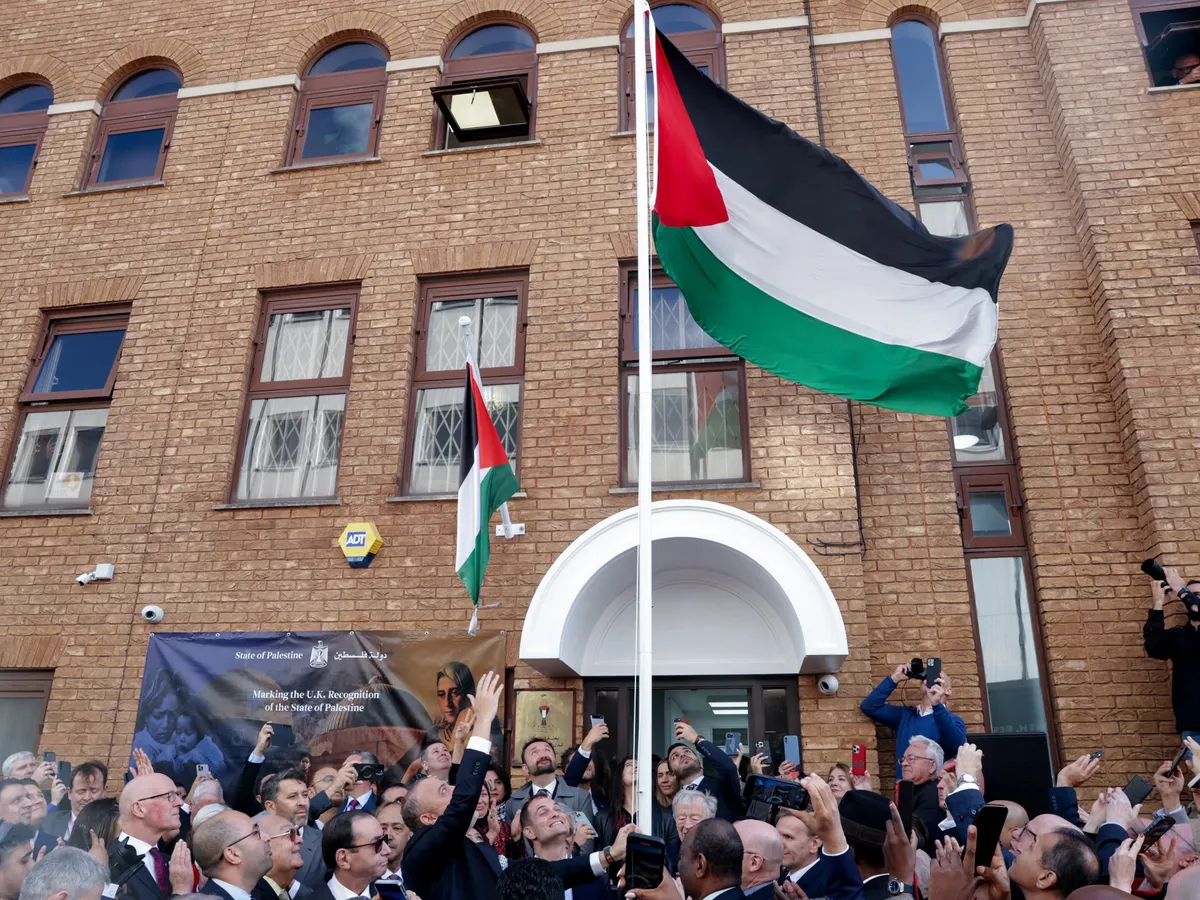
The British government is moving to translate rhetoric into policy.Ambassador of the Palestine" class="entity-link entity-location" data-entity-id="22009" data-entity-type="location">State of Palestine to the United Kingdom.Published On 26 Sep 2026The Palestinian flag is raised as the Palestinian mission to the United Kingdom holds a ceremony after the British government announced on Sunday the country's formal recognition of a Palestinian state, at the mission's headquarters in London, Britain, September 22, 2025. REUTERS/Toby Melville (Reuters)This week marks one year since the United Kingdom, along with nine other Western countries, recognised the Palestine" class="entity-link entity-location" data-entity-id="22009" data-entity-type="location">State of Palestine. What shifted was politics, not policy: overwhelming support for the Palestinian cause by the British public finally persuaded the government to align with the law.For decades, the UK backed a two-state solution in words only. Its logic was twisted: recognise statehood only after a final peace agreement, handing Israel a veto over the very policy it claimed to support, even as successive Israeli governments worked – through words, bulldozers and bombs – to render Palestinian statehood impossible.This approach treated Palestinian self-determination as conditional, not an inalienable right — earned through reform, “good governance” and benchmarks no other people have been made to meet.The British recognition of Palestinian statehood marked a turning point – one that is already bearing fruit a year later. Upgrading relations with Palestine has allowed the UK to turn rhetoric into policy.From words to policyAlmost a year after the UK formally recognised the Palestine" class="entity-link entity-location" data-entity-id="22009" data-entity-type="location">State of Palestine, Foreign Secretary Ed Miliband announced that the British government now regards the Israeli occupation of Palestinian lands as unlawful.He then set out bans on settlement goods, services, advertising and arms licences, as well as sanctions on companies that build, finance or sell settlement homes. This move is a logical next step after the British recognition of Palestinian statehood.The British foreign secretary, to his credit, acknowledged Britain should have acted sooner. Prime Minister Andy Burnham put it plainly: support for two states is “meaningless unless we back it up with action”.The legal groundwork for these measures was laid in July 2024, when the International Court of Justice declared Israel’s occupation unlawful, along with the separation wall and settlements, and its near-total separation of settlers to be equivalent to racial segregation and apartheid. The court ruled the occupation must end “as rapidly as possible”.After Miliband’s announcement, 11 other governments, including Canada, Denmark, Finland, France, Iceland, Ireland, Norway, Poland, Portugal, Spain, and Sweden, joined a parallel statement on sanctions and trade with settlements.These measures matter because the occupation runs on an ecosystem of contractors, lenders, estate agents and Israeli state institutions sponsoring the settlements — and the new rules must reach every part of it. For decades, words on Palestine cost nothing while settlements multiplied; now there are consequences.Israel has responded. It has ordered London to close its consulate in occupied East Jerusalem, which it cannot legally do since it holds no sovereignty there. The punitive measures unleashed onto the Palestinian population are worse still.Since September 2, Israeli forces have demolished every home in Khirbet al-Tabban and northern al-Fakhit in the occupied West Bank, leaving roughly 70 people, 28 of them children, without shelter.Settlement activities have also accelerated. Earlier this month, the occupation authorities issued tenders for 3,401 planned housing units as part of the E1 project, which would cut off occupied East Jerusalem from the occupied West Bank.In Gaza, where two million of our people are confined to less than 30 percent of the Strip’s territory, Israel continues to bomb and kill civilians. More than 1,400 Palestinians have been killed since the so-called ceasefire began last October last year. Meanwhile, more than 140,000 tarpaulins and 7,500 tents meant to provide shelter for the winter for homeless Palestinians sit blocked in the Jordan corridor.The way forwardFor too long, countries like the UK exercised caution and hesitation, sending the wrong signal to Israel, inviting more aggressive action and solidifying its culture of impunity.For that to change, the announced sanction measures need to be followed by action.First, there needs to be immediate and full implementation. The sanctions must be put into practice and the 12 governments should agree on how they will respond to pressure to reverse course. Unity can help withstand coercion.Second, there needs to be protection for the people these measures exist for. The olive harvest begins next month in Palestine. During last year’s harvest, the United Nations recorded 126 settler attacks in 70 towns and villages within its first three weeks. This year’s harvest is the first real test of whether settler sanctions carry weight on the ground.Collective action should not be limited to the occupied West Bank. There must be efforts to end the ongoing genocide in Gaza and Israel’s continuing violations of the ceasefire. Urgently, there needs to be pressure to secure the delivery of aid, particularly the much-needed shelter materials held in the Jordan corridor.Moving forward, we must remember the example of apartheid South Africa. The boycott and sanctions campaign was resisted by Western governments, including the British one, and their action is remembered now as lagging behind their people.This time, the UK can lead and be judged differently, if it holds its nerve, moving together with a growing number of partners, as it did with the 11 other governments two weeks ago.Next year marks 110 years since the Balfour Declaration, 80 since the UN partition vote, and 60 since the occupation began. Palestine has had enough beginnings. What it needs now is an ending.For the first time in a generation, law, politics and sentiment in London are beginning to point the same way. This is Britain’s chance to lead a better future and redeem the past.When the occupation ends, and it will, the path to a peace rooted in justice, dignity and equality can finally be laid.The views expressed in this article are the author’s own and do not necessarily reflect Al Jazeera’s editorial stance.
SRCAl Jazeera
LANGEN
LEANCenter
WORDS971
ENT12
SAT · 2026-09-26 · 15:20 GMTBRIEF NSR-2026-0926-114299
NSR-2026-0926-114299Analysis·EN·Diplomatic
One year on, the UK’s recognition of Palestinian statehood is bearing fruit
One year after the United Kingdom formally recognized the State of Palestine, the British government is translating this recognition into policy. Foreign Secretary Ed Miliband announced that the UK now considers the Israeli occupation of Palestinian lands unlawful and has implemented bans on settlement goods, services, advertising, and arms licenses, alongside sanctions on companies involved in settlement construction.
Husam S ZomlotAl JazeeraFiled 2026-09-26 · 15:20 GMTLean · CenterRead · 4 min
Al JazeeraFIG 01
Reading time
4min
Word count
971words
Sources cited
2cited
Entities identified
12entities
Quality score
100%
§ 01
Briefing Summary
AI-generatedNEWSAR · AI
One year after the United Kingdom formally recognized the State of Palestine, the British government is translating this recognition into policy. Foreign Secretary Ed Miliband announced that the UK now considers the Israeli occupation of Palestinian lands unlawful and has implemented bans on settlement goods, services, advertising, and arms licenses, alongside sanctions on companies involved in settlement construction. These actions follow a July 2024 International Court of Justice ruling declaring the occupation unlawful. Eleven other Western governments have joined parallel statements on sanctions and trade with settlements. Israel has responded by ordering the closure of the UK's consulate in East Jerusalem and has intensified punitive measures against Palestinians, including demolitions and accelerated settlement activities.
Confidence 0.90Sources 2Claims 5Entities 12
§ 02
Article analysis
Model · rule-basedFraming
Diplomatic
Social Justice
Tone
Measured
AI-assessed
CalmNeutralAlarmist
Factuality
0.60 / 1.00
Mixed
LowHigh
Sources cited
2
Limited
FewMany
§ 03
Key claims
5 extracted01
11 other governments joined a parallel statement on sanctions and trade with settlements after the UK's announcement.
factual
Confidence
1.00
02
The International Court of Justice declared Israel’s occupation unlawful in July 2024.
factualInternational Court of Justice
Confidence
1.00
03
The UK announced bans on settlement goods, services, advertising, arms licenses, and sanctions on companies involved in settlement construction.
factual
Confidence
1.00
04
The British government now regards the Israeli occupation of Palestinian lands as unlawful.
factualForeign Secretary Ed Miliband
Confidence
1.00
05
The UK formally recognized the State of Palestine one year ago, along with nine other Western countries.
factual
Confidence
1.00
§ 04
Full report
4 min read · 971 words§ 05
Entities
12 identifiedKey playerOppositionContextPositiveNeutralNegative
People3
Organizations3
Locations4
§ 06
Keywords & salience
10 termspalestinian statehood
1.00
uk recognition
0.90
two-state solution
0.80
israeli occupation
0.70
settlement goods
0.60
palestinian self-determination
0.50
international court of justice
0.50
ed miliband
0.40
andy burnham
0.40
apartheid
0.40
§ 07
Topic connections
Interactive graph Network visualization showing 5 related topics
View Full Graph Person Organization Location Event|Click node to navigate|Edge numbers = shared articles