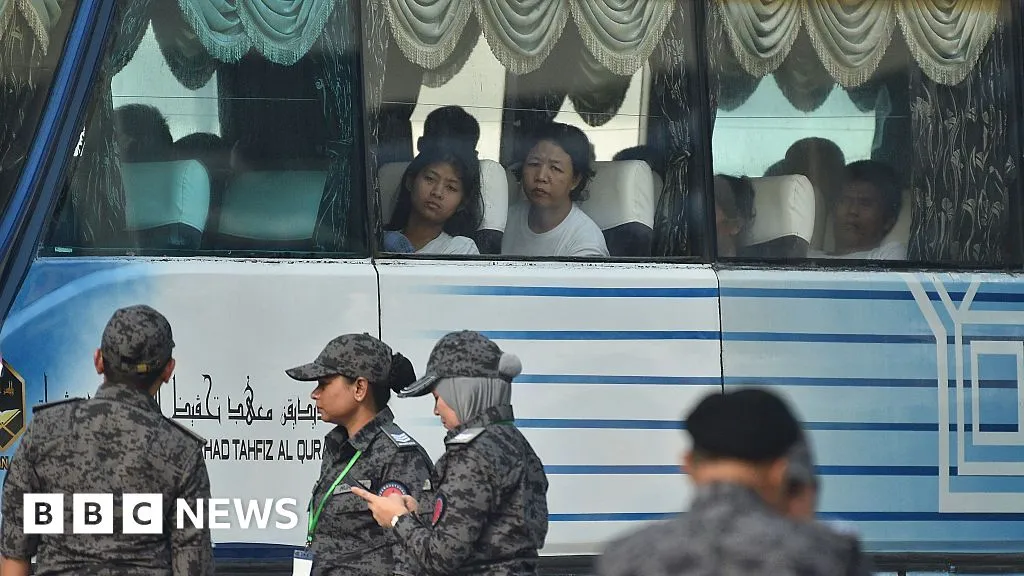
Getty ImagesThe repatriation represents a striking shift in Malaysia's attitude towards the refugeesThe Malaysian government has started repatriating around 5,000 asylum seekers from Myanmar, under a controversial deal agreed with Myanmar's military ruler Min Aung Hlaing.Three ships from the Myanmar navy are scheduled to leave Malaysia later today carrying the first 1,476 returnees.Human rights groups have condemned the repatriation, saying the returnees face violence, persecution and forced conscription into the Myanmar army.Malaysia has described the repatriation as voluntary, but has barred the UN refugee agency from seeing or screening the returnees, who have been kept in detention centres.According to Malaysian prime minister Anwar Ibrahim, these returnees will include Rohingyas: a persecuted Muslim minority who have sought sanctuary in Malaysia in large numbers after being driven out of Myanmar, where they are not recognised as citizens. Anwar, whose popularity has fallen sharply this year, says he is responding to growing public hostility towards the large Rohingya population in Malaysia and has no choice but to negotiate with the Myanmar government over their return.But the move signals a striking shift in attitude. Anwar, a former political prisoner, has previously presented himself as a defender of human rights and freedom, and called for more to be done to help the Rohingyas. Under him, Malaysia has refused to recognise Min Aung Hlaing's regime, and has been one of the strongest voices in South East Asia pushing for a negotiated end to Myanmar's civil war.What has changed?Two things. First, increased economic strain on lower-income Malaysians since the Covid pandemic, which has stirred resentment of the Rohingyas.Second, the febrile state of Malaysian politics since 2018, when a historic election unseated the United Malays National Organisation (UMNO), the ethnic Malay party which had monopolised power for more than 60 years, leading to a revolving door of unstable coalition governments.Shifting sentimentsFor many years there was strong public sympathy among Malaysians for their fellow Muslims in Myanmar. In August 2017, a brutal campaign by the Myanmar military drove three quarters of a million Rohingyas out of their homes in Rakhine State and into neighbouring Bangladesh. In the years since, dire conditions in Bangladeshi refugee camps have driven those with enough money to make the perilous sea journey to Malaysia in search of sanctuary and work. While the Malaysian navy and coastguard have long tried to block Rohingya boats from landing in Malaysia, many gotten in via other routes, and for a long time were tolerated. More than 200,000 are now believed to live there, most eking out basic livings from manual labour.Sentiment among Malaysians started to shift during the pandemic, which hit the country's economy hard. At a time of heightened public fear over the new coronavirus, accusations against Rohingya migrants spread on social media, with demands for their deportation. In response, the then-government hardened its attitude, saying Malaysia could accept no more refugees and ordering raids on communities believed to be harbouring illegal immigrants.Much the same has happened in 2026. In May, an online complaint claimed that Rohingyas had failed to dispose of animal waste properly after the Muslim Eid al Adha festival, igniting a viral social media campaign falsely accusing Rohingya leaders of demanding land and citizenship in Malaysia. Shortly thereafter, an online petition on Change.org calling for Rohingyas to be kicked out of Malaysia received more than 400,000 signatures, before being taken down.A PM under pressureGiven Anwar's one-time reputation as a champion of liberal values, he might have been expected to push back against this wave of hate and disinformation. He has said the Rohingyas should be treated humanely. "We can arrest them, but do not beat, intimidate or humiliate them," he said in a recent podcast interview - although this is exactly what human rights groups have accused Malaysian officials of doing in immigration detention centres. Nonetheless, Anwar insists that the Rohingya must be expelled. "They have clearly become a burden," he said in the same interview. "A security burden, an economic burden and a source of hostility among the people."Some of his former supporters have accused him of betraying his principles. The former head of the Malaysian Anti Corruption Commission, Latheefa Koya, says his decision is "disgraceful, amoral, and shames the nation in the eyes of the international community".Getty ImagesAnwar says Rohingya refugees have become a burden for MalaysiaAnwar, though, is under great political pressure. Once described as a perpetual prime minister-in-waiting, he finally got the top job in 2022, but only by forming an uneasy coalition with his one-time adversaries UMNO. Since then he has seen his own popularity plunge and his party lose seats in recent local elections. He must call a general election by early 2028."He is in a corner, at his weakest point", says Tricia Yeoh, Director of the Asian Institute for Policy and Engagement at the University of Nottingham Malaysia."He has been forced to make concessions to his UMNO partners... There have been several corruption scandals, and his own party is divided. And after four years of telling voters this is what is required to maintain his fragile coalition, they are no longer willing to go along with that narrative."Instead, Yeoh says, ethnic Malays, who make up more than half of the electorate, are responding to the well-trodden UMNO narrative that they need special support and protection from the state - the kind of racial politics which she says feeds fear and resentment of outsiders. "It's the same narrative you hear in the rest of the world, about immigrants taking jobs, that we should not be spending our public funds on facilities for them."Forced homeHowever, it is not clear how any Rohingyas can be repatriated to Myanmar, where they are not recognised as citizens.Rohingyas are not permitted to travel inside Myanmar, and are only allowed to live in Rakhine State, which borders Bangladesh. But nearly all of Rakhine State is now under the control of the insurgent Arakan Army, and subject to sustained bombardment by the Myanmar air force. On Monday, the day before the repatriation, the Arakan Army said two bombs killed 49 people at a market in the town of Kyauktaw.The only place Rohingyas could conceivably be returned to is the state capital Sittwe - but it is besieged and isolated, and even there Rohingyas are confined to wretched camps which are critically short of food and medicine. Rights groups also fear that any men in the group could be forcibly conscripted into the army to fight in the civil war. Neither Malaysia nor Myanmar have explained how these formidable obstacles can be overcome, nor how their planned repatriation can be consistent with humanitarian principles."We all dream of being able to return home one day," said Nur Sadek, a Rohingya refugee rights advocate, "but we want to return because it is safe and because we choose to — not because we are forced to. "For me, the most important thing is that Rohingya and other refugees affected by this decision are listened to and treated with dignity."
SRCBBC News - World
LANGEN
LEANCenter
WORDS1 160
ENT10
TUE · 2026-09-29 · 06:06 GMTBRIEF NSR-2026-0929-114909
NSR-2026-0929-114909News Report·EN·Human Rights
Malaysia begins controversial repatriation of asylum seekers to Myanmar
Malaysia has begun repatriating approximately 5,000 asylum seekers, including Rohingyas, to Myanmar under a deal with the country's military ruler. Human rights groups have condemned the move, warning that returnees face violence, persecution, and forced conscription, and have criticized Malaysia for barring the UN refugee agency from screening them.
4 hours agoShareSaveAdd as preferred on GoogleJonathan HeadSouth East Asia correspondentBBC News - WorldFiled 2026-09-29 · 06:06 GMTLean · CenterRead · 5 min
BBC News - WorldFIG 01
Reading time
5min
Word count
1 160words
Sources cited
3cited
Entities identified
10entities
Quality score
100%
§ 01
Briefing Summary
AI-generatedNEWSAR · AI
Malaysia has begun repatriating approximately 5,000 asylum seekers, including Rohingyas, to Myanmar under a deal with the country's military ruler. Human rights groups have condemned the move, warning that returnees face violence, persecution, and forced conscription, and have criticized Malaysia for barring the UN refugee agency from screening them. Prime Minister Anwar Ibrahim stated the repatriation is voluntary and driven by growing public hostility and the perceived burden of the Rohingya population on Malaysia's security and economy. This shift in policy contrasts with Anwar's past stance as a human rights advocate. The decision appears influenced by increased economic strain on Malaysians post-pandemic and the country's unstable political landscape, which has fueled resentment towards the Rohingya community.
Confidence 0.90Sources 3Claims 5Entities 10
§ 02
Article analysis
Model · rule-basedFraming
Human Rights
Political Strategy
Tone
Mixed Tone
AI-assessed
CalmNeutralAlarmist
Factuality
0.70 / 1.00
Factual
LowHigh
Sources cited
3
Well sourced
FewMany
§ 03
Key claims
5 extracted01
The move signifies a shift from Anwar Ibrahim's previous stance as a defender of human rights and supporter of Rohingya aid.
factual
Confidence
1.00
02
Anwar Ibrahim attributes the decision to growing public hostility towards the Rohingya population and economic strain.
factualAnwar Ibrahim
Confidence
1.00
03
Malaysia's Prime Minister Anwar Ibrahim states the repatriation is voluntary but barred the UN refugee agency from screening returnees.
factualAnwar Ibrahim
Confidence
1.00
04
Human rights groups condemn the repatriation, stating returnees face violence, persecution, and forced conscription.
factualhuman rights groups
Confidence
1.00
05
Malaysia has begun repatriating around 5,000 asylum seekers from Myanmar under a deal with the military ruler.
factual
Confidence
1.00
§ 04
Full report
5 min read · 1 160 words§ 05
Entities
10 identifiedKey playerOppositionContextPositiveNeutralNegative
Organizations2
Locations4
Topics1
§ 06
Keywords & salience
10 termsrohingyas
1.00
asylum seekers repatriation
1.00
myanmar military
0.90
human rights
0.80
malaysia
0.70
myanmar
0.70
un refugee agency
0.60
public hostility
0.50
economic strain
0.40
political instability
0.40
§ 07
Topic connections
Interactive graph Network visualization showing 51 related topics
View Full Graph Person Organization Location Event|Click node to navigate|Edge numbers = shared articles