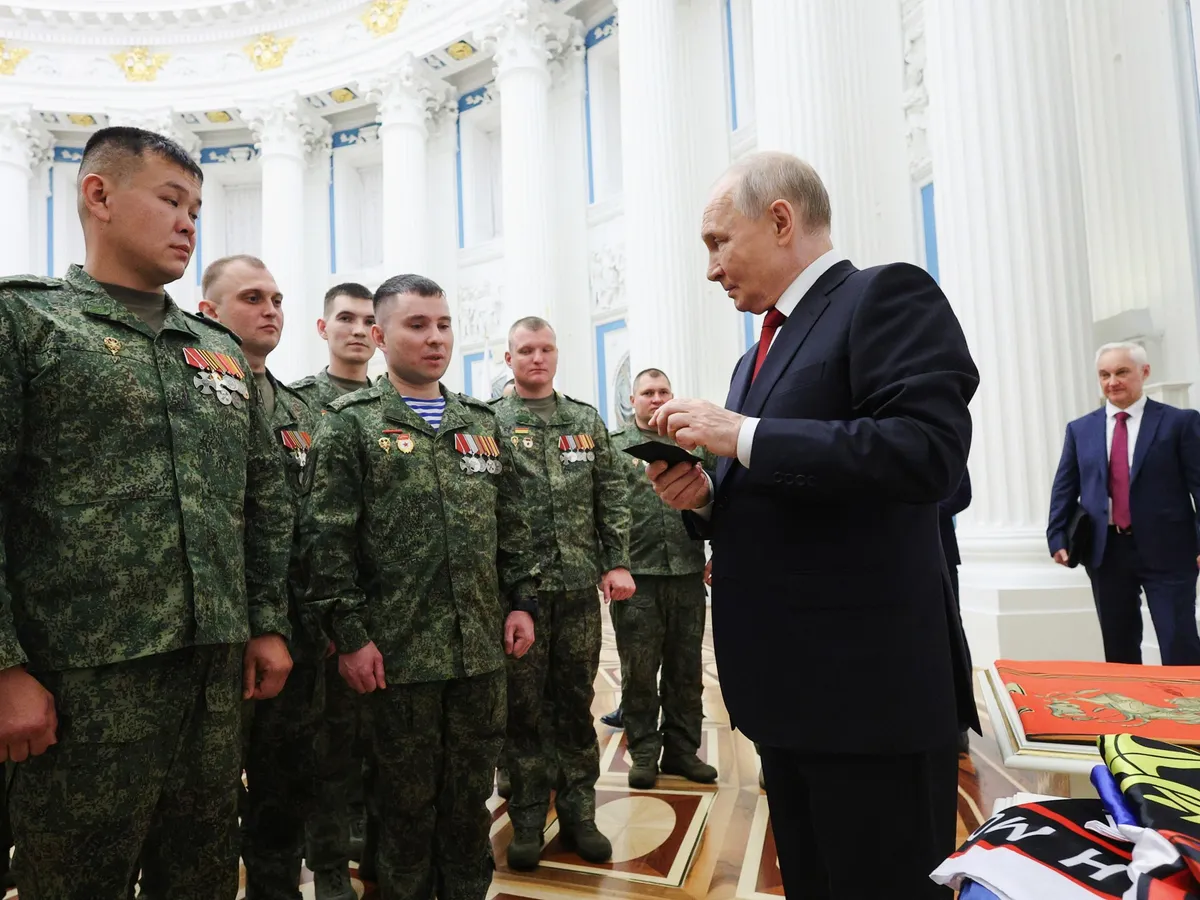
EXPLAINERThe move marks the fourth military expansion this year as Russia war in Ukraine seemingly stalls.Russian President Vladimir Putin, foreground right, speaks with members of the military in the Kremlin in Moscow [File: Vyacheslav Prokofyev/Sputnik/Kremlin Pool Photo via AP Photo]Published On 29 Sep 2026Russian President Vladimir Putin has ordered another military expansion, adding 15,500 military personnel as Moscow’s battlefield advances in Ukraine have stalled after more than four and a half years of fighting.Putin signed the decree on Sunday, marking the fourth time this year the president has increased the authorised size of the Russian military. Together, the orders have added 47,860 military personnel since March.Recommended Stories list of 3 itemslist 1 of 3US seeks to revive Russia-Ukraine-ceasefire-talks" class="entity-link entity-event" data-entity-id="211242" data-entity-type="event">Russia-Ukraine ceasefire talks as seven killed in Kyivlist 2 of 3Lavrov: Russia’s war in Ukraine will continue ‘through to the end’list 3 of 3At least 10 people killed in Russian and Ukrainian attacksend of listThis comes as both sides have increasingly been relying on drones and long-range strikes against each other.Ukraine, meanwhile, has repeatedly accused Moscow of preparing another mobilisation – something Putin has dismissed as Ukrainian “disinformation”.So why has Putin issued this decree, and where is the conflict headed?What does the decree say?“The authorised personnel strength of the Russian armed forces is to be set at 2,441,630 units, including 1,550,500 military personnel,” the decree said.It did not elaborate on why the additional troops were needed or how they would be recruited. Putin had already issued orders expanding the military in March, June and July.Andrei Kortunov, director general of the Russian International Affairs Council, dubbed the expansion technical.“This is mostly a technical decision rather than a strategic shift. It is technical in the sense that another 15,000 will not change the conflict dynamics,” he told Al Jazeera.“As for a diplomatic solution, we are still far away from it.”Why has Putin decided to increase the size of the army?The Kremlin has not publicly given a reason, but the order comes as Russia faces mounting human and material losses together with limited territorial gains.Ukraine expert Olena Halushka says Russia’s war effort is not going according to plan.“Last year, at the Anchorage summit [in the US state of Alaska], Putin continued to demand that Ukraine withdraw from the rest of the Donetsk region that Russia had failed to capture, likely claiming that Ukraine would soon lose those lands anyway. Yet a year afterwards, the situation on the battlefield today shows absolutely the opposite,” Halushka, a board member at the Anti-Corruption Action Centre in Kyiv, told Al Jazeera.“Putin’s latest decree is … likely not the last, and should be viewed in the context of Russia’s continuing efforts to expand the manpower available for a protracted war,” she added.Russia’s advances have slowed sharply this year, with the widespread use of drones making large concentrations and rapid movements of troops increasingly dangerous.Ukraine’s military said earlier this month that Russian losses in 2026 had surpassed 300,000, and estimated that Moscow suffered more than 20,000 casualties in the first half of September alone. Al Jazeera could not independently verify those figures.The latest decrees also come as Ukraine repeatedly claims Moscow is looking outside Russia to bolster its forces and is preparing another mobilisation, a claim Russia denies.Ukrainian President Volodymyr Zelenskyy on Monday said that more than 8,000 North Korean soldiers were currently in Russia and preparations were under way to deploy another 10,000. North Korea has already sent an estimated 14,000 to 15,000 soldiers to support Russia since 2024, according to Ukrainian and South Korean estimates.Putin last ordered a mobilisation of reservists in September 2022 after Russia suffered a series of battlefield setbacks.Nevertheless, Russia expert Alexey D Muraviev said this latest increase was unlikely to be linked to Ukraine.“Putting things into place would require some time in terms of planning, in terms of recruitment, in terms of formation of new units, and that’s not going to address Russia’s immediate operational needs at the theatre of war,” Muraviev, professor and senior research fellow in Defence and Strategic Studies at Edith Cowan University, told Al Jazeera.In his view, Putin’s decision to increase the military has more to do with “longer-term strategic considerations” such as Moscow’s tensions with NATO, and the “increased possibility of a major open conflict between Russia and NATO in the foreseeable future”.“This also drives Russia’s continuous reorganisation of its military, the expansion of its standing force, and the formation of new units, including army divisions and marine divisions.“We should also be mindful that the Russians are concerned about the buildup of Japan’s military power, as well as US military power in the Pacific, and subsequently the need to respond to those security concerns.”What is the latest in the war?Russia and Ukraine continue to exchange major aerial attacks even as the ground war moves slowly.At least 10 people were killed and more than 80 wounded in Russian attacks across the country on Monday.Russian drones struck the National Academy of Sciences in central Kyiv, while attacks were also reported in Dnipro, Kharkiv, Zaporizhia and other parts of Ukraine.Russian forces have also increased their attacks on the Ukrainian capital, Kyiv, forcing a top university – Taras Shevchenko National University – to switch to remote classes.Firefighters work to put out a fire at the private medical centre following a Russian drone attack on Kyiv on September 28, 2026 [Serhii Okunev/AFP]Shevchenko University said it would “switch to a remote format of work” until at least October 16, “due to the deteriorating security situation in Kyiv”.Meanwhile, Ukraine, on the eastern front, has reportedly been making gains in northern Donetsk. According to the Reuters news agency, a senior Ukrainian commander said Kyiv’s forces had recaptured 51 square kilometres (19.7sq miles) in a recent operation, taking the total recovered during that operation to 176sq km (68sq miles).Donetsk remains one of the central battlegrounds – and a major sticking point in negotiations – with Ukraine still controlling about 20 percent of the region.Russia annexed four occupied Ukrainian regions, including Donetsk and Luhansk, in 2022. The move has not been recognised by the international community, including the UN.(Al Jazeera)What is the latest on the diplomatic front?While diplomatic efforts have resumed, there has been no breakthrough.Russia wants Ukraine to cede the eastern region annexed by it and wants Kyiv to renounce its NATO ambitions. But Ukraine has ruled out territorial concessions, and has urged its European allies to provide a security guarantee in case of a deal.Earlier this month, US envoys Steve Witkoff and Jared Kushner travelled to Moscow and Kyiv, meeting Putin and Zelenskyy as Washington sought to restart negotiations. Zelenskyy later said the envoys had presented “decent ideas”, although fundamental disagreements remained, particularly over territory.According to Zelenskyy, Washington is now seeking technical-level trilateral talks involving Russia, Ukraine and the US, with the United Arab Emirates floated as a possible venue.Putin said last week that proposals to resume negotiations remained “on the table”, while saying his country still needed to assess what was in its best interest.Ukraine expert Halushka said a diplomatic solution was not possible as long as Moscow concludes that “continuing the war will cost it less than ending it”.“Russia’s actions suggest that the Kremlin still believes it can improve its position through military force, terrorism against Ukrainian civilians and breaking Western support for Ukraine,” she noted.
SRCAl Jazeera
LANGEN
LEANCenter
WORDS1 209
ENT12
TUE · 2026-09-29 · 14:46 GMTBRIEF NSR-2026-0929-115034
NSR-2026-0929-115034Analysis·EN·Conflict
Why has Putin added 15,000 new soldiers to Russia’s army?
Russian President Vladimir Putin has ordered a fourth military expansion this year, adding 15,500 personnel to the armed forces, bringing the total authorized strength to over 2.4 million. This move comes as Russia's battlefield advances in Ukraine have stalled after more than four and a half years of fighting.
Usaid SiddiquiAl JazeeraFiled 2026-09-29 · 14:46 GMTLean · CenterRead · 5 min
Al JazeeraFIG 01
Reading time
5min
Word count
1 209words
Sources cited
2cited
Entities identified
12entities
Quality score
100%
§ 01
Briefing Summary
AI-generatedNEWSAR · AI
Russian President Vladimir Putin has ordered a fourth military expansion this year, adding 15,500 personnel to the armed forces, bringing the total authorized strength to over 2.4 million. This move comes as Russia's battlefield advances in Ukraine have stalled after more than four and a half years of fighting. While the Kremlin has not provided a specific reason, experts suggest it may be a technical adjustment for a protracted war, or linked to longer-term strategic considerations such as tensions with NATO and concerns about Japan's military buildup. Ukraine has repeatedly accused Moscow of preparing another mobilization, which Russia denies. This latest increase follows previous expansions in March, June, and July, adding a total of 47,860 personnel since March.
Confidence 0.90Sources 2Claims 5Entities 12
§ 02
Article analysis
Model · rule-basedFraming
Conflict
Political Strategy
Tone
Measured
AI-assessed
CalmNeutralAlarmist
Factuality
0.60 / 1.00
Mixed
LowHigh
Sources cited
2
Limited
FewMany
§ 03
Key claims
5 extracted01
Putin's latest decree should be viewed in the context of Russia’s continuing efforts to expand manpower for a protracted war.
quoteOlena Halushka
Confidence
1.00
02
Russia's war effort is not going according to plan, with slowed advances and limited territorial gains.
quoteOlena Halushka
Confidence
1.00
03
The expansion is a technical decision that will not change the conflict dynamics in Ukraine.
quoteAndrei Kortunov
Confidence
1.00
04
This is the fourth military expansion ordered by Putin this year, adding a total of 47,860 personnel since March.
factual
Confidence
1.00
05
Russian President Vladimir Putin has ordered the addition of 15,500 military personnel to Russia's armed forces.
factual
Confidence
1.00
§ 04
Full report
5 min read · 1 209 words§ 05
Entities
12 identifiedKey playerOppositionContextPositiveNeutralNegative
People3
Organizations2
Locations6
§ 06
Keywords & salience
10 termswar in ukraine
1.00
russian military expansion
1.00
vladimir putin
0.90
military personnel increase
0.80
stalled battlefield advances
0.70
drones and long-range strikes
0.60
limited territorial gains
0.50
human and material losses
0.50
technical decision
0.40
diplomatic solution
0.40
§ 07
Topic connections
Interactive graph Network visualization showing 51 related topics
View Full Graph Person Organization Location Event|Click node to navigate|Edge numbers = shared articles