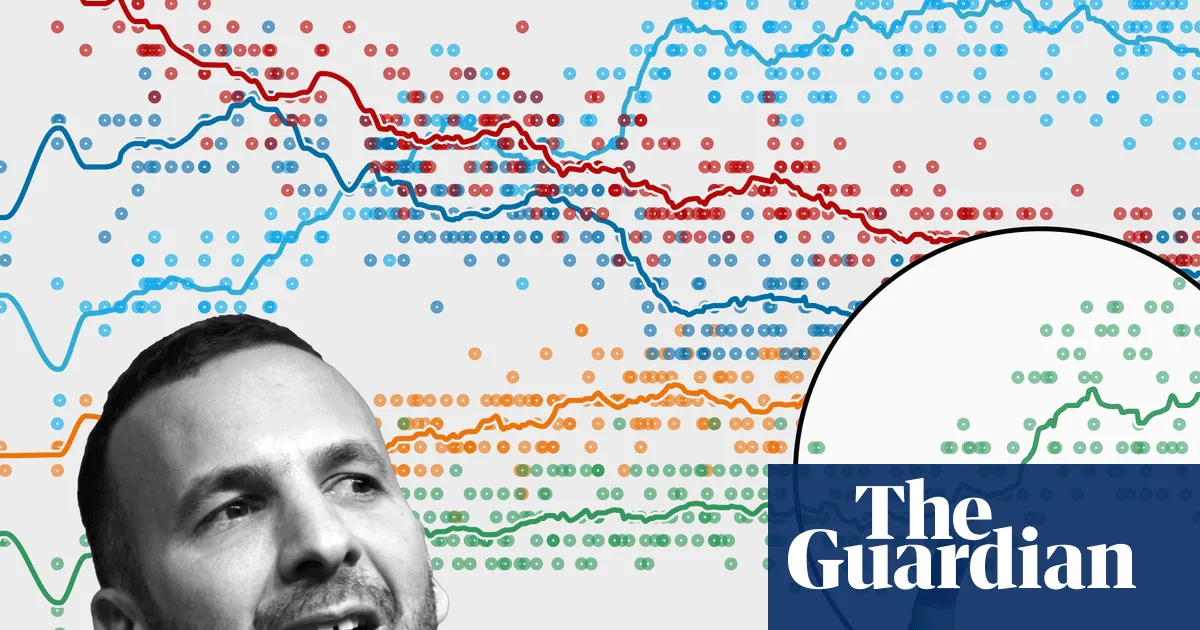
The Greens talk of a “Polanski effect” – a surge of momentum and visibility since Zack Polanski became leader, as the party gains attention in an increasingly fragmented political landscape.The polls offer the clearest signal so far of whether that narrative is borne out in public support. But they are not the only thing to consider and experts say the reality is hard to be certain about.Since Polanski was elected in September 2025, the Greens have risen by an average of four points in the polls.The Guardian’s latest poll tracker – which combines polls over the last 10 days – has the party polling at 13.5%. This is five points behind Labour, on 18.6%.Line chart of Westminster poll averagesThe chart above shows that the average position of the Greens has increased since Polanski took over the leadership, but experts have pointed out that there is disparity in the level of support the Greens receive across polls.January polling from YouGov and Find Out Now had the Greens on 17%, significantly more than Focaldata (10%), More in Common (11%) and Survation (11%).This may be down to what exactly polling companies are asking voters – some pollsters do not include the Greens as an option in their surveys, which would lead to lower vote shares than if respondents had been prompted.Or it could be down to bigger modelling assumptions. Polling companies disagree on the number of 2024 Labour supporters currently backing the Greens, for example.Who is switching to the Greens?If we look at YouGov figures, its polling estimates that currently, 20% of Labour voters would vote Green. This has increased from 11% in similar polling when Polanski took over the leadership.Prof Sir John Curtice, of the University of Strathclyde, said: “The polls disagree by how much, but the Greens have added to Labour’s woes. Already there was the case that Labour’s vote was scattering in all directions, and now that’s even become clearer in a post-Polanski world.”Bar chart showing how one in five 2024 Labour voters currently say they would vote GreenAge is the biggest factor in Green support. Not only are 18- to 24-year-olds the most likely to say they will vote Green, but they are also the group who have swung the most to the Greens in the last couple of months.Polling from YouGov reveals that 26% of 18- to 24-year-olds said they would vote for the Greens in early September last year, but this number had increased to 45% as of 18-19 January.Chart showing how the Greens have gained the most support among young peopleCurtice added that the Greens’ appeal to this demographic group could hurt Labour hard, especially in May’s local elections in London. “The Labour vote is young middle-class professionals, who are mostly in London. This is precisely the group that the Greens appeal to.”What are the key issues for Green voters?The cost of living is the top concern for all Green party supporters.However, the economy and Brexit are more important to new Green voters than to existing supporters, while Gaza is less important to them. YouGov data from December shows 30% of new Green voters (non-2024 voters) prioritise the economy, compared with just 18% of existing supporters.New Green supporters also place less importance on climate change (7% listed it as their most important issue) than existing supporters (12%).Chart showing how the economy and the NHS are more important issues for Green voters who have switched since the electionAdam McDonnell, the head of UK political and academic research at YouGov, said: “There isn’t much difference between those who already voted Green at the last election and those they’ve gained since, with both groups highlighting the cost of living, the NHS and the environment as top concerns.“Those who didn’t vote Green in 2024 but now intend to place a higher weight on the economy in general. In terms of positioning, that implies the Greens may want to look at economic messages which resonate with the voters they are winning over, who we know from other work tend to be young, highly educated and relatively affluent.”An Ipsos polling analyst said that Green supporters were in line with Lib Dem and Labour supporters on defence and the NHS, but they are more likely to be concerned about inequality and have relaxed views on immigration. They also commented on the anti-establishment strain among Green supporters, with them more likely to be distrustful of authority figures and think there are problems with the wider system.How are Polanski’s personal ratings?Curtice said that with Polanski and Farage on the national stage, “you now have charismatic leaders at both ends of the spectrum. Both of them have a clear vision. And that creates a contrast between that and the conventional political leaders.”Polling from Ipsos suggests Polanski’s current net favourability rating is -15 points. As of 19 January, 20% of people had a favourable view of him, compared with 35% who had an unfavourable view of him.This net favourability rating is better than all national political leaders with the exception of the Lib Dem leader, Ed Davey. However, a lot of this is down to the fact that 45% of the public still have not made up their minds about Polanski, or simply do not know who he is yet.A greater proportion of people are favourable of the Tory leader, Kemi Badenoch, Davey and Reform UK’s Nigel Farage.Chart showing how despite his net favourability rating being better than most leaders, lots of people still don’t know who Polanski isJoe Twyman, the founder and director of the public opinion consultancy Deltapoll, said the Greens’ positioning as an anti-establishment party, alongside Reform, was critical in a political world where incumbent parties were struggling. “There is a desire for a new political movement because the ‘old guard’ have been seen to have failed. You have options for nationalist parties, but if you want proper challengers on a national level, it’s either Reform or Green – and it’s the Greens if you’re more socially liberal.”Twyman added that there was a lot of uncertainty on where the Greens would end up in a political volatile period: “If you have five- or six-way races, and any party could take it as they’re within five or 10 points of each other, that brings tactical voting to the fore.“The key question is how those parties – Reform and the Greens – will be able to convert good polling numbers into actual voters come the next general election. Up until now previous general elections strategies have been based on specific constituencies, but if you have wider ambitions you have to broaden to a national campaign. That means asking questions on how you get a party machine with boots on the ground, knocking on doors, how you mature into a national party. We don’t have an answer to those questions yet.”What could this mean for an election?In its latest MRP polling, More in Common estimated that there were 16 seats where the Greens were likely to get over 30% of the vote.The polling technique, known as multi-level regression and post-stratification (MRP) modelling, is designed to help reveal an increasingly chaotic political map by giving estimated results for every individual seat. It estimated that the party would win nine seats in total: mostly urban seats, although holding onto their two rural constituencies that they won in 2024.At the time the poll was published, More in Common said: “Four projected gains come directly from Labour collapse in progressive-leaning urban areas such as Bristol, Manchester, and Sheffield, suggesting the Greens are managing to position themselves as the progressive alternative.”Table of Modelled constituency results based on January polling.This MRP also reveals the potential for tactical voting.There are 179 seats where the combined Lib Dem, Green and Labour vote share is greater than the combined Conservative and Reform vote share. Forty of these are forecast to be won by either Reform or the Conservatives – and in eight of these the Greens are the biggest of the three progressive national parties.Looking ahead at the local elections in May, Green gains in London would be seen as a strong signal that the party is flipping the kind of progressive voter they would need to switch allegiance in a general election. They have also announced a major push for the Gorton and Denton byelection.
SRCThe Guardian - World News
LANGEN
LEANCenter-Left
WORDS1 380
ENT8
THU · 2026-01-29 · 07:37 GMTBRIEF NSR-2026-0129-11525
NSR-2026-0129-11525News Report·EN·Political Strategy
The Polanski effect? These charts reveal how much the Greens have advanced
Since Zack Polanski became leader in September 2025, the Green Party has seen a rise in public support, averaging a four-point increase in polls. The Guardian's poll tracker shows the Greens at 13.5%, five points behind Labour.
Ashley KirkThe Guardian - World NewsFiled 2026-01-29 · 07:37 GMTLean · Center-LeftRead · 6 min
The Guardian - World NewsFIG 01
Reading time
6min
Word count
1 380words
Sources cited
1cited
Entities identified
8entities
Quality score
100%
§ 01
Briefing Summary
AI-generatedNEWSAR · AI
Since Zack Polanski became leader in September 2025, the Green Party has seen a rise in public support, averaging a four-point increase in polls. The Guardian's poll tracker shows the Greens at 13.5%, five points behind Labour. While polls indicate a "Polanski effect," experts note disparities in support levels across different polling companies, potentially due to varying survey methodologies. YouGov figures suggest that 20% of 2024 Labour voters would now vote Green, up from 11% previously. The shift is particularly pronounced among 18- to 24-year-olds, with support increasing from 26% to 45% in recent months. This surge in Green support is contributing to Labour's challenges, as their vote scatters in multiple directions.
Confidence 0.90Sources 1Claims 5Entities 8
§ 02
Article analysis
Model · rule-basedFraming
Political Strategy
Economic Impact
Tone
Measured
AI-assessed
CalmNeutralAlarmist
Factuality
0.70 / 1.00
Factual
LowHigh
Sources cited
1
Limited
FewMany
§ 03
Key claims
5 extracted01
The Guardian’s latest poll tracker has the party polling at 13.5%.
statisticnull
Confidence
1.00
02
45% of 18- to 24-year-olds said they would vote for the Greens as of 18-19 January.
statisticYouGov
Confidence
0.90
03
Since Polanski was elected in September 2025, the Greens have risen by an average of four points in the polls.
statisticnull
Confidence
0.90
04
20% of Labour voters would vote Green.
statisticYouGov figures
Confidence
0.80
05
The polls disagree by how much, but the Greens have added to Labour’s woes.
quoteProf Sir John Curtice
Confidence
0.70
§ 04
Full report
6 min read · 1 380 words§ 05
Entities
8 identifiedKey playerOppositionContextPositiveNeutralNegative
§ 06
Keywords & salience
9 termsgreens
1.00
polling
0.90
zack polanski
0.80
voter support
0.70
political landscape
0.60
labour voters
0.60
age demographics
0.50
poll tracker
0.50
election
0.40
§ 07
Topic connections
Interactive graph Network visualization showing 40 related topics
View Full Graph Person Organization Location Event|Click node to navigate|Edge numbers = shared articles