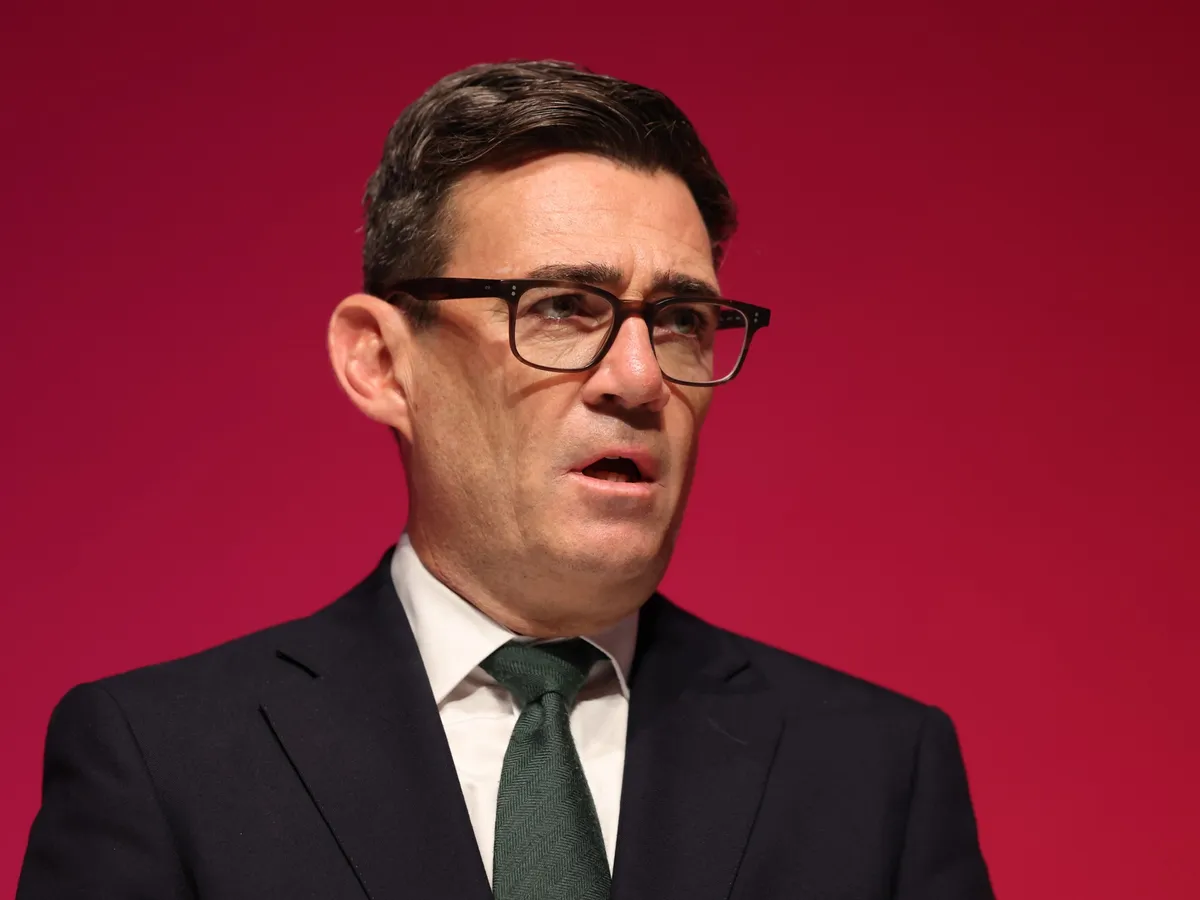
British opinion polls suggest the Labour Party steadily gaining favour as Reform UK dips.British Prime Minister Andy Burnham on the final day of the Labour Party Conference in Liverpool, Britain, on September 30 [Adam Vaughan/EPA]Published On 30 Sep 2026Just more than two months into office, Andy Burnham was roundly praised for his first speech as prime minister at the Labour conference in Liverpool.The Financial Times described his vision as “courageous”; the broadcaster Piers Morgan said the speech was “one of the best, and most powerfully delivered, by a British politician in a very long time”, and journalist Andrew Marr said he remembered seeing Tony Blair speak, but “Andy Burnham might be better”.Recommended Stories list of 3 itemslist 1 of 3Pro-Palestine Action group to rally at Labour conference led by Burnhamlist 2 of 3‘Stop arming Israel’: Pro-Palestine protesters march on Labour conferencelist 3 of 3Palestine Action protesters arrested outside UK Labour Party conferenceend of listThe new premier’s pitch focused on his plans for social welfare. And in recent months, the Labour Party has been enjoying what has been dubbed a “Burnham bounce”.Some polling still reflects that bounce, especially in the race against the right-wing Reform UK party.The Survation polling platform on Wednesday predicted Westminster’s voting intention for the Labour Party had risen two percentage points to 29 percent, while Reform UK fell one point to 23 percent.“Very little” of Labour’s recovery is because of large numbers of Reform voters moving towards Labour, said Tim Bale, politics professor at Queen Mary University of London.He told Al Jazeera left-wing and liberal voters are likely more supportive of Burnham’s direction.While Burnham’s ability to move polling numbers is “significant”, the bounce is not “necessarily long-lasting”.“The budget is going to be tough, the cost of living is still rising, and there is a long way to go before [an] election. Leaders matter, but so too does the government’s ability to restore prosperity and a sense that key public services are improving,” he said.Since the Labour Party won the 2024 general election, it has been in constant competition with Reform UK, led by the telegenic Nigel Farage.A YouGov poll last week found that if an election were called tomorrow, Labour would win the most seats but would face a hung parliament, with 241 seats. In contrast, the Conservatives would secure 130 and Reform UK 123.But in reality, “voters will gather around the candidate best placed to beat Reform”, predicted Patrick Diamond, professor of public policy at Queen Mary University of London.He argued that Farage’s party is losing appeal due to recent financial scandals while Burnham is “regaining ground on the left from the Greens”.Britain’s Prime Minister Andy Burnham is pictured on the final day of the annual Labour Party conference in Liverpool, northwest England [AFP]Burnham bounceA YouGov poll published on Tuesday showed Reform UK slightly ahead of Labour, a sign of how fragile the Burnham bounce is.At least 25 percent would vote for Reform UK, while 24 percent would choose Labour and 19 percent would choose the Conservatives, YouGov polling suggested. Only 12 percent would vote for the Liberal Democrats, 11 percent for the Greens, and 3 percent for the far-right Restore Britain party.Reform UK’s deputy leader, Richard Tice, celebrated the survey, posting on X: “Burnham bounces down.”During the 2024 general election, Labour won 412 seats out of 650, ending 14 years of Conservative rule.However, Prime Minister Keir Starmer proved to be an unpopular leader while Reform UK gained more interest.In July, Starmer resigned.“Once Starmer left, Labour’s position recovered, but Burnham has boosted that further,” said Diamond. “The Labour brand remains reasonably popular – recent difficulties were more related to the unpopularity of Keir Starmer as PM and public antipathy to his government.”Starmer was criticised over a range of issues from his position on Israel-Palestine and his policy U-turns to his lack of leadership qualities.As Starmer’s popularity dropped, Farage took support from the Conservatives and, for the first time in Reform’s relatively brief political life, had polls predicting it could win an election.A year ago, a More in Common poll of nearly 20,000 Britons showed how Reform could secure a 96-seat majority in parliament, taking 373 seats. In the May 2025 local elections, Reform outperformed expectations, winning 677 of the 1,637 seats up for grabs, or 41 percent of all seats available.But in July, a More in Common poll found Reform UK’s chances of success had shrunk, with the party projected to win 293 seats.Burnham’s promisesBurnham on Tuesday promised to “break with the direction of the past 40 years and put Britain on a new path”.He said he would overturn former Conservative Prime Minister Margaret Thatcher’s 1980s reforms and give the public more control over housing, water and energy.While potentially popular with some Labour supporters, Diamond said that Burnham needs to address people in the centre.“Centrist voters who are broadly from the middle class are ones to watch. They often live in marginal seats,” he said.“They like some Labour policies on public services and support measures to boost economic growth, including by moving closer to Europe. But they are also very sensitive about the issue of tax, believing they already pay enough and want the government to be more efficient. That is a big test for the Burnham administration,” he added.
SRCAl Jazeera
LANGEN
LEANCenter
WORDS874
ENT12
WED · 2026-09-30 · 17:34 GMTBRIEF NSR-2026-0930-115378
NSR-2026-0930-115378Analysis·EN·Political Strategy
The Burnham bounce: Is Labour gaining ground against Farage’s Reform?
British opinion polls indicate the Labour Party is gaining favor, with a phenomenon dubbed the "Burnham bounce" following Prime Minister Andy Burnham's early tenure. This surge appears to be at the expense of Reform UK, which has seen a dip in support.
Edna MohamedAl JazeeraFiled 2026-09-30 · 17:34 GMTLean · CenterRead · 4 min
Al JazeeraFIG 01
Reading time
4min
Word count
874words
Sources cited
3cited
Entities identified
12entities
Quality score
100%
§ 01
Briefing Summary
AI-generatedNEWSAR · AI
British opinion polls indicate the Labour Party is gaining favor, with a phenomenon dubbed the "Burnham bounce" following Prime Minister Andy Burnham's early tenure. This surge appears to be at the expense of Reform UK, which has seen a dip in support. While some polls show Labour ahead of Reform UK, others suggest Reform UK is still slightly leading, highlighting the fragility of Labour's gains. Experts suggest Labour's recovery is more due to left-wing and liberal voters aligning with Burnham's direction than a significant shift from Reform voters. Reform UK's appeal may be declining due to financial scandals, while Burnham is reportedly regaining ground on the left. The article notes that Labour's overall position improved after Keir Starmer's resignation as Prime Minister, with Burnham further boosting support.
Confidence 0.90Sources 3Claims 5Entities 12
§ 02
Article analysis
Model · rule-basedFraming
Political Strategy
Human Interest
Tone
Measured
AI-assessed
CalmNeutralAlarmist
Factuality
0.60 / 1.00
Mixed
LowHigh
Sources cited
3
Well sourced
FewMany
§ 03
Key claims
5 extracted01
A YouGov poll found that if an election were called tomorrow, Labour would win the most seats but face a hung parliament, with 241 seats.
statisticYouGov
Confidence
0.90
02
The Survation polling platform predicted Labour Party voting intention had risen two percentage points to 29 percent, while Reform UK fell one point to 23 percent.
statisticSurvation
Confidence
0.90
03
Burnham's ability to move polling numbers is significant, but the bounce is not necessarily long-lasting.
factualTim Bale
Confidence
0.80
04
British opinion polls suggest the Labour Party is steadily gaining favour as Reform UK dips.
factual
Confidence
0.80
05
Reform UK is losing appeal due to recent financial scandals.
factualPatrick Diamond
Confidence
0.70
§ 04
Full report
4 min read · 874 words§ 05
Entities
12 identifiedKey playerOppositionContextPositiveNeutralNegative
People5
Organizations5
§ 06
Keywords & salience
10 termsreform uk
1.00
labour party
1.00
andy burnham
0.90
opinion polls
0.80
political strategy
0.70
voting intention
0.60
social welfare
0.50
election
0.40
cost of living
0.40
public services
0.40
§ 07
Topic connections
Interactive graph Network visualization showing 51 related topics
View Full Graph Person Organization Location Event|Click node to navigate|Edge numbers = shared articles