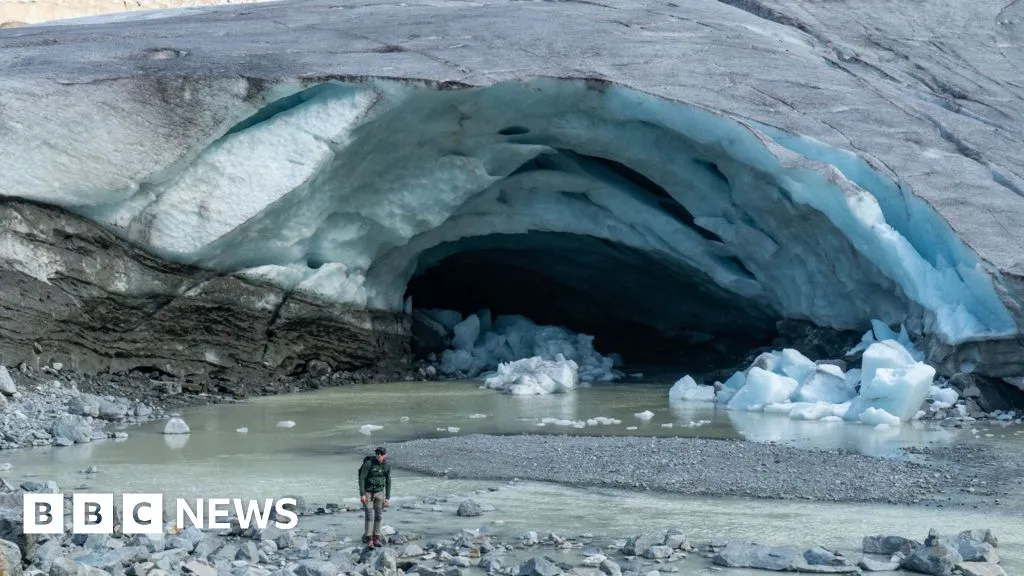
One of the most ominous findings is what researchers observed at measurement sites at the highest elevations, where temperatures are lowest and glaciers are typically snow-covered.Even as high as 3,500 metres above sea level, scientists found no snow remaining at the end of summer."At some glaciers we've seen four metres of ice loss at the highest point, where they should be covered by several metres of winter snow at this time of the year," said Huss, from Switzerland" class="entity-link entity-organization" data-entity-id="211960" data-entity-type="organization">Glacier Monitoring Switzerland.snow is like glacier food - and under stable conditions some of it would eventually compact into ice.But if no snow survives the summer, it cannot replace the ice lost to melting at lower, warmer elevations. The glacier will starve, shrink and eventually disappear."glaciers are complex because they gain mass at the top and they flow downstream, so there is a lot of physics," explained Maussion."But in its simplest form, what we see right now is that we took an ice cube out of the fridge and it's just melting in front of our eyes."
SRCBBC News - World
LANGEN
LEANCenter
WORDS174
ENT10
THU · 2026-10-01 · 00:08 GMTBRIEF NSR-2026-1001-115419
NSR-2026-1001-115419News Report·EN·Environmental
Swiss glaciers suffer 'disastrous' year of ice loss, threatening water supplies
Swiss glaciers experienced a "disastrous" year of ice loss, according to scientists. Researchers observed that even at elevations of 3,500 meters, where temperatures are lowest and glaciers are typically snow-covered, no snow remained at the end of summer.
2 hours agoShareSaveAdd as preferred on GoogleMark PoyntingClimate reporterBBC News - WorldFiled 2026-10-01 · 00:08 GMTLean · CenterRead · 1 min
BBC News - WorldFIG 01
Reading time
1min
Word count
174words
Sources cited
2cited
Entities identified
10entities
Quality score
100%
§ 01
Briefing Summary
AI-generatedNEWSAR · AI
Swiss glaciers experienced a "disastrous" year of ice loss, according to scientists. Researchers observed that even at elevations of 3,500 meters, where temperatures are lowest and glaciers are typically snow-covered, no snow remained at the end of summer. Some glaciers lost up to four meters of ice at their highest points, which should have been covered by winter snow. This lack of snow, crucial for replenishing ice lost to melting at lower elevations, means glaciers are shrinking and will eventually disappear. Scientists attribute this rapid melting to the pace of climate change, comparing the situation to an ice cube melting outside a refrigerator.
Confidence 0.90Sources 2Claims 5Entities 10
§ 02
Article analysis
Model · rule-basedFraming
Environmental
Human Interest
Tone
Mixed Tone
AI-assessed
CalmNeutralAlarmist
Factuality
0.80 / 1.00
Factual
LowHigh
Sources cited
2
Limited
FewMany
§ 03
Key claims
5 extracted01
Glaciers are like ice cubes melting in front of our eyes.
quoteMaussion
Confidence
1.00
02
Some glaciers saw four meters of ice loss at their highest points.
statisticHuss, Glacier Monitoring Switzerland
Confidence
0.95
03
No snow remained at measurement sites as high as 3,500 meters above sea level at the end of summer.
factualscientists
Confidence
0.95
04
Swiss glaciers experienced a 'disastrous' year of ice loss.
factualarticle
Confidence
0.90
05
If no snow survives the summer, glaciers will starve, shrink, and eventually disappear.
predictionarticle
Confidence
0.85
§ 04
Full report
1 min read · 174 words§ 05
Entities
10 identifiedKey playerOppositionContextPositiveNeutralNegative
Organizations1
Locations1
§ 06
Keywords & salience
8 termsglacier melt
1.00
ice loss
1.00
water supplies
0.90
climate change
0.80
snow cover
0.70
glacier monitoring
0.60
shrinking glaciers
0.50
high elevations
0.40
§ 07
Topic connections
Interactive graph Network visualization showing 4 related topics
View Full Graph Person Organization Location Event|Click node to navigate|Edge numbers = shared articles