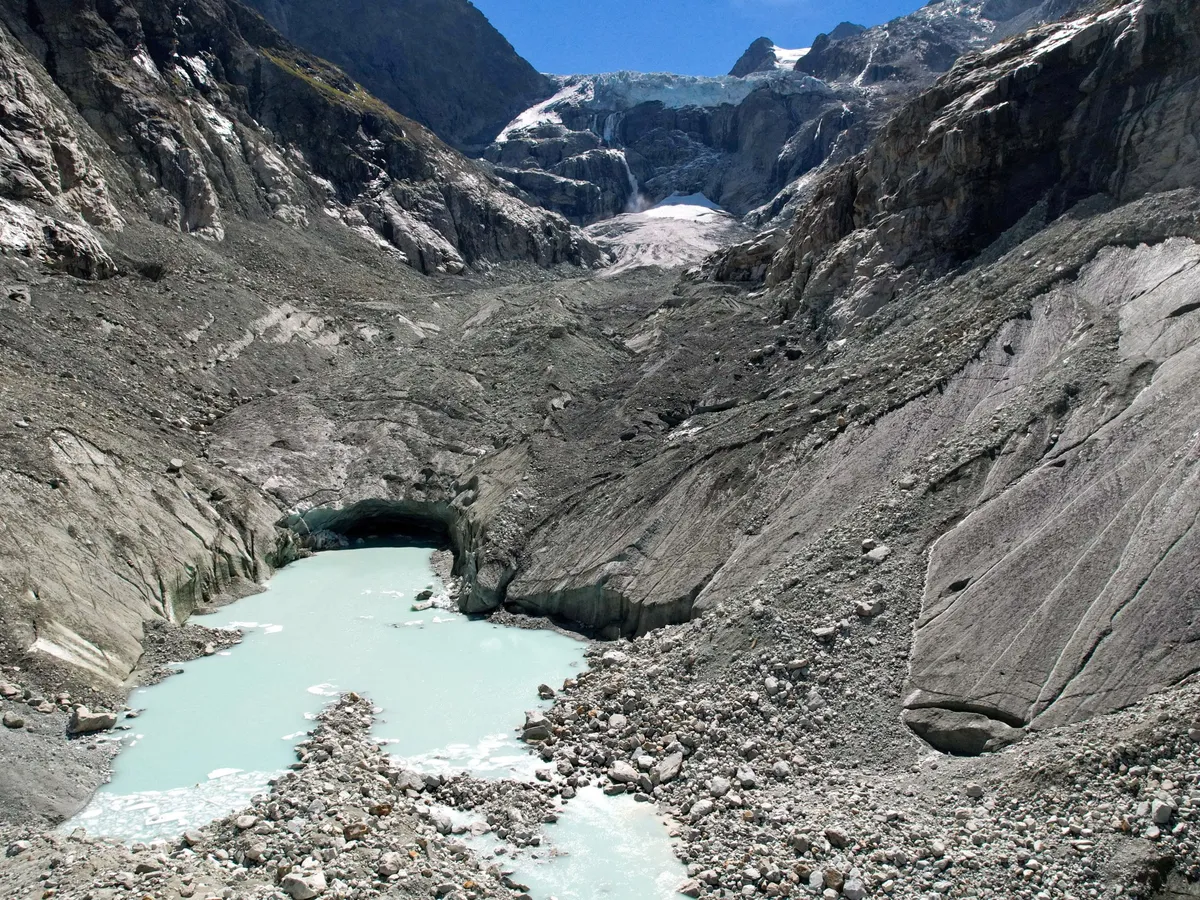
EXPLAINERSwiss glaciers have lost more than 5 percent of their ice, threatening the country’s alpine economy.A drone view shows meltwater forming a small lake at the tongue of the Mont Mine glacier on a warm summer day in Ferpecle near Evolene, Switzerland [File: Denis Balibouse/Reuters]Published On 2 Oct 2026Switzerland’s glaciers are rapidly receding due to a combination of winters with too little snow and record-high temperatures across Europe this summer, scientists say. In all, one of the world’s top ski destinations has lost nearly one-fifth of its glacial ice in just five years.In a report (PDF) published by the Swiss Glacier Monitoring Network (GLAMOS) and the Swiss Commission for Cryosphere Observation of the Swiss Academy of Sciences (SCNAT) on Thursday, researchers said Swiss glaciers lost 5.5 percent of their ice volume over the hydrologic year ending September 30, 2026, and nearly 20 percent since 2021.Recommended Stories list of 3 itemslist 1 of 3Are Europe’s extreme summers the new normal? What the science sayslist 2 of 3Why Nepal is demanding climate justice and compensation after deadly floodslist 3 of 3India to supply Nepal electricity after floods wrecked hydropower projectsend of listWhy is Switzerland, famed for its Alpine terrain and winter sports, losing its glaciers and what does this mean for the country?Here’s what we know.What have scientists discovered?In September, a GLAMOS team visited 23 glaciers in Switzerland to record end-of-summer measurements of ice melt and snow accumulation.Visiting one glacier named Scex Rouge in the Western Swiss Alps in early September, GLAMOS chief Matthias Huss, one of the report’s researchers, told the Reuters news agency that a measuring pole, about four metres (13 feet) high, was drilled into the ice in July to provide the team with a point of reference.“Now when we have come back here, we saw the pole was out by three metres [10ft]. So just in August and September of this year, even excluding the heatwaves of June and July, we have lost three metres of ice at an elevation of almost 3,000 metres [9,843ft],” he explained.“This clearly indicates these conditions that we had this summer, they are just inconsistent with the survival of these small glaciers in the Alps,” he added.Glaciologist at ETH Zurich and head of GLAMOS Matthias Huss holds a pole that indicates four metres of ice lost over the past year on the Scex Rouge glacier amid Climate Change at Glacier 3000 in Les Diablerets, Switzerland [File: Denis Balibouse/Reuters]Why are glaciers in Switzerland losing ice?According to the report, the total mean thickness of individual glaciers in Switzerland has fallen by between 2.5 and four metres in 2026. At glacier tongues – narrow glacial extensions of a glacier which project from land into a body of water – it had decreased by as much as 10 metres in some places over the summer.“We can clearly attribute the massive ice loss to the warming, and thus anthropogenic [caused by humans] Climate Change. The summer has been the hottest on record in Switzerland. In addition, there was little snow in winter, and therefore the glaciers were poorly protected when the heat started,” GLAMOS chief Huss told Al Jazeera.He noted that while their measurements have indicated that the melting has affected all glaciers in Switzerland equally, the effects were most visible on smaller glaciers.“Those shrink very quickly and sometimes even completely disappeared. Also, large glaciers lost an enormous quantity of ice, but they remain impressive,” he added.The report’s scientists warned that the glaciers also lost a total of about 2.2 trillion litres of water (581 billion gallons) between July and September alone.“This is more than four times the annual drinking water consumption of all Swiss households,” the report’s researchers said and warned this could impact the country’s future water supply.What does this mean for Switzerland?Switzerland is a country known for winter sports and Alpine tourism, which depends on the glaciers. About 4 percent of the country’s entire workforce is employed in the tourism sector.“This affects tourism and also how we perceive the mountains – they are no longer white but increasingly grey and black,” he told Al Jazeera.He added that the water provided by glaciers is also important for the economy. “It is used to fill up hydropower lakes that produce clean energy, and supplies the biggest streams of Europe,” he said.“We’re not yet seeing the full consequences as glaciers are still around and they contribute water when we need it. But this potential is soon being lost,” he added.Harry Zekollari, a glaciologist and associate research professor at the Department of Water and Climate at the Vrije Universiteit Brussel, shared a similar view.He stressed that glaciers are important natural water suppliers, as they provide water when people need it most – in summer, when it is hot and dry.“With Climate Change, glaciers initially provide more water during summer as they rapidly melt. However, as glaciers become smaller, there is less ice to be melted, and as such the water supply in summer decreases. This peak in water supply has now been passed for glaciers in the European Alps, meaning that we expect glaciers to provide less and less water in the coming years,” he told Al Jazeera.“Glacier changes can also cause natural hazards, and since most of the ice lost turns into water that reaches the oceans, the consequences of glacier loss [in Switzerland and elsewhere] will be felt for coastlines all around the globe,” he added.Is there a solution?Yes. According to Zekollari, in order to save as much glacier ice as possible in Switzerland, the world needs to stabilise rising temperatures as soon as possible.“Projections for the European Alps and Swiss glaciers show that if we are able to rapidly stop emissions, we may still be able to save about one-third of their ice mass. However, in a case with strong warming, these glaciers are projected to lose more than 90 percent of their volume by 2100,” he said.He noted that the situation is less grim globally as some glaciers in other regions are more persistent.“However, even globally, future emissions play a big role and will decide whether we lose about 25 percent of glacier mass by 2100 – that’s the good case, with limited warming – or rather 50 percent – the bad case, with more warming,” he said.“The losses in the longer term – past 2100 – are even larger due to the long response of glaciers, but also here it is the future warming that decides how much remains. Every 0.1 degree Celsius warming matters.”
SRCAl Jazeera
LANGEN
LEANCenter
WORDS1 081
ENT12
FRI · 2026-10-02 · 04:59 GMTBRIEF NSR-2026-1002-115737
NSR-2026-1002-115737News Report·EN·Environmental
How Switzerland lost 20 percent of its ice in five years
Swiss glaciers have experienced a significant loss of ice, with nearly 20 percent disappearing since 2021 and 5.5 percent lost in the hydrologic year ending September 30, 2026. Scientists attribute this rapid recession to winters with insufficient snow and record-high summer temperatures, exacerbated by human-caused climate change.
Priyanka ShankarAl JazeeraFiled 2026-10-02 · 04:59 GMTLean · CenterRead · 5 min
Al JazeeraFIG 01
Reading time
5min
Word count
1 081words
Sources cited
2cited
Entities identified
12entities
Quality score
100%
§ 01
Briefing Summary
AI-generatedNEWSAR · AI
Swiss glaciers have experienced a significant loss of ice, with nearly 20 percent disappearing since 2021 and 5.5 percent lost in the hydrologic year ending September 30, 2026. Scientists attribute this rapid recession to winters with insufficient snow and record-high summer temperatures, exacerbated by human-caused climate change. This melting threatens Switzerland's alpine economy, impacting winter sports tourism and the country's water supply, which is crucial for hydropower and major European streams. The loss is particularly noticeable on smaller glaciers, some of which are shrinking rapidly or disappearing entirely.
Confidence 0.90Sources 2Claims 5Entities 12
§ 02
Article analysis
Model · rule-basedFraming
Environmental
Economic Impact
Tone
Mixed Tone
AI-assessed
CalmNeutralAlarmist
Factuality
0.80 / 1.00
Factual
LowHigh
Sources cited
2
Limited
FewMany
§ 03
Key claims
5 extracted01
In August and September 2026, three meters of ice were lost at an elevation of almost 3,000 meters on the Scex Rouge glacier.
statisticMatthias Huss (GLAMOS chief)
Confidence
1.00
02
Swiss glaciers have lost nearly 20 percent of their ice since 2021.
statisticSwiss Glacier Monitoring Network (GLAMOS) and Swiss Commission for Cryosphere Observation of the Swiss Academy of Sciences (SCNAT)
Confidence
1.00
03
Swiss glaciers lost 5.5 percent of their ice volume over the hydrologic year ending September 30, 2026.
statisticSwiss Glacier Monitoring Network (GLAMOS) and Swiss Commission for Cryosphere Observation of the Swiss Academy of Sciences (SCNAT)
Confidence
1.00
04
These summer conditions are inconsistent with the survival of small glaciers in the Alps.
factualMatthias Huss (GLAMOS chief)
Confidence
0.90
05
The massive ice loss can be clearly attributed to warming and anthropogenic causes.
factualReport authors
Confidence
0.90
§ 04
Full report
5 min read · 1 081 words§ 05
Entities
12 identifiedKey playerOppositionContextPositiveNeutralNegative
Organizations5
Locations5
§ 06
Keywords & salience
8 termsglacier melt
1.00
climate change
0.90
alpine economy
0.80
switzerland
0.70
record temperatures
0.60
ice volume
0.50
swiss glaciers
0.50
glamos
0.40
§ 07
Topic connections
Interactive graph Network visualization showing 51 related topics
View Full Graph Person Organization Location Event|Click node to navigate|Edge numbers = shared articles