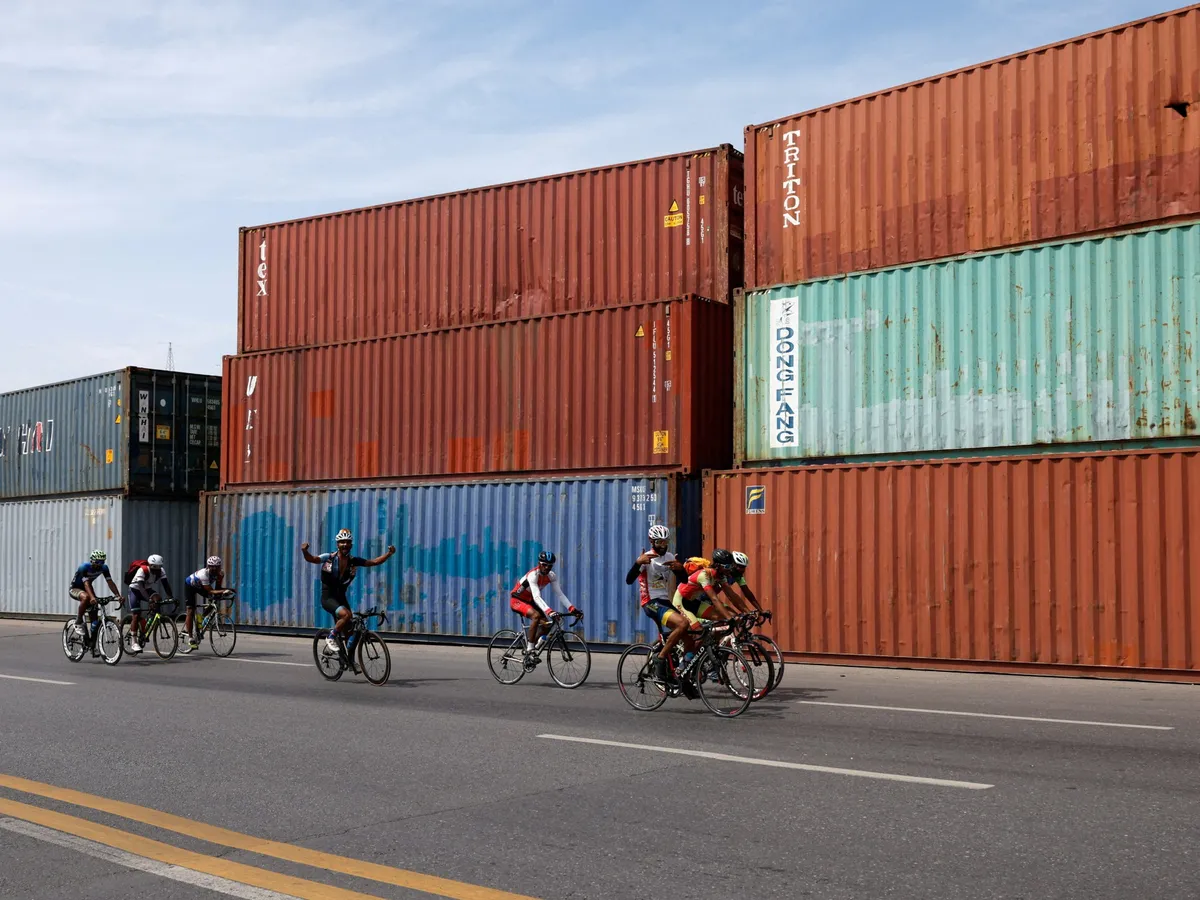
As Islamabad prepares for another opposition march, drivers and businesses are counting the cost of the barricades.Cyclists ride past shipping containers used to block roads ahead of a planned march by former Pakistani Prime Minister Imran Khan's PTI party, at Peshawar Morr interchange in Islamabad, Pakistan, on September 25, 2026 [Staff/Reuters]Published On 2 Oct 2026Islamabad, Pakistan — Two boys scale the rusted corner of a shipping container marked “EVERGREEN” in block white letters. They kick up into handstands, legs steady, without so much as a glance upward, even as traffic passes on the road behind them.The clip runs 27 seconds, cut exactly to a verse from rap singer Cheema Y’s Punjabi track “Police”, about containers of smuggled goods crossing the border that nobody can account for.Recommended Stories list of 4 itemslist 1 of 4Can Pakistan’s Sohail Afridi win freedom for ex-PM Imran Khan?list 2 of 4‘Source of anxiety’: Pakistan cracks down before march to free Imran Khanlist 3 of 4Pakistan seals roads to Islamabad before protests for Imran Khan’s releaselist 4 of 4Former Pakistan PM Imran Khan’s sisters arrested before planned PTI marchend of listThe four-tonne container beneath their feet carries nothing at all. It is one of what transport associations and officials put at between 1,500 and 2,000 heavy steel boxes barricading Islamabad’s roads ahead of an opposition march.The idea for the video, shared on Instagram six days ago, was the brainchild of 26-year-old Mujaddad Asrar, a callisthenics and parkour athlete. Asrar has been staging shoots like this one on Islamabad’s containers for several years. This clip, along with several others, went out from a friend’s account rather than his own, because the friend has a bigger following, he says.“It’s like clockwork every year,” he told Al Jazeera. “One lot of containers or another comes right on time, like it’s part of the calendar. It’s basically a fifth season.“Yeah, these containers have now made Islamabad as Containerabad,” he added, cheerfully.The containers have been up for nearly four weeks as part of efforts by the country’s government to block an upcoming march on the capital by Pakistan-tehreek-e-insaf" class="entity-link entity-organization" data-entity-id="6795" data-entity-type="organization">Pakistan Tehreek-e-Insaf (PTI), the party of jailed former Prime Minister Imran Khan. The party had planned to set off on September 27 from Peshawar, in Khyber Pakhtunkhwa, then pushed the date back to October 4, citing “strategic reasons.” The march is PTI’s latest attempt to pressure the government into releasing Khan, the country’s most popular political figure according to polls, who has been behind bars for more than three years.Islamabad has been here before several times in recent years. In August 2024, as PTI petitioned the Islamabad High Court over a cancelled rally permit at D-Chowk, the square where the city’s high-security Red Zone starts, then-Chief Justice Aamer Farooq remarked that the authorities had turned the capital into a “container city”.Talal Chaudhry, the state minister for interior, however, said the use of containers ahead of the coming protest reflects standard practice rather than overreach.“Security preparations are based on intelligence assessments and anticipated security requirements, not simply on the date a political event is formally announced,” he told Al Jazeera. “Islamabad is the federal capital, so precautionary security arrangements are often put in place well in advance.”The price of securityThe containers come with a price tag, though no one agrees on what it is.Shipping containers are used to block the road leading to the Aiwan-e-Sadr (Presidential Palace) ahead of a planned march by former Pakistani Prime Minister Imran Khan’s party, in Islamabad, Pakistan, on September 24, 2026 [Akhtar Soomro/Reuters]Islamabad police initially sought roughly 820 million rupees ($2.9m) for a week of security arrangements around PTI’s planned march, according to local media reports. With the march delayed a week, officials now expect the final bill to top 1 billion rupees ($3.6m).Container rental sits at the centre of that budget: one estimate puts the daily rental for more than 1,500 containers at 46.5 million rupees ($167,000).While owners maintain they have not been paid for their containers, Chaudhry disputes this.“What I can say with certainty is that legitimate container rentals are documented and paid through the proper process,” he said.In a written reply to the National Assembly in March 2025, Interior Minister Mohsin Naqvi disclosed that the government had spent 1.35 billion rupees ($4.9m) on law-and-order deployments in Islamabad over five years, with a peak of 724 million rupees ($2.6m) in 2022-23.The reply itemised personnel movement, housing and meals for deployed police, and, in one year, anti-riot equipment, but excluded the period covering the 2024 PTI protest. Nowhere in the government response did the word “container” appear.Chaudhry rejected the idea that this amounted to an omission. “Container rentals are not necessarily recorded as a separate political-protest expenditure category,” he said. “They are processed through the established administrative and contractual mechanism. Every container hired is recorded, and the corresponding payment is traceable through official accounts.”Whose containers are these?The containers fall into two categories: trucks with containers welded on to them owned by individuals, and containers owned by foreign shipping lines sitting on someone else’s vehicle.A view of containers set aside by authorities to block a planned rally by the opposition Pakistan-tehreek-e-insaf" class="entity-link entity-organization" data-entity-id="6795" data-entity-type="organization">Pakistan Tehreek-e-Insaf (PTI), on the outskirts of Islamabad, Pakistan, on September 14, 2026 [Sohail Shahzad/EPA]Roughly 2,000 vehicles and containers are held across Islamabad, Punjab and Khyber Pakhtunkhwa, according to transporters’ associations, though the figure remains an estimate rather than a definitive number.Muhammad Owais Chaudhry, a lawyer who heads the All Pakistan Goods Transport Owners Association, represents owners in the first category — those whose trucks and containers have been grabbed by the police.“If you combine the container and the vehicle, the total cost comes to 30,000 to 40,000 rupees ($108 to $144) a day,” he told Al Jazeera, describing earnings lost per truck-container combination while idle.“Not a single rupee has been given,” he said of compensation from the government. “No procedure has ever been worked out for how it would be paid. In our history, no transporter has ever received money for any past protests.”Talal Chaudhry, the state minister, disputes this entirely.“That is simply not consistent with our records,” he told Al Jazeera. “Containers are hired through a proper contractual mechanism at market rates, and payments are made through official accounts. We have a complete container-by-container record, including payments made in previous years. If there is any legitimate outstanding claim, it will be settled.”Owais Chaudhry has also pressed officials to buy a fleet of containers outright rather than renting them for every sit-in, adding that the purchase cost of a container is between 400,000 and 500,000 rupees ($1,444 to $1805).Talal Chaudhry called that a question of policy, not principle.“The government already has an established rental mechanism that allows containers to be deployed when required without permanently bearing the cost of purchasing, storing and maintaining them,” he said.One of the vehicles seized belongs to Haji Atlas Khan, provincial general secretary of the All-Pakhtunkhwa Goods Federation.He was at home in Nowshera district in Khyber Pakhtunkhwa province when his driver rang one evening in early September to say police had impounded his lorry minutes after it entered Islamabad.“We didn’t know, and the police didn’t know either, under what authority these vehicles were being seized,” Khan told Al Jazeera.In the following days, three more of his trucks joined the first at police stations across the capital.Dozens of trucks with welded containers have been kept by police at various locations in Islamabad for the past few weeks [Abid Hussain/Al Jazeera]Owais Chaudhry has watched containers seized for sit-ins and protests since 2018, he says. Haji Atlas Khan, in his early 50s, has been in the business for 26 years and has seen his vehicles impounded through several protests and rallies.But neither has ever waited this long to retrieve a vehicle — and both insist they have never been paid for their losses.Owais said association officials have met Islamabad’s police leadership and Talal Chaudhry since the crackdown began, but came out of those meetings with “empty promises”.“Everyone says you’ll get everything,” he said. “But we ask, how, and when?”Asked about a compensation timeline, minister Talal Chaudhry said the process concerns “the hiring or temporary use of containers, not an indefinite seizure of vehicles”.Loaded vehicles, he said, were returned immediately, while empty containers taken for security arrangements fall under “the rental arrangement,” with release “coordinated with the relevant authorities.”None of the drivers or transporters Al Jazeera spoke to recognised that arrangement, received anything in writing, or knew when they might get their vehicles back.The container ownership has another variable, say sector experts.“In most cases, the shipping line is the owner of the container,” Mehmood ul Hassan Awan, a Karachi-based customs agent and importer, told Al Jazeera. “We don’t have a single shipping line in Pakistan, only shipping agents.”Of the roughly 2,000 containers stuck in the three regions, most, he says, belong to foreign shipping lines, each accruing $150 to $300 a day in penalties that flow abroad through the State Bank.“Those dollars don’t come into our economy,” he said. “They go out.”Waiting by the trucksDrivers waiting for release tell a similar story. Owners don’t trust that their trucks and containers will stay safe even in police custody, so they ask drivers to stay near the vehicles — even as they gather dust parked on the streets of Islamabad.On a strip of open ground near Islamabad’s fruit and vegetable market, Muhammad Naseer and a handful of others sit out the days on a mat laid beside their parked trucks.Naseer, 48, from Mianwali, on the border of Punjab and Khyber Pakhtunkhwa, was hauling an empty container back towards Karachi when police stopped him as he was leaving Islamabad.“Our container belongs to a shipping line,” he told Al Jazeera. There is a 10-day window to return it, Nasir said, after which “a claim will come.”One of the trucks nearby belongs to Khan from Nowshera district.Muhammad Saleem Jaffar, his driver, recalled the night it was stopped: 3am, at a checkpoint near a wholesale market in Islamabad.Muhammad Saleem Jaffar stands beside his truck near Islamabad’s fruit and vegetable market where his vehicle has been kept since early September [Abid Hussain/Al Jazeera]He had just dropped off his shipment when police stopped him. Like the others, he, too, has not been told when he might leave.“No one has ever asked how we are,” he said of the police who come and go from the holding area. “Whether anyone of us is sick, what the loss has been. No one has asked anything at all.”Conditions have become more difficult.Driver Farooq Khan, 22, said the single washroom at a nearby fuel pump now draws an hour-long queue, and there has been nowhere to bathe since his container was seized.The uncertainty extends to when it all ends.Jaffar said a fellow driver walked to the nearby police post to ask about release, and was first told October 4. Days later, the police told him the date was changed to October 16, with no guarantee attached, he said.“It could go beyond that too,” Jaffar said.Asked if he had ever thought about simply walking away from the job, Naseer pointed first to the truck he was minding, worth close to 15 million rupees ($54,000) and entrusted to him by an owner in Karachi.But he framed it as more than a question of money or debt.“How can we become disloyal to him, and abandon the vehicle over a little hardship?” he asked.Back in the city where Asrar and his friends perform atop the containers, the economics take a different shape.The full cost, says Sajid Amin Javed, deputy executive director for research at the Sustainable Development Policy Institute, goes well beyond container rental.“When we close a hotel and cancel all bookings, it is not the room rent that the hotel loses,” he told Al Jazeera. “It is the signalling it sends to investors, businesses, tourists. Every pillar of state, society bears that cost.”The impact is not limited to the capital, others say.“The metropolitan area it forms with Rawalpindi is the third-largest in the country,” said Danyal Adam Khan, an Islamabad-based researcher and urban governance specialist, adding that people from distant provinces too were deeply integrated into the socioeconomic fabric of the city. “When you shut down the capital like this, you cut everyone off.”For now, the containers remain where they have always ended up: half barricade, half backdrop, and Asrar says the response to his friends’ video online has mostly been good-natured.“Some people call it showing off,” he said. “Some call it political. We try to stay neutral about it.”Asrar recalled one police officer who figured they were not damaging anything and stayed to watch. “They were just impressed by it,” he added, speaking of his stunts.But not everyone has the luxury of treating the containers as a backdrop.“This is such a government that it doesn’t listen to anyone’s request, anyone’s plea, anyone’s complaint,” Khan, the truck owner, told Al Jazeera. “There’s simply no one we can go to who will hear us.”
SRCAl Jazeera
LANGEN
LEANCenter
WORDS2 151
ENT10
FRI · 2026-10-02 · 11:22 GMTBRIEF NSR-2026-1002-115813
NSR-2026-1002-115813News Report·EN·Political Strategy
‘Containerabad’: Pakistan’s capital and truckers bleed money amid lockdown
Islamabad, Pakistan, is experiencing significant disruption due to the extensive use of shipping containers to barricade roads ahead of an opposition march by Imran Khan's PTI party. The containers, numbering between 1,500 and 2,000, have been in place for nearly four weeks, impacting businesses and truckers.
Abid HussainAl JazeeraFiled 2026-10-02 · 11:22 GMTLean · CenterRead · 9 min
Al JazeeraFIG 01
Reading time
9min
Word count
2 151words
Sources cited
3cited
Entities identified
10entities
Quality score
100%
§ 01
Briefing Summary
AI-generatedNEWSAR · AI
Islamabad, Pakistan, is experiencing significant disruption due to the extensive use of shipping containers to barricade roads ahead of an opposition march by Imran Khan's PTI party. The containers, numbering between 1,500 and 2,000, have been in place for nearly four weeks, impacting businesses and truckers. The government cites security concerns and intelligence assessments for these measures, which are standard practice for protecting the federal capital during anticipated political events. The cost of these security arrangements, particularly container rentals, is substantial, with estimates suggesting over 1 billion rupees ($3.6 million) for the current deployment. While container owners claim non-payment, the government states that legitimate rentals are processed properly. This situation has led to the capital being colloquially referred to as "Containerabad."
Confidence 0.90Sources 3Claims 5Entities 10
§ 02
Article analysis
Model · rule-basedFraming
Political Strategy
Economic Impact
Tone
Measured
AI-assessed
CalmNeutralAlarmist
Factuality
0.70 / 1.00
Factual
LowHigh
Sources cited
3
Well sourced
FewMany
§ 03
Key claims
5 extracted01
Authorities had turned the capital into a 'container city'.
quoteAamer Farooq (then-Chief Justice)
Confidence
0.95
02
The containers have been in place for nearly four weeks.
factual
Confidence
0.95
03
Islamabad has been nicknamed 'Containerabad' due to the frequent use of containers for barricades.
quoteMujaddad Asrar
Confidence
0.90
04
The march is PTI's latest attempt to pressure the government into releasing Imran Khan.
factual
Confidence
0.90
05
Between 1,500 and 2,000 shipping containers are barricading Islamabad's roads.
statistictransport associations and officials
Confidence
0.90
§ 04
Full report
9 min read · 2 151 words§ 05
Entities
10 identifiedKey playerOppositionContextPositiveNeutralNegative
People3
Organizations3
§ 06
Keywords & salience
9 termsislamabad lockdown
1.00
opposition march
0.90
imran khan
0.80
shipping containers
0.70
pakistan tehreek-e-insaf
0.70
truckers
0.60
political protest
0.50
economic cost
0.50
road barricades
0.40
§ 07
Topic connections
Interactive graph Network visualization showing 51 related topics
View Full Graph Person Organization Location Event|Click node to navigate|Edge numbers = shared articles