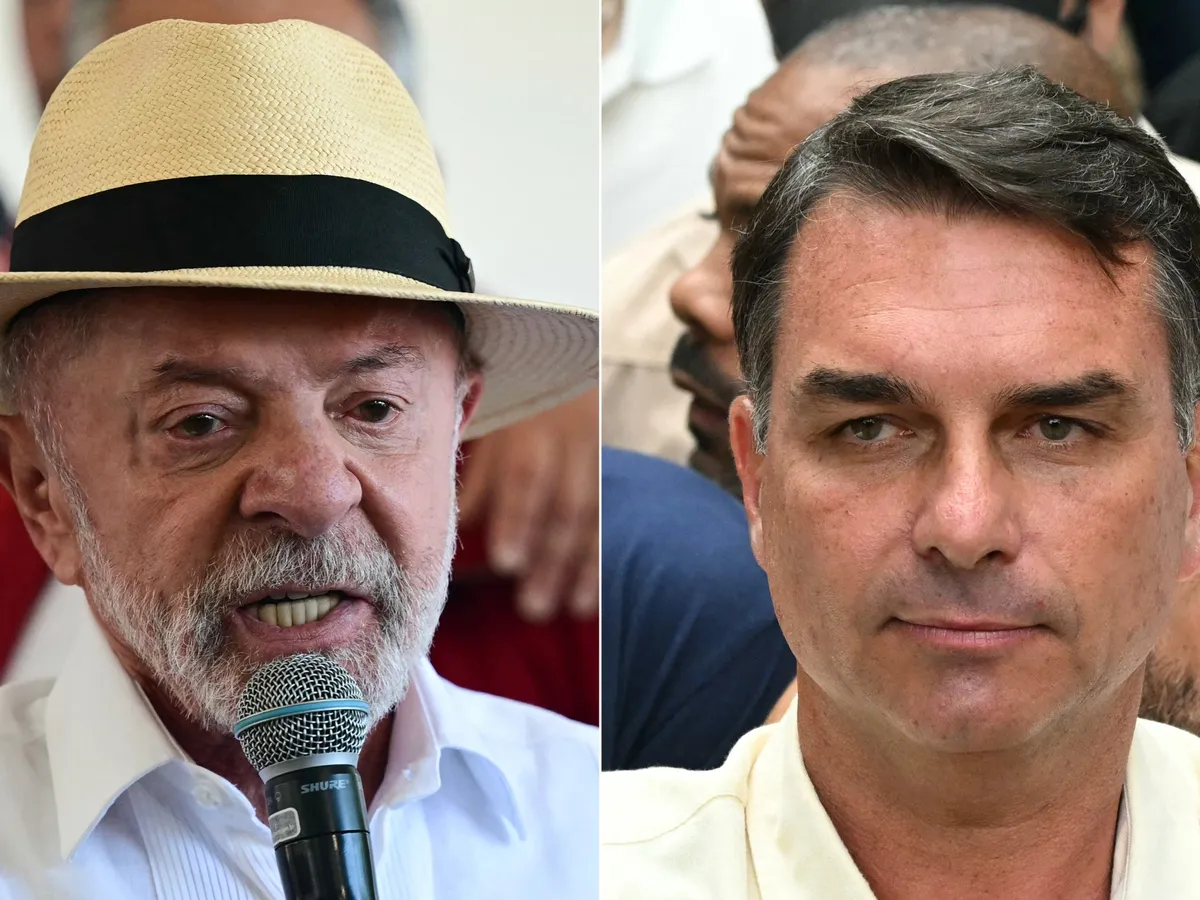
Flavio Bolsonaro beat polling expectations as Brazil’s right gained ground, setting up October 25 run-off with Lula.This combination of pictures shows Brazil's president and re-election candidate for the Workers' Party (PT), Luiz Inacio Lula da Silva (left), and Brazil's right-wing senator and presidential candidate for the Liberal Party (PL), Flavio Bolsonaro, during the presidential election on October 4, 2026 [AFP]Published On 5 Oct 2026Brazil’s closely watched presidential election is heading to a second round between leftist President Luiz Inacio Lula da Silva and right-wing Senator Flavio Bolsonaro, prolonging a deeply polarised race with major implications for the country and the wider region.Brazil’s electoral court confirmed on Sunday that the two candidates will advance to a run-off on October 25 after neither won the majority needed to secure the presidency outright, with Bolsonaro leading at 55.8 million votes to Lula’s almost 53.2 million.Recommended Stories list of 4 itemslist 1 of 4Brazil’s Lula and Bolsonaro close campaigns ahead of critical electionlist 2 of 4Will Brazil’s Lula halt the right-wing wave sweeping Latin America?list 3 of 4Polls close in Brazil’s polarised election pitting Lula against Bolsonarolist 4 of 4Lula and Bolsonaro vote in Brazil’s polarised presidential electionend of listLula, 80, is seeking a fourth, non-consecutive term after a political career spanning nearly five decades.Bolsonaro, 45, is the eldest son of former President Jair Bolsonaro and is trying to return his father’s right-wing movement to power, even as the former president serves a 27-year prison sentence for plotting a coup after losing the 2022 election.The election comes at a pivotal time for Latin America’s largest economy. Brazilians are grappling with concerns over crime and the cost of living, while the country faces an increasingly tense relationship with the United States. The vote is also being closely watched across a region that has shifted sharply to the right in a series of recent elections.While a second round was widely expected, the first-round result did not play out quite as pollsters had predicted.Here are some of the key takeaways from the election so far.Brazil is heading for another Lula-Bolsonaro run-offWith nearly 99 percent of votes reported, Bolsonaro had about 47 percent of valid votes, compared with 44.9 percent for Lula. Neither reached the 50 percent threshold needed to win in the first round.That sets up another Lula-Bolsonaro showdown, four years after Lula narrowly defeated former President Jair Bolsonaro. This time, he will face the former president’s eldest son.The race could be extremely close, as polling ahead of Sunday’s vote suggested Lula and Flavio Bolsonaro were roughly tied in a potential run-off.That puts voters who backed one of the other 10 candidates in the first round at the centre of the fight for the presidency over the next three weeks.Ronaldo Caiado and Renan Santos, who together received about 5.3 million votes, have previously said they will not endorse either candidate in the run-off.Flavio Bolsonaro did better than polls suggestedMost polls leading up to election day predicted the race would be pushed into the second round, but had Lula finishing the first round ahead of Bolsonaro.Instead, Bolsonaro emerged with a lead of two percentage points, raising questions about why the final polls underestimated his support.On Sunday, Bolsonaro said the results showed that Brazilians want change.Analysts told the Reuters news agency that Bolsonaro may have benefitted from “protest votes” from people who may have preferred another candidate but saw defeating Lula as the priority. Many had been expected to shift their support to Bolsonaro only in a second round, meaning this could have consequences for his support in three weeks.“The protest vote foreshadows what is to come in the run-off,” political analyst Rafael Favetti told Reuters. “While this should benefit Flavio Bolsonaro now, his growth potential in the second round drops precisely because that support has already been front-loaded.”After the results came in, Lula said the votes were “unexpected” but that he would come back stronger in the run-off.“I admit, I was convinced I would win in the first round. The game is about to start. We are in extra time. In extra time, we will win over the Brazilian people,” the 80-year-old said.The right had a strong night in Congress, tooBolsonaro’s surprising performance in the first round was part of a broader show of strength for Brazil’s right.Right-wing parties, led by Bolsonaro’s Liberal Party (PL), were performing strongly in both houses of Congress, with the PL on track to emerge as the largest force in the Chamber of Deputies and making gains in the Senate.This included victories for other members of the Bolsonaro family, including former First Lady Michelle Bolsonaro, Flavio’s stepmother, who won a Senate seat in the Federal District, her first elected office.His brother, Carlos Bolsonaro, was elected to the Senate in Santa Catarina.The results show that the political movement built around former President Jair Bolsonaro – known as “bolsonarista” – remains a powerful electoral force, even with the former president barred from running himself.“The fact that far-right candidates for the legislature have exceeded all expectations suggests a deeper popular grounding for the bolsonarista project than many expected,” Andre Pagliarini, an assistant professor of history and international studies at Louisiana State University and author of a book on Lula, told Al Jazeera.“Millions of Brazilians right now evidently feel the right best reflects their values and vision for the future,” he added.The congressional results matter beyond election night, too. Both houses were already dominated by conservative lawmakers, and a stronger right-wing presence could make it even harder for Lula to push through his agenda if he wins another term.A Bolsonaro victory, meanwhile, could give him more room to pursue his own priorities, including his pledge to seek an amnesty for his father.
SRCAl Jazeera
LANGEN
LEANCenter
WORDS945
ENT10
MON · 2026-10-05 · 01:55 GMTBRIEF NSR-2026-1005-116346
NSR-2026-1005-116346News Report·EN·Political Strategy
Brazil’s presidential race: Three key takeaways from the first round
Brazil's presidential election will proceed to a second round on October 25 between leftist President Luiz Inacio Lula da Silva and right-wing Senator Flavio Bolsonaro. Neither candidate secured the necessary majority in the first round, with Bolsonaro receiving more votes than Lula.
By AFP, Reuters and The Associated PressAl JazeeraFiled 2026-10-05 · 01:55 GMTLean · CenterRead · 4 min
Al JazeeraFIG 01
Reading time
4min
Word count
945words
Sources cited
1cited
Entities identified
10entities
Quality score
100%
§ 01
Briefing Summary
AI-generatedNEWSAR · AI
Brazil's presidential election will proceed to a second round on October 25 between leftist President Luiz Inacio Lula da Silva and right-wing Senator Flavio Bolsonaro. Neither candidate secured the necessary majority in the first round, with Bolsonaro receiving more votes than Lula. This outcome defied polling expectations, which had predicted Lula would lead after the first round. The election is significant for Brazil and the region, occurring amidst concerns over crime, cost of living, and a shifting political landscape in Latin America. The right also demonstrated strength in congressional elections, with Bolsonaro's Liberal Party expected to be a major force.
Confidence 0.90Sources 1Claims 5Entities 10
§ 02
Article analysis
Model · rule-basedFraming
Political Strategy
Diplomatic
Tone
Measured
AI-assessed
CalmNeutralAlarmist
Factuality
0.80 / 1.00
Factual
LowHigh
Sources cited
1
Limited
FewMany
§ 03
Key claims
5 extracted01
Brazilians are grappling with concerns over crime and the cost of living.
factual
Confidence
1.00
02
Flavio Bolsonaro is the eldest son of former President Jair Bolsonaro.
factual
Confidence
1.00
03
Flavio Bolsonaro received 55.8 million votes, and Lula received almost 53.2 million votes in the first round.
statistic
Confidence
1.00
04
Brazil's presidential election is heading to a second round between Luiz Inacio Lula da Silva and Flavio Bolsonaro.
factual
Confidence
1.00
05
The country faces an increasingly tense relationship with the United States.
factual
Confidence
0.90
§ 04
Full report
4 min read · 945 words§ 05
Entities
10 identifiedKey playerOppositionContextPositiveNeutralNegative
People3
§ 06
Keywords & salience
10 termsbrazil
1.00
presidential election
1.00
run-off
0.90
lula
0.90
flavio bolsonaro
0.90
polarised race
0.80
right-wing
0.70
latin america
0.60
election results
0.50
cost of living
0.40
§ 07
Topic connections
Interactive graph Network visualization showing 51 related topics
View Full Graph Person Organization Location Event|Click node to navigate|Edge numbers = shared articles