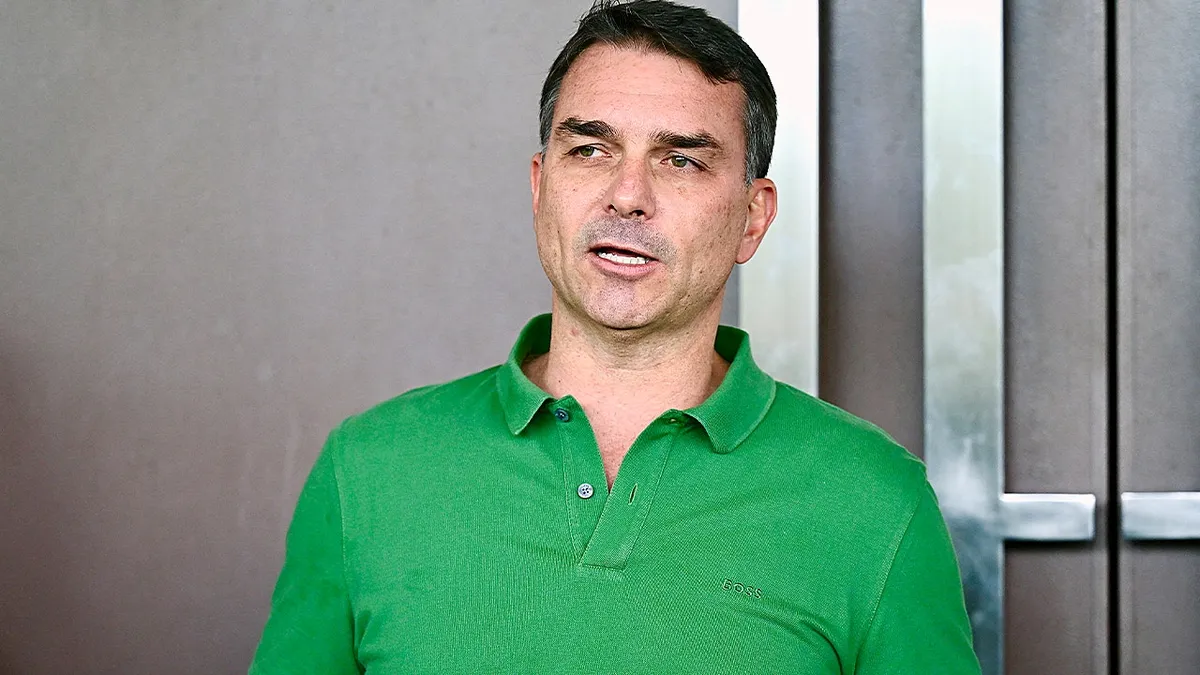
close Video Flavio Bolsonaro leads Sao Paulo caravan ahead of Brazil's presidential election Flavio Bolsonaro joined supporters in Santa Barbara D'Oeste to lead a motorcade. Polls in Brazil show a tight presidential race with incumbent Luiz Inacio Lula da Silva. (Video: Reuters.) NEWYou can now listen to Fox News articles! Hören Sie sich diesen Artikel an 5 Min Senator Flavio Bolsonaro, son of former President Jair Bolsonaro, won the first round of the Brazilian presidential election tonight, turning in a surprisingly strong showing, and continuing a long run of wins for Latin American Trump-backed right-wing candidates. Although the race had tightened considerably in the weeks leading up to the election, the vast majority of the polls showed incumbent President Inacio Lula da Silva with a single digit lead. Bolsonaro will now face off against President Lula da Silva in an October 25 second round election. With 99% of the votes in, Bolsonaro led Lula 47.2% to 44.9%, in a race Lula had widely been expected to win. LATIN AMERICA’S CONSERVATIVE SHIFT FACES ITS BIGGEST TEST YET IN Brazil ELECTION Senator Flávio Bolsonaro has entered the 2026 Brazilian presidential race after father's prison endorsement. (Evaristo Sa / AFP via Getty Images) Tonight, the question on everyone's mind: how could the pollsters get the results so wrong? The epic polling failure will serve to give further ammunition to the Brazilian right and the Bolsonaro camp, which have long alleged that the nation's leading pollsters turn in work biased in favor of Lula and his Workers Party. The polling situation was similarly unfavorable to Jair Bolsonaro in the 2022 and 2018 elections, but relatively minor in comparison with the disparity in tonight's electoral results. Bolsonaro put in an incredibly strong showing in his electoral strongholds in the south of Brazil, winning the country's three largest states by large margins: In Sao Paulo state, the nation's largest, Bolsonaro led Lula 52% to 38%. In Minas Gerais, which is Brazil's historic "bellwether state", Bolsonaro led Lula 48% to 43%, while in his stronghold of Rio de Janeiro, he bested the incumbent president 53% to 39%. Brazil'S LULA INAUGURATED AS NEW PRESIDENT AFTER BOLSONARO REPORTEDLY FLED TO FLORIDA HOME OF MMA FIGHTER Lula racked up large margins in his traditional strongholds in the Northeast, where he won vote-rich Bahia, Pernambuco, and Ceara by large margins, but it was not enough to surmount Bolsonaro's unprecedented electoral strength in Brazil's south. President Trump sent a letter to former Brazilian President Jair Bolsonaro calling for an immediate end to the ‘unjust’ trial against him for allegedly starting a coup. (AP Photo/Evan Vucci and Evaristo Sa/AFP via Getty Images) Bolsonaro enjoyed a close relationship with Donald Trump through the course of the campaign, who made no secret of his intent to unceremoniously eject longtime geopolitical adversary Lula from office. Tonight's surprising result is merely the latest in a long string of right-wing victories across Latin America, which has recently ushered in a red wave of conservative candidates in Chile, Argentina, Peru, Ecuador, and Bolivia. The election will undoubtedly prompt a period of soul-searching for the Brazilian left, which may be asking, "Should Lula have run at all?" At 80 years old, with three presidential terms under his belt, and aspiring to a fourth, Lula was widely viewed as the only contender who could unite the contentious and often-fractured Brazilian left. President of Brazil Luiz Inacio Lula da Silva speaks during the 80th session of the United Nations General Assembly (UNGA) at the United Nations headquarters on September 23, 2025 in New York City. World leaders convened for the 80th Session of UNGA, with this year’s theme for the annual global meeting being "Better together: 80 years and more for peace, development and human rights." (Photo by Taylor Hill/Getty Images) Lula's political story marks one of the greatest comebacks in history. Once imprisoned on corruption charges, Lula was freed by the nation's Supreme Court, and then defeated incumbent Jair Bolsonaro in a heated 2022 election by a razor-thin margin. Famously, he pledged to serve only one term as president in 2022, and then reneged on that promise. Now, the move seems likely to backfire on him, in what will almost certainly be his last electoral campaign. Flavio Bolsonaro will now face off against incumbent Lula in a second round election on October 25. Bolsonaro begins the race with several structural advantages. In addition to vastly outperforming across the country, and proving the pollsters wrong, he is likely to win the vast majority of the votes of the major third-party candidates: Augusto Cury, Renan Santos, Ronaldo Caiado, and Romeu Zema. Together, these four candidates received nearly 8% of the vote. What remains to be seen is whether any of these candidates will make an endorsement. It is suspected that Caiado and Zema will back Bolsonaro, while Cury and Santos will likely not make an endorsement. Former Brazilian President Jair Bolsonaro's son announces biopic while brother Senator Flávio Bolsonaro enters 2026 presidential race from prison endorsement. (Ton Molina/Getty Images/ Evaristo Sa / AFP via Getty Images) If elected, Flavio Bolsonaro is all but certain to free his father, and senior Brazilian military officers, who are currently jailed on charges of planning a coup to remain in power following the 2022 election. The election also saw other members of the Bolsonaro family ushered into higher office: Jair Bolsonaro's wife, Michelly, was elected senator, as was his son Carlos, while another son, Renan, was elected federal deputy. Bolsonaro's Liberal Party also turned in strong results in races for both chambers of Brazil's Congress, particularly in the Senate, where they are expected to hold 29 seats, compared to just 9 for Lula's Workers Party. In Brazil's lower chamber, the Liberal Party is also expected to hold the greatest number of seats, with 121, while Brazil Fe, a left-wing coalition, is on track to secure 78 seats. Political analyst Flavio Morgenstern argued, "This election was not about Flavio Bolsonaro vs. Lula. It's about all of freedom-loving Brazil against the Brazilian Supreme Court. People have no voice in the institutions, and all the power in Brazil is concentrated in the Supreme Court." The Brazilian right and the Bolsonaro family have long butted heads with the nation's Supreme Federal Court, which is dominated by justices appointed by the Workers Party. While Bolsonaro appears to have the wind in his sails, it is too early to count out Lula in the second round election in three weeks. Lula is renowned as a smart and effective campaigner, and still commands a powerful electoral machinery. Yet, is winning election to an unprecedented fourth term a feat too daunting for even Lula, the great giant of the Latin American left? David Unsworth reports on Latin America. You can follow David Unsworth on Twitter @LatinAmerUpdate
SRCFox News - World
LANGEN
LEANCenter-Right
WORDS1 131
ENT12
MON · 2026-10-05 · 00:17 GMTBRIEF NSR-2026-1005-116327
NSR-2026-1005-116327News Report·EN·Political Strategy
Bolsonaro wins first round of Brazilian presidential election, as Trump-backed candidates continue red wave
Flavio Bolsonaro, son of former President Jair Bolsonaro, surprisingly won the first round of the Brazilian presidential election, leading incumbent President Lula da Silva 47.2% to 44.9%. This result defied most polls and continues a trend of wins for Trump-backed right-wing candidates in Latin America.
Fox News - WorldFiled 2026-10-05 · 00:17 GMTLean · Center-RightRead · 5 min
Fox News - WorldFIG 01
Reading time
5min
Word count
1 131words
Sources cited
3cited
Entities identified
12entities
Quality score
100%
§ 01
Briefing Summary
AI-generatedNEWSAR · AI
Flavio Bolsonaro, son of former President Jair Bolsonaro, surprisingly won the first round of the Brazilian presidential election, leading incumbent President Lula da Silva 47.2% to 44.9%. This result defied most polls and continues a trend of wins for Trump-backed right-wing candidates in Latin America. Bolsonaro performed strongly in southern Brazil, while Lula secured large margins in the Northeast. The two will face each other in a second-round election on October 25. The article notes that Flavio Bolsonaro is expected to receive support from third-party candidates and that if elected, he would likely free his father and other jailed military officers. The election also saw other Bolsonaro family members elected to office and the Liberal Party achieving strong results in Congress.
Confidence 0.90Sources 3Claims 5Entities 12
§ 02
Article analysis
Model · rule-basedFraming
Political Strategy
Diplomatic
Tone
Mixed Tone
AI-assessed
CalmNeutralAlarmist
Factuality
0.70 / 1.00
Factual
LowHigh
Sources cited
3
Well sourced
FewMany
§ 03
Key claims
5 extracted01
Bolsonaro led Lula 47.2% to 44.9% with 99% of votes in.
statistic
Confidence
1.00
02
Flavio Bolsonaro won the first round of the Brazilian presidential election.
factual
Confidence
1.00
03
Bolsonaro performed strongly in his strongholds in the south of Brazil, winning Sao Paulo, Minas Gerais, and Rio de Janeiro by significant margins.
factual
Confidence
0.95
04
Polls showed incumbent President Inacio Lula da Silva with a single digit lead before the election.
factual
Confidence
0.90
05
The surprising result is seen as a continuation of a trend of wins for Trump-backed right-wing candidates in Latin America.
factual
Confidence
0.80
§ 04
Full report
5 min read · 1 131 words§ 05
Entities
12 identifiedKey playerOppositionContextPositiveNeutralNegative
People3
Organizations1
Locations6
§ 06
Keywords & salience
10 termsbrazilian presidential election
1.00
flavio bolsonaro
0.90
luiz inacio lula da silva
0.90
trump-backed candidates
0.80
latin american conservative shift
0.70
polling failure
0.60
second round election
0.50
right-wing candidates
0.50
workers party
0.40
electoral strongholds
0.40
§ 07
Topic connections
Interactive graph Network visualization showing 51 related topics
View Full Graph Person Organization Location Event|Click node to navigate|Edge numbers = shared articles