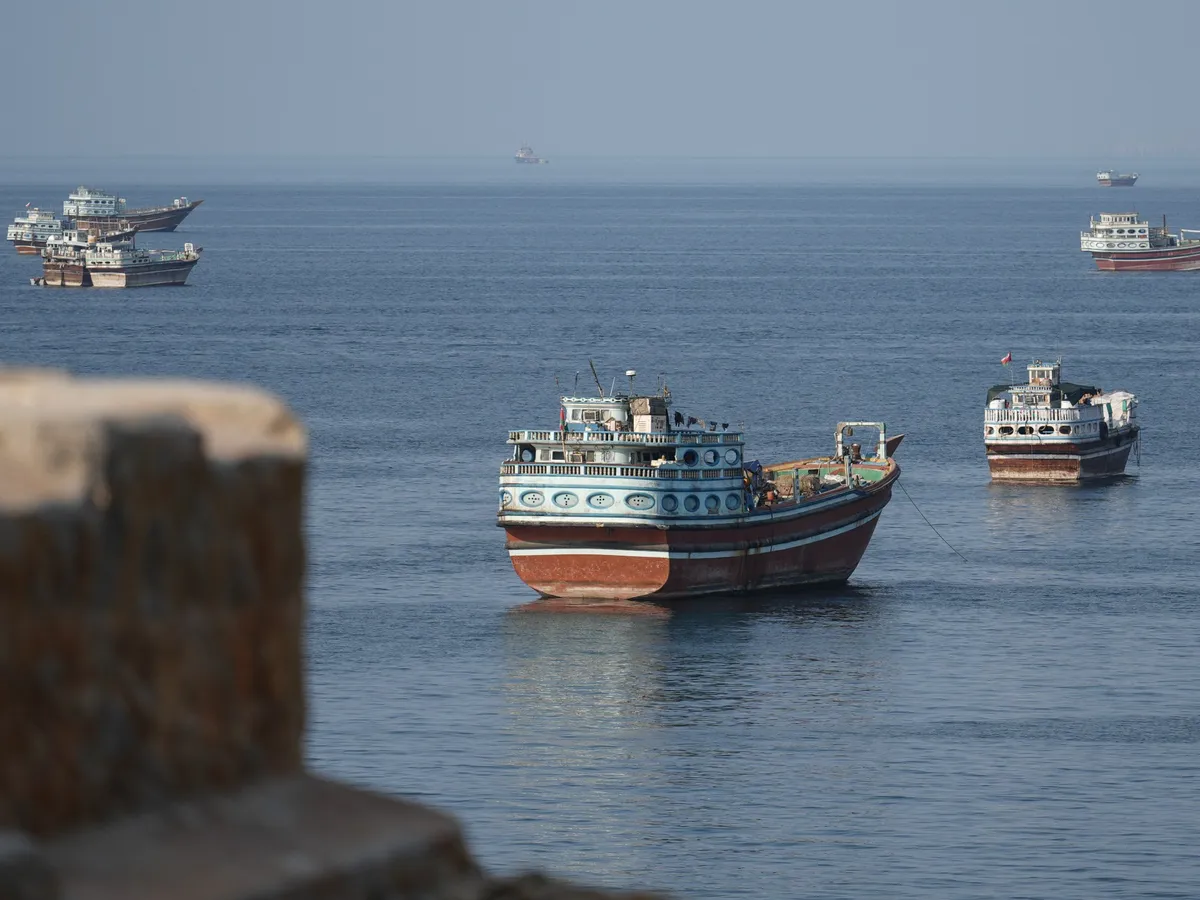
EXPLAINERCrude exports bypassing Hormuz surged in September, yet oil prices remain high. Could a secret fee be the reason?Ships anchored off the coast of Khasab in Oman’s Musandam governorate, near the Strait of Hormuz, October 2, 2026 [AFP]Published On 5 Oct 2026Middle East oil exports have climbed back above levels seen before the Iran" class="entity-link entity-event" data-entity-id="38678" data-entity-type="event">US-Israel war on Iran began in February, despite Tehran’s attempts to blockade the Strait of Hormuz and attack vessels.Crude exports from the region exceeded pre-war levels on four days in the final week of September, reaching between 19.5 and 22.5 million barrels per day (bpd), according to provisional data from maritime tracking firm Kpler. Before the war, exports averaged about 18 million bpd.Recommended Stories list of 3 itemslist 1 of 3Trump vs Europe as US presses for release of emergency diesel stockslist 2 of 3Iraq grants Iranian airlines 40 daily Najaf flights after US exemptionlist 3 of 3Iran says Hormuz to remain closed until US meets conditionsend of listThis surge in oil exports from the region has so far largely been attributed to US ships shepherding tankers out of the Strait of Hormuz, coupled with increasing ship-to-ship transfers that reduce the risks of being targeted by Iranian missiles and drones. Meanwhile, the fact that oil prices have remained high has been explained by analysts as the result of still-elevated insurance rates — driven by fears of Iranian attacks — and a market factoring in the possibility of a return to a hot war.But a senior Kpler analyst last week offered a different explanation for the rise in oil exports at high prices. Gulf countries, she suggested, may be paying Iran to allow their oil through – potentially handing Tehran a significant portion of the value of the cargo.Before the war, one-fifth of the world’s oil and natural gas exports passed through the Strait of Hormuz.Does this explanation hold up, and what does it mean for the war and oil prices?What did the Kpler analyst say?Michelle Brohard, head of policy and geopolitical risk at Kpler, recently said some countries could be paying Iran for passage through the Strait of Hormuz.“I suspect there is a toll that’s being paid, which is giving these ships safe passage,” she said in an interview last week with energy analyst Rory Johnston.“I also suspect that these countries know that this is unsustainable from a perspective of [the] US escorting [ships], and also unsustainable from them paying Iran 10 percent of their cargo, or 20 percent of their cargo,” she added.“So you’re starting to see like what I would call like a race to get out as much as possible, as quickly as possible before the war restarts.”The claim has not been independently verified, and Brohard presented it as speculation rather than a finding backed by evidence.But as early as March, the shipping journal Lloyd’s List reported that Iran’s Islamic Revolutionary Guard Corps (IRGC) had already imposed a “toll booth” system to control vessel traffic through the strait.The Trump administration, during the course of the war, has repeatedly said Iran will not be permitted to charge a toll under any potential agreement with Washington.Closure of the strait has caused global fuel costs to soar and has tested agricultural sectors across the world.What does traffic in the Hormuz look like?Oil is increasingly getting out of the Middle East, marine trackers report.In the last week of September, the seven-day average climbed above the roughly 18 million bpd recorded before the Iran" class="entity-link entity-event" data-entity-id="38678" data-entity-type="event">US-Israel war on Iran began in February – the first time since the conflict started.Kpler said crude exports excluding Iran had also recovered to at least 16.5 million bpd as an average over September.The pattern of increasing oil exports has continued into October. Iraq’s state-owned Oil Tanker Company on Saturday announced that it had transported two million barrels of crude on a very large crude carrier (VLCC) through the Strait of Hormuz, in what its director general said was the company’s first such operation in decades.According to Kpler, “40 percent now bypass Hormuz, and most crude crossing the strait changes tankers offshore”, with much of it flowing through Saudi Arabia and the United Arab Emirates pipelines.The export figures also include supplies moved through the Red Sea, which has become an increasingly important alternative to the Strait of Hormuz.Moreover, the Kpler figures exclude any vessels that may have crossed the key transit route with their automatic identification system transponders turned off to avoid detection.Iran, however, disputes suggestions that it has lost control of the waterway.Senior IRGC commander Ali Fadavi said on Sunday only three to four million bpd were travelling along a US-supervised route and described that amount as “negligible” compared with pre-war traffic.Before the war erupted seven months ago, the strait routinely saw about 125 large commercial vessels a day, including tankers, gas carriers, bulk carriers and container ships.Where are oil prices right now?oil prices have eased marginally as exports from the Middle East recover. Last week, the Group of Seven countries also announced a decision to release 100 million barrels of oil from emergency reserves.But crude prices remain significantly higher than pre-war levels. Brent crude was trading at about $101.59 a barrel on Monday, down 0.71 percent, while US West Texas Intermediate fell 1.2 percent to about $90.05.“Despite exports from the region resurging, much will depend, longer-term, on the security of energy supplies,” said Susannah Streeter, chief investment strategist at Wealth Club, noting that the “situation is still tense”.“The Strait of Hormuz remains a major flashpoint, with the attack on another tanker on Sunday keeping worries bubbling about the potential for further disruption to supplies, particularly if shipping companies become increasingly reluctant to risk sending vessels through the crucial chokepoint.”On Monday, an oil tanker transiting the Strait of Hormuz was instructed by the IRGC to turn back or risk being targeted, according to the United Kingdom Maritime Trade Operations (UKMTO) group that monitors shipping traffic.Does the Kpler analyst’s claim hold weight?Academic Abdul Khalique says while Kpler analyst Brohard’s speculation that a transit-fee arrangement has been put in place may be “plausible”, it is best described as an “informal security mechanism rather than a formal maritime levy”.“No public proof confirms a systematic, state-run Iranian toll system,” Khalique, head of the Liverpool John Moores University Maritime Centre, told Al Jazeera.He said the United Nations Convention on the Law of the Sea (UNCLOS) safeguards transit passage through international straits, “rendering formal tolls legally dubious”.Chris Beauchamp, chief market analyst at IG Group, told Al Jazeera that Brohard’s suspected scenario was “in part” possible.“Everything appears to be happening under the radar in the Middle East, from the US convoying ships to Iran quietly charging tolls,” he told Al Jazeera.In September, the US government also imposed sanctions on a digital assets firm, BitBank, that it said had been used by Iran’s Hormuz Safe Marine Services Authority — a body set up by the country’s government to collect fees for allowing the safe transit of vessels through the strait — to transfer money to Tehran.However, Beauchamp said the biggest challenge for oil exports was now what he called the “problem of shipping”.“The shuttle system in the Gulf is doing wonders in getting oil out, but it requires plenty of ships, and that has pushed freight rates higher while also reducing supply beyond the region itself,” he added.
SRCAl Jazeera
LANGEN
LEANCenter
WORDS1 215
ENT12
MON · 2026-10-05 · 13:11 GMTBRIEF NSR-2026-1005-116456
NSR-2026-1005-116456Analysis·EN·Conflict
Is Iran charging a toll to allow oil traffic through Hormuz?
Middle East crude oil exports have rebounded above pre-war levels, reaching 19.5 to 22.5 million barrels per day in late September, according to Kpler data. This surge occurs despite Iran's attempts to disrupt traffic through the Strait of Hormuz.
Usaid SiddiquiAl JazeeraFiled 2026-10-05 · 13:11 GMTLean · CenterRead · 5 min
Al JazeeraFIG 01
Reading time
5min
Word count
1 215words
Sources cited
3cited
Entities identified
12entities
Quality score
100%
§ 01
Briefing Summary
AI-generatedNEWSAR · AI
Middle East crude oil exports have rebounded above pre-war levels, reaching 19.5 to 22.5 million barrels per day in late September, according to Kpler data. This surge occurs despite Iran's attempts to disrupt traffic through the Strait of Hormuz. While US escorts and ship-to-ship transfers are cited as reasons for increased exports, a Kpler analyst has speculated that Gulf countries might be paying Iran a secret toll for safe passage. This claim, though unverified, aligns with earlier reports of Iran imposing a "toll booth" system. Despite rising exports, oil prices remain high due to insurance costs and market fears of renewed conflict.
Confidence 0.90Sources 3Claims 5Entities 12
§ 02
Article analysis
Model · rule-basedFraming
Conflict
Economic Impact
Tone
Mixed Tone
AI-assessed
CalmNeutralAlarmist
Factuality
0.40 / 1.00
Mixed
LowHigh
Sources cited
3
Well sourced
FewMany
§ 03
Key claims
5 extracted01
The Strait of Hormuz was a critical chokepoint, with one-fifth of the world’s oil and natural gas exports passing through it before the war.
factual
Confidence
0.90
02
Crude exports from the Middle East exceeded pre-war levels in the final week of September, reaching between 19.5 and 22.5 million barrels per day.
statisticKpler
Confidence
0.90
03
Iran's IRGC had already imposed a 'toll booth' system to control vessel traffic through the Strait of Hormuz as early as March.
factualLloyd's List
Confidence
0.70
04
Some countries may be paying Iran for safe passage through the Strait of Hormuz, potentially handing Tehran a significant portion of cargo value.
quoteMichelle Brohard (Kpler)
Confidence
0.60
05
There is a race to export as much oil as possible quickly before the war restarts.
predictionMichelle Brohard (Kpler)
Confidence
0.50
§ 04
Full report
5 min read · 1 215 words§ 05
Entities
12 identifiedKey playerOppositionContextPositiveNeutralNegative
Organizations1
Locations6
§ 06
Keywords & salience
10 termsoil exports
1.00
strait of hormuz
1.00
oil prices
0.90
iran
0.80
us-israel war on iran
0.70
toll fee
0.70
maritime security
0.60
geopolitical risk
0.50
kpler
0.40
tanker traffic
0.40
§ 07
Topic connections
Interactive graph Network visualization showing 51 related topics
View Full Graph Person Organization Location Event|Click node to navigate|Edge numbers = shared articles