On the rare occasions when a neutrino strikes an atomic nucleus, it produces fast-moving charged particles. It is these racing through the ice, which give off a blue glow, which sensitive light detectors can pick up.The pattern and timing of that light allow scientists to estimate the direction the neutrino came from — helping them trace its origins in the cosmos. But these interactions are so rare that the observatory needed an enormous volume of clear ice.Halzen's idea was to use a vast natural ice sheet in Antarctica. So began an audacious plan to build a neutrino observatory at the geographic South Pole, with thousands of light sensors embedded deep in the ice.The neutrino's ghostly nature, the very thing that makes it so hard to detect, also makes it a powerful messenger from the distant Universe. Neutrinos rarely interact with material in its way, so they can go right through dense regions that light cannot easily penetrate. And because they have no electric charge, magnetic fields do not bend their paths through space. That means their direction of arrival can point scientists back towards their source.Their energies carry further insight into the processes that created them - helping scientists investigate how exploding stars and the environments around giant black holes accelerate particles to extraordinary energies. Louis Barson, director of science at the Institute of Physics in London, said the IceCube Observatory had opened a "remarkable" new window on the Universe that has enabled astronomers to investigate phenomena that conventional telescopes cannot see.
SRCBBC News - World
LANGEN
LEANCenter
WORDS252
ENT10
TUE · 2026-10-06 · 11:24 GMTBRIEF NSR-2026-1006-116724
NSR-2026-1006-116724News Report·EN·Technology
'Ghost particles' from space telescope wins physics Nobel
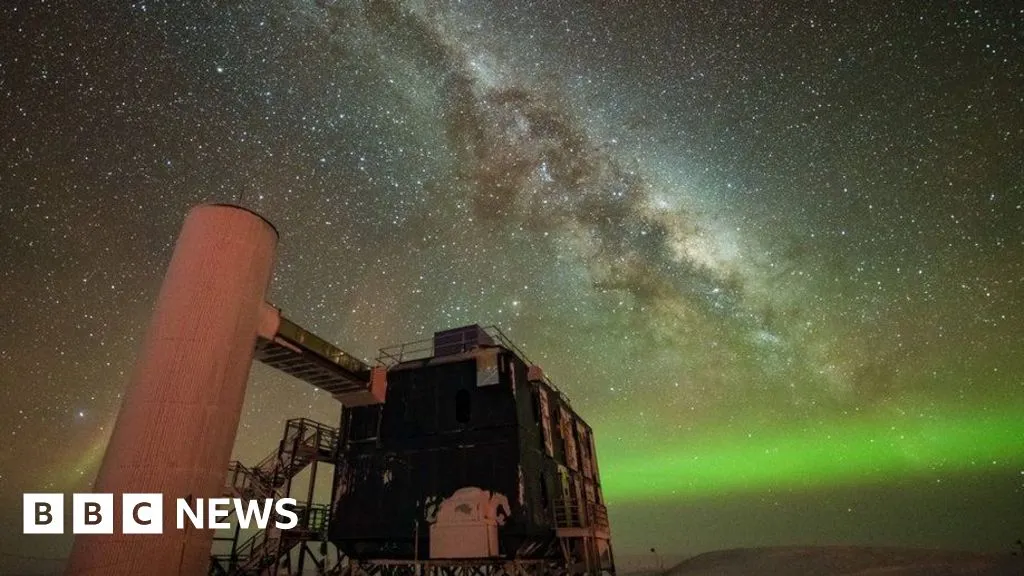
Physicist Prof Francis Halzen has been awarded the Nobel Prize for his pioneering work on an observatory that detects neutrinos from space. These elusive "ghost particles" are detected by observing the faint blue glow they produce when interacting with atomic nuclei in Antarctic ice.
36 minutes agoShareSaveAdd as preferred on GooglePallab GhoshScience correspondentBBC News - WorldFiled 2026-10-06 · 11:24 GMTLean · CenterRead · 2 min
BBC News - WorldFIG 01
Reading time
2min
Word count
252words
Sources cited
1cited
Entities identified
10entities
Quality score
100%
§ 01
Briefing Summary
AI-generatedNEWSAR · AI
Physicist Prof Francis Halzen has been awarded the Nobel Prize for his pioneering work on an observatory that detects neutrinos from space. These elusive "ghost particles" are detected by observing the faint blue glow they produce when interacting with atomic nuclei in Antarctic ice. Halzen's innovative idea was to embed thousands of light sensors deep within a vast natural ice sheet at the geographic South Pole, creating the IceCube Observatory. This observatory's immense volume of clear ice is necessary due to the rarity of neutrino interactions. Neutrinos are valuable cosmic messengers because their lack of charge and weak interaction allow them to travel unimpeded through dense regions, pointing directly to their origins and carrying information about high-energy cosmic events like exploding stars and black holes.
Confidence 0.90Sources 1Claims 5Entities 10
§ 02
Article analysis
Model · rule-basedFraming
Technology
Human Interest
Tone
Measured
AI-assessed
CalmNeutralAlarmist
Factuality
0.90 / 1.00
Factual
LowHigh
Sources cited
1
Limited
FewMany
§ 03
Key claims
5 extracted01
The IceCube Observatory has opened a 'remarkable' new window on the Universe for phenomena conventional telescopes cannot see.
quoteLouis Barson
Confidence
1.00
02
Neutrinos are powerful messengers from the distant Universe because they rarely interact with material and are not affected by magnetic fields.
factual
Confidence
1.00
03
The IceCube Observatory uses a vast natural ice sheet in Antarctica with thousands of light sensors embedded deep in the ice.
factual
Confidence
1.00
04
The pattern and timing of light from neutrino interactions allow scientists to estimate the neutrino's direction and origin.
factual
Confidence
1.00
05
Neutrinos striking an atomic nucleus produce fast-moving charged particles that give off a blue glow detected by light sensors.
factual
Confidence
1.00
§ 04
Full report
2 min read · 252 words§ 05
Entities
10 identifiedKey playerOppositionContextPositiveNeutralNegative
§ 06
Keywords & salience
8 termsneutrino
1.00
icecube observatory
0.90
physics nobel
0.80
cosmic messenger
0.70
light detectors
0.60
antarctica ice sheet
0.50
exploding stars
0.40
giant black holes
0.40
§ 07
Topic connections
Interactive graph No topic relationship data available yet. This graph will appear once topic relationships have been computed.