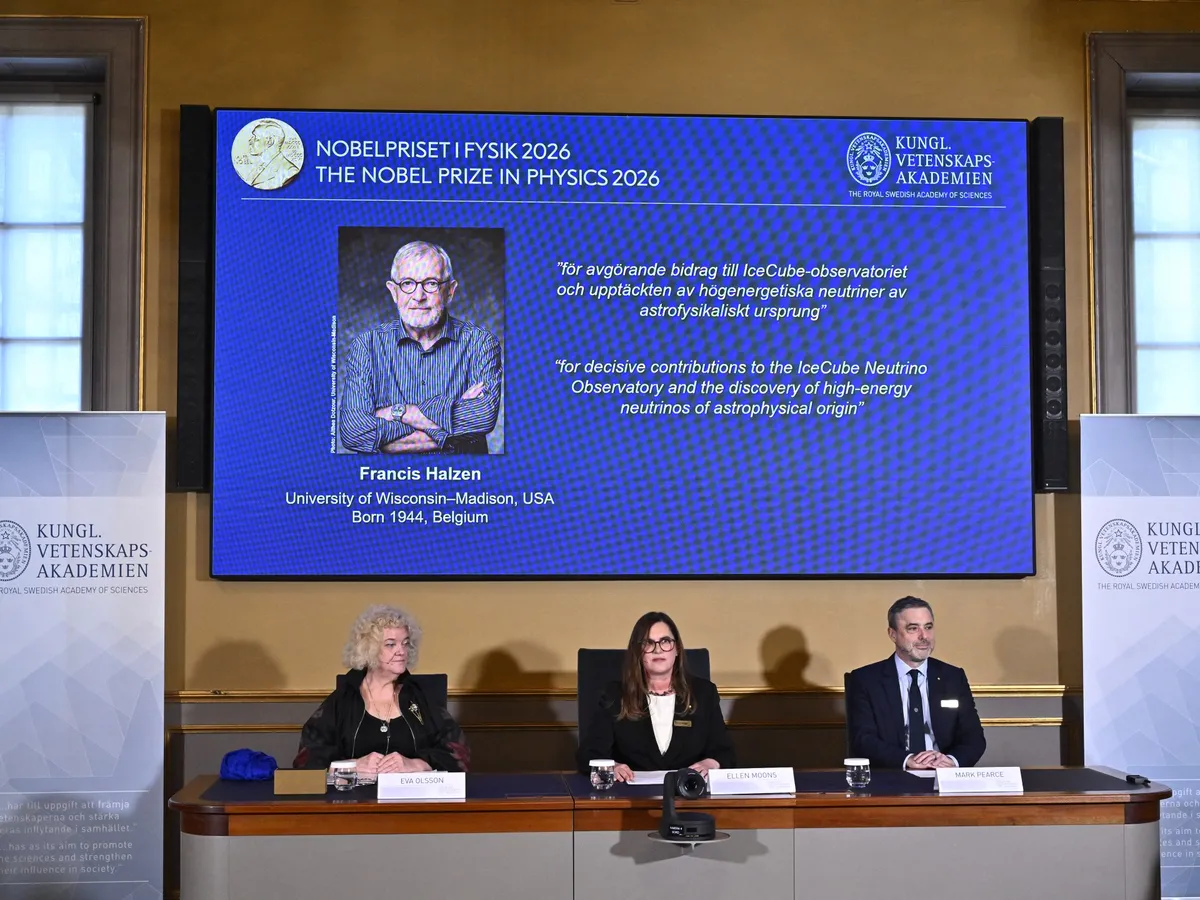
Belgian physicist worked to build Antarctic observatory that tracks neutrinos from deep space.Belgian physicist Francis Halzen has won the 2026 Nobel Prize in Physics for creating a giant detector in Antarctica that captures neutrinos, the so-called “ghost particles” from space that scientists believe offer clues to how the universe evolved.The Royal Swedish Academy of Sciences announced the prestigious award in Stockholm on Tuesday, crediting Halzen with a central role in building the IceCube Neutrino Observatory.Recommended Stories list of 3 itemslist 1 of 3Is there life on another planet? Scientists find the strongest evidence yetlist 2 of 3Have scientists discovered a dark matter particle?list 3 of 3Nobel medicine prize honours US and German scientists for optogenetics workend of listThe neutrino interactions collected by the observatory provide information about how high-energy neutrinos are created and may even reveal previously unknown phenomena, the Academy said.“It was a great surprise, and I obviously didn’t expect it,” Halzen said, speaking to the committee by phone from Italy, in a call broadcast at the news conference to announce the winner.The 82-year-old said it was predicted before that he would win the Nobel Prize, but the announcement still made him feel “strange”.“I am working on a proposal, and I hope that this prize will help getting it approved,” he said to chuckles from the audience.‘Information from the cosmos’neutrinos have nearly no mass and carry no electric charge, so they can cross between planets, stars and human bodies without being altered, making them rare and hard to catch. There are roughly 100 trillion solar and cosmic neutrinos that pass through our bodies every second.Halzen first proposed the IceCube project in 1988, realising that the clear ice beneath the South Pole could act as a detector, so on the rare occurrence a neutrino strikes an atomic nucleus, it gives off a flash of light that buried sensors can record.
SRCAl Jazeera
LANGEN
LEANCenter
WORDS310
ENT9
TUE · 2026-10-06 · 12:31 GMTBRIEF NSR-2026-1006-116782
NSR-2026-1006-116782News Report·EN·Human Interest
Francis Halzen wins Nobel Prize in Physics for work on ‘ghost particles’
Belgian physicist Francis Halzen has been awarded the 2026 Nobel Prize in Physics for his pivotal role in constructing the IceCube Neutrino Observatory in Antarctica. This observatory tracks neutrinos, also known as "ghost particles," originating from deep space.
Al Jazeera StaffAl JazeeraFiled 2026-10-06 · 12:31 GMTLean · CenterRead · 2 min
Al JazeeraFIG 01
Reading time
2min
Word count
310words
Sources cited
2cited
Entities identified
9entities
Quality score
100%
§ 01
Briefing Summary
AI-generatedNEWSAR · AI
Belgian physicist Francis Halzen has been awarded the 2026 Nobel Prize in Physics for his pivotal role in constructing the IceCube Neutrino Observatory in Antarctica. This observatory tracks neutrinos, also known as "ghost particles," originating from deep space. The Royal Swedish Academy of Sciences recognized Halzen for his work in building the detector, which captures the faint light emitted when neutrinos interact with ice. Scientists believe these interactions provide crucial information about the evolution of the universe and potentially reveal new phenomena. Halzen proposed the IceCube project in 1988, recognizing the Antarctic ice's potential as a detector for these elusive particles that pass through matter unimpeded.
Confidence 0.90Sources 2Claims 5Entities 9
§ 02
Article analysis
Model · rule-basedFraming
Human Interest
Technology
Tone
Measured
AI-assessed
CalmNeutralAlarmist
Factuality
0.90 / 1.00
Factual
LowHigh
Sources cited
2
Limited
FewMany
§ 03
Key claims
5 extracted01
Francis Halzen first proposed the IceCube project in 1988, realizing Antarctic ice could act as a detector for neutrino-induced light flashes.
factual
Confidence
1.00
02
Roughly 100 trillion solar and cosmic neutrinos pass through our bodies every second.
statistic
Confidence
1.00
03
Neutrinos have nearly no mass and carry no electric charge, allowing them to pass through matter unaltered.
factual
Confidence
1.00
04
The IceCube Neutrino Observatory tracks neutrinos from deep space, which are believed to offer clues to how the universe evolved.
factualRoyal Swedish Academy of Sciences
Confidence
1.00
05
Francis Halzen won the 2026 Nobel Prize in Physics for his work on a giant detector in Antarctica that captures neutrinos.
factualRoyal Swedish Academy of Sciences
Confidence
1.00
§ 04
Full report
2 min read · 310 words§ 05
Entities
9 identifiedKey playerOppositionContextPositiveNeutralNegative
Organizations2
Locations4
Topics1
§ 06
Keywords & salience
9 termsghost particles
1.00
neutrinos
1.00
nobel prize in physics
0.90
icecube neutrino observatory
0.90
antarctic observatory
0.80
universe evolution
0.70
deep space
0.60
high-energy neutrinos
0.50
francis halzen
0.50
§ 07
Topic connections
Interactive graph No topic relationship data available yet. This graph will appear once topic relationships have been computed.