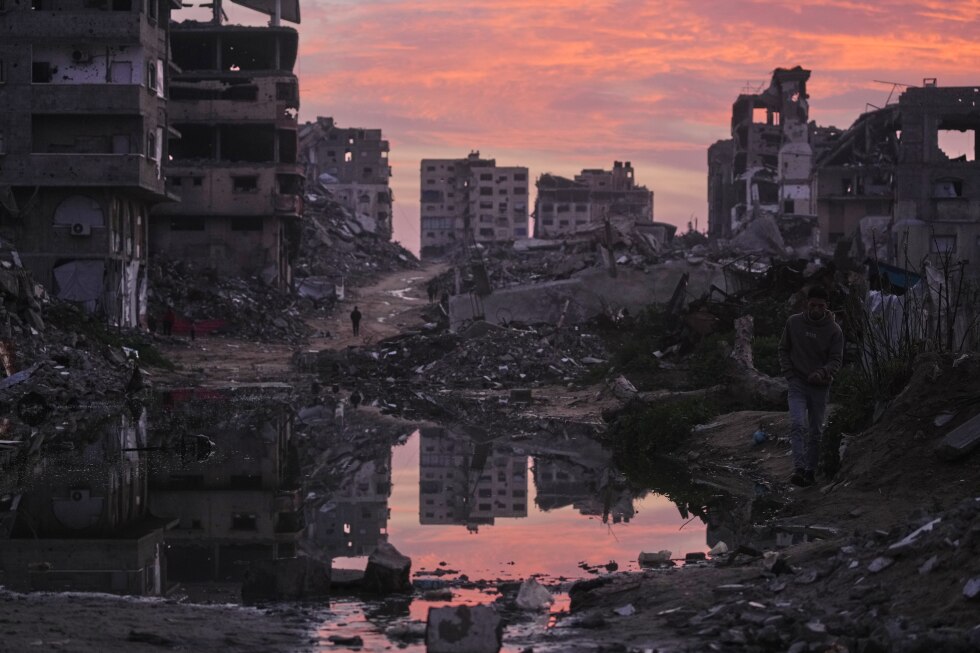
Israel returns Palestinian bodies, official says, marking last exchange between Israel and Hamas 1 of 5 | Palestinians walk amid buildings destroyed by Israeli air and ground operations in Gaza City, Thursday, Jan. 29, 2026. (AP Photo/Jehad Alshrafi) 2 of 5 | Palestinians watch the sun set over the Mediterranean Sea in Gaza City, Thursday, Jan. 29, 2026. (AP Photo/Jehad Alshrafi) 3 of 5 | Red Cross vehicles transport bodies of Palestinians returned from Israel as part of the ceasefire deal to Shifa Hospital, in Gaza City, Thursday, Jan. 29, 2026. (AP Photo/Abdel Kareem Hana) 4 of 5 | Bodies of Palestinians returned from Israel as part of the ceasefire deal are brought to Shifa Hospital, in Gaza City, Thursday, Jan. 29, 2026. (AP Photo/Abdel Kareem Hana) 5 of 5 | Palestinian children fill plastic bottles with water at a tent camp in Deir al-Balah, Gaza Strip, Thursday, Jan. 29, 2026. (AP Photo/Abdel Kareem Hana) 1 of 5 Palestinians walk amid buildings destroyed by Israeli air and ground operations in Gaza City, Thursday, Jan. 29, 2026. (AP Photo/Jehad Alshrafi) Add AP News on Google Add AP News as your preferred source to see more of our stories on Google. 2 of 5 Palestinians watch the sun set over the Mediterranean Sea in Gaza City, Thursday, Jan. 29, 2026. (AP Photo/Jehad Alshrafi) Add AP News on Google Add AP News as your preferred source to see more of our stories on Google. 3 of 5 Red Cross vehicles transport bodies of Palestinians returned from Israel as part of the ceasefire deal to Shifa Hospital, in Gaza City, Thursday, Jan. 29, 2026. (AP Photo/Abdel Kareem Hana) Add AP News on Google Add AP News as your preferred source to see more of our stories on Google. 4 of 5 Bodies of Palestinians returned from Israel as part of the ceasefire deal are brought to Shifa Hospital, in Gaza City, Thursday, Jan. 29, 2026. (AP Photo/Abdel Kareem Hana) Add AP News on Google Add AP News as your preferred source to see more of our stories on Google. 5 of 5 Palestinian children fill plastic bottles with water at a tent camp in Deir al-Balah, Gaza Strip, Thursday, Jan. 29, 2026. (AP Photo/Abdel Kareem Hana) Add AP News on Google Add AP News as your preferred source to see more of our stories on Google. Updated [hour]:[minute] [AMPM] [timezone], [monthFull] [day], [year] Deir al-Balah, Gaza Strip (AP) — Israel turned over the bodies of 15 Palestinians on Thursday, just days after recovering the remains of the last Israeli hostage, a Gaza Health Ministry official said.This marks the last hostage-detainee exchange between Israel and Hamas carried out as part of the first phase of the U.S.-brokered ceasefire reached in October. The Red Cross said it helped facilitate the return of the bodies. They were taken to Shifa Hospital in Gaza City, said Zaher al-Wahidi, a spokesperson at the health ministry. The return of all remaining hostages, living or dead, had been a key part of the first phase in the ceasefire that paused the war.Israel agreed to return 15 Palestinian bodies for each hostage recovered, according to the ceasefire terms. It’s unclear if the bodies released Thursday were of Palestinian detainees who died in Israeli custody or bodies taken from Gaza by Israeli troops during the war. Israel has released roughly 2,000 Palestinian prisoners under the ceasefire deal, many who were seized by Israeli troops during the two-year war and held without charge. It also has released the bodies of 360 Palestinians back to Gaza, where officials have struggled to identify them. The Gaza health ministry, part of the Hamas-run government, has posted photos of the deceased for families to identify. Of the bodies handed back by Israel, about 100 have been identified by families, al-Wahidi said. On Monday, Israel announced that it found and identified the remains of the last Israeli hostage, police officer Ran Gvili, following an extensive search at a cemetery in northern Gaza.The Oct. 7, 2023, attack on Israel that launched the war killed about 1,200 people and saw 251 taken hostage. Gvili, a 24-year-old police officer known affectionately as “Rani,” was killed while fighting Hamas militants. The return of his body closed a painful chapter for the country and cleared the way for the next and more challenging phase of the ceasefire, which calls for deploying an international security force, disarming Hamas, pulling back Israeli soldiers and rebuilding Gaza. Deaths from strikes in Gaza nears 500 since the ceasefire beganWhile U.S. envoy Steve Witkoff announced the launch of the second phase of the ceasefire deal earlier this month, Israeli fire and strikes continue to kill Palestinians across Gaza almost daily.Israeli fire killed two Palestinians on Thursday in southern Gaza’s Khan Younis area, according to Nasser hospital, where the bodies were taken. Health officials said that the two men were killed in areas that are not Israeli-controlled.Another Israeli strike in central Gaza killed one Palestinian and wounded others, according to Al-Aqsa martyrs hospital, where the casualties were taken.The Gaza Health Ministry said some 492 Palestinians have been killed since the ceasefire. It does not distinguish between civilians and combatants in its figures. The ministry maintains detailed casualty records that are seen as generally reliable by U.N. agencies and independent experts.The Israeli military has said that some of those killed in recent months were along the ceasefire line that splits Israeli-held areas and most of Gaza’s Palestinian population, and that it has targeted those posing a threat to its troops. For Palestinians separated from their families by the war and the tens of thousands of people outside Gaza seeking to return home, the opening of the Rafah crossing along the border with Egypt can’t come soon enough.The crossing is expected to open soon, Israeli officials have said, but how many people will be allowed to enter and leave Gaza remains unclear. Preparations are underway to allow the departure of a limited number of medical evacuees who were wounded in the war and need to travel abroad for medical care. But Israel Prime Minister Benjamin Netanyahu has said the crossing will not be open to goods for now. The crossing, Gaza’s main gateway to the outside world, has been largely closed since May 2024.Ezzidin reported from Cairo. Associated Press writer Samy Magdy in Cairo contributed.
SRCAssociated Press (AP)
LANGEN
LEANCenter
WORDS1 053
ENT8
THU · 2026-01-29 · 17:23 GMTBRIEF NSR-2026-0129-11704
NSR-2026-0129-11704News Report·EN·Conflict
Israel returns Palestinian bodies, official says, marking last exchange between Israel and Hamas
On Thursday, January 29, 2026, Israel returned the bodies of 15 Palestinians to Gaza, according to a Gaza Health Ministry official. The bodies were transported to Shifa Hospital in Gaza City via Red Cross vehicles.
By
WAFAA SHURAFA and TOQA EZZIDINAssociated Press (AP)Filed 2026-01-29 · 17:23 GMTLean · CenterRead · 5 min
Associated Press (AP)FIG 01
Reading time
5min
Word count
1 053words
Sources cited
2cited
Entities identified
8entities
Quality score
100%
§ 01
Briefing Summary
AI-generatedNEWSAR · AI
On Thursday, January 29, 2026, Israel returned the bodies of 15 Palestinians to Gaza, according to a Gaza Health Ministry official. The bodies were transported to Shifa Hospital in Gaza City via Red Cross vehicles. This exchange occurred just days after Israel recovered the remains of the last Israeli hostage. The return of the bodies is reported to be the final exchange between Israel and Hamas. The event took place in the context of destroyed buildings and tent camps in Gaza, as seen in associated photographs.
Confidence 0.90Sources 2Claims 5Entities 8
§ 02
Article analysis
Model · rule-basedFraming
Conflict
Human Interest
Tone
Measured
AI-assessed
CalmNeutralAlarmist
Factuality
0.90 / 1.00
Factual
LowHigh
Sources cited
2
Limited
FewMany
§ 03
Key claims
5 extracted01
They were taken to Shifa Hospital in Gaza City.
factualZaher al-Wahidi, a spokesperson at the health ministry
Confidence
1.00
02
The Red Cross said it helped facilitate the return of the bodies.
quoteThe Red Cross
Confidence
1.00
03
The exchange was carried out as part of the first phase of the U.S.-brokered ceasefire reached in October.
factualnull
Confidence
1.00
04
Israel turned over the bodies of 15 Palestinians on Thursday.
factualGaza Health Ministry official
Confidence
1.00
05
This marks the last hostage-detainee exchange between Israel and Hamas.
factualnull
Confidence
0.90
§ 04
Full report
5 min read · 1 053 words§ 05
Entities
8 identifiedKey playerOppositionContextPositiveNeutralNegative
§ 06
Keywords & salience
7 termspalestinian bodies
1.00
israel
0.90
hamas
0.80
body exchange
0.70
gaza strip
0.60
ceasefire deal
0.50
shifa hospital
0.40
§ 07
Topic connections
Interactive graph Network visualization showing 51 related topics
View Full Graph Person Organization Location Event|Click node to navigate|Edge numbers = shared articles