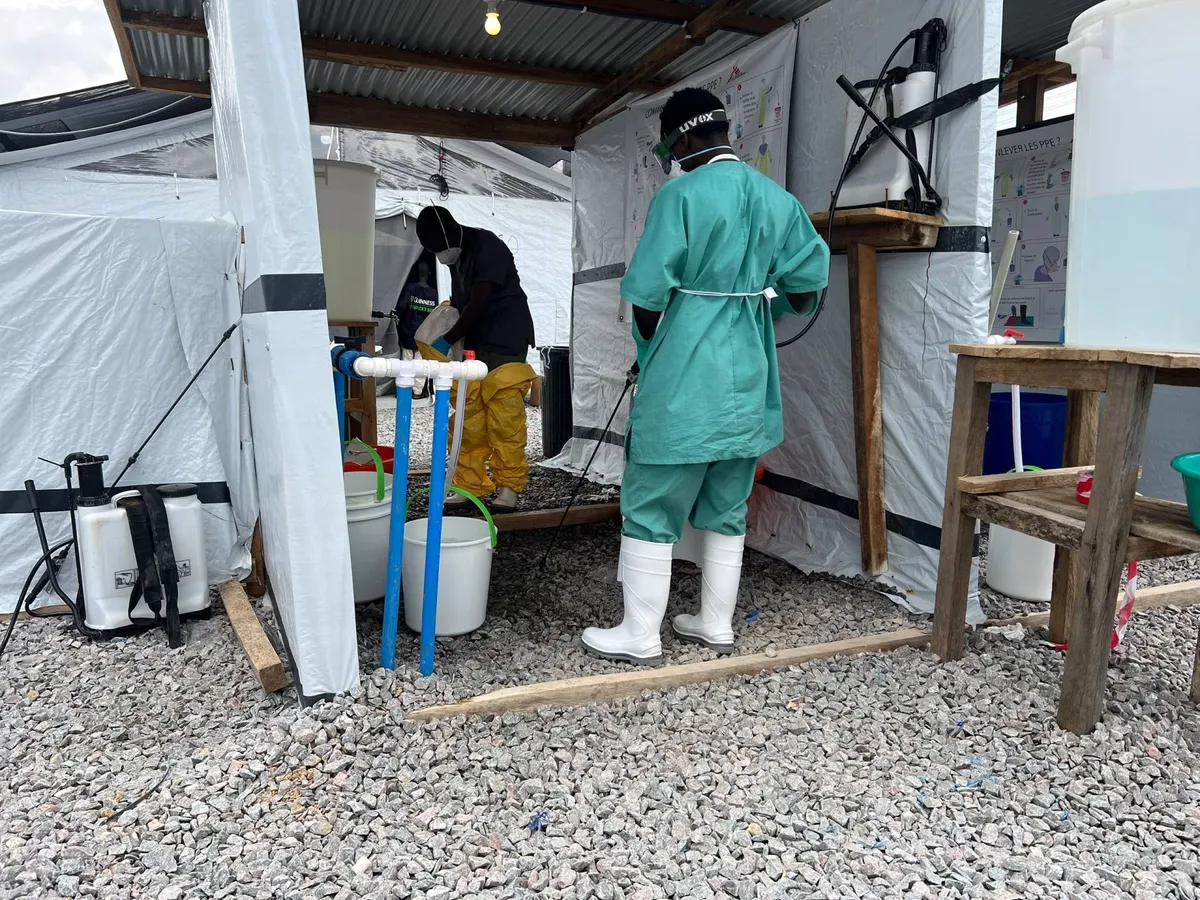
New cases in eastern DRC and a fatal imported infection in Kenya highlight the challenges of containing Ebola.A hygienist at an Ebola treatment centre in Bunia, in the Democratic Republic of the Congo [Prosper Heri /Al Jazeera]Published On 11 Oct 2026Beni, Democratic Republic of Congo – The Ebola outbreak in the Democratic Republic of the Congo (DRC) has spread to another health zone in the east, while a fatal imported case in Kenya has underscored the risk of cross-border transmission.The World Health Organization (WHO) said in an October 8 update that Alimbongo health zone in North Kivu province had reported cases for the first time. As of October 6, four confirmed cases, including two deaths, had been recorded there.The outbreak is caused by the Bundibugyo virus, a species of Ebola virus. According to the WHO, cases had been reported in 64 health zones across seven provinces in the DRC. Ituri remained the worst-affected province in cumulative cases, while North Kivu was accounting for a growing share of newly confirmed infections.As of October 6, the WHO had recorded 8,728 confirmed cases and 4,205 confirmed deaths in the DRC. A further 2,269 people had recovered, and the crude case fatality ratio stood at 48.2 percent.Kenya confirms imported caseKenya confirmed its first imported case of Bundibugyo virus disease on October 6, according to the WHO. The patient, a Kenyan citizen who had been living in the DRC, fell ill there and received treatment at several health facilities before travelling to Kenya through Uganda.The patient travelled by road to Kampala, Uganda, before flying to Nairobi, arriving on October 3. The patient was isolated in hospital and tested positive for the virus. Despite supportive treatment, the patient died on October 5, the WHO said.Kenyan authorities identified 28 contacts, including family members and healthcare workers. The WHO also reported efforts to trace passengers and crew members from the flight to Nairobi.Kenyan Ministry of Health officials screen arriving passengers at Jomo Kenyatta International Airport in Nairobi amid Ebola-related health precautions [AFP]Public health measures have been initiated in Kenya and Uganda, including contact tracing and enhanced surveillance.On October 8, preliminary laboratory results for a suspected Ebola case in Kenya’s Wajir County came back negative, according to the county governor. The result eased concerns about a possible second case, although monitoring continued.The imported infection has underscored the importance of surveillance and coordination between neighbouring countries. Identifying exposed people and monitoring them for symptoms are central to detecting infections early and interrupting further transmission.Treatment capacity under pressureIn the DRC, the response is facing mounting pressure from limited treatment capacity, insecurity and difficulties securing cooperation from some communities.Daniel Makasi Levergénois, founder of Watoto Radio, said insecurity and misinformation were undermining efforts to contain the outbreak. In Beni and Butembo, both in North Kivu, rumours and misconceptions about Ebola had contributed to reluctance among some residents to cooperate with response teams, he said.In an October 5 update, medical charity Doctors Without Borders, known by its French initials MSF, said North Kivu accounted for nearly 40 percent of newly confirmed cases nationwide, up from 24 percent at the end of August.MSF also reported that, as of September 28, 34 percent of confirmed Ebola patients were being treated in non-specialised health facilities. Dedicated treatment centres lacked sufficient beds, while delays in diagnosis meant some patients were being treated outside facilities equipped to manage Ebola.The organisation warned that many of these facilities lacked the resources and expertise needed to manage the disease, increasing the risk of transmission among patients and healthcare workers.“For weeks, treatment capacity has stretched to its limit,” said Stephanie Hoffmann, coordinator of MSF’s Ebola treatment centre in Butembo.“Because there are not enough beds available, we are sometimes forced to refer confirmed Ebola patients elsewhere, despite the significant risk this poses to the wider community. In addition, standards of care in some peripheral facilities do not always meet the requirements for Ebola treatment. This is extremely concerning.”Mistrust threatens containment effortsAlberto Lusenge, a community leader in Beni, said the failure to stop transmission early in Ituri province, followed by new cases and attacks on response workers in Beni and Butembo, had deepened public concern.Lusenge warned that mistrust could discourage residents from reporting symptoms or cooperating with health workers. He said North Kivu could become a greater focus of the outbreak if authorities failed to secure stronger cooperation from local communities.A worker in protective gear handles sanitary basins at an Ebola treatment centre run by MSF in Butembo, eastern DRC [Gradel Muyisa Mumbere/Reuters]The WHO said response teams were following up 23,741 of the 29,535 identified contacts as of October 4, equivalent to 80.4 percent – below the response target of at least 85 percent.Contact tracing allows health authorities to identify people who may have been exposed, monitor them for symptoms and detect infections early. Gaps in follow-up can make it harder to identify and interrupt chains of transmission.The Africa Centres for Disease Control and Prevention (Africa CDC) has called for a community-centred response, including active case finding, systematic contact tracing, daily follow-up of exposed people and sustained engagement with local communities.A history of deadly outbreaksThe DRC’s 2018–2020 Ebola outbreak, caused by a different virus species, killed nearly 2,300 people. The current outbreak presents distinct challenges: According to the WHO, there are no approved vaccines or specific treatments for Bundibugyo virus disease.Early detection, supportive care and infection prevention therefore remain central to the response. But as infections spread into additional health zones and treatment facilities struggle to accommodate patients, health authorities face the dual challenge of containing transmission and maintaining public trust.Jean Kaseya, director-general of Africa CDC, has stressed the importance of rapidly identifying and monitoring people exposed to the virus.“To bring this outbreak under control, we need to know where every contact is, track them and quickly identify anyone showing symptoms before they pass the virus on to their family, their community or across borders. We will only bring this outbreak under control once the last chain of transmission has been broken,” Kaseya said in a news release seen by Al Jazeera.
SRCAl Jazeera
LANGEN
LEANCenter
WORDS1 007
ENT12
SUN · 2026-10-11 · 00:23 GMTBRIEF NSR-2026-1011-117977
NSR-2026-1011-117977News Report·EN·Public Health
Ebola spreads in eastern DRC as Kenya confirms imported case
The Ebola outbreak in the Democratic Republic of the Congo (DRC) has expanded to the Alimbongo health zone in North Kivu province, reporting four cases and two deaths as of October 6. This outbreak, caused by the Bundibugyo virus, has affected 64 health zones across seven provinces, with Ituri and North Kivu being the most impacted.
Prosper Heri NgororaAl JazeeraFiled 2026-10-11 · 00:23 GMTLean · CenterRead · 5 min
Al JazeeraFIG 01
Reading time
5min
Word count
1 007words
Sources cited
3cited
Entities identified
12entities
Quality score
100%
§ 01
Briefing Summary
AI-generatedNEWSAR · AI
The Ebola outbreak in the Democratic Republic of the Congo (DRC) has expanded to the Alimbongo health zone in North Kivu province, reporting four cases and two deaths as of October 6. This outbreak, caused by the Bundibugyo virus, has affected 64 health zones across seven provinces, with Ituri and North Kivu being the most impacted. Concurrently, Kenya confirmed its first imported case of the Bundibugyo virus on October 6, a Kenyan citizen who had been in the DRC and died on October 5 despite treatment. Public health measures, including contact tracing and enhanced surveillance, are underway in Kenya and Uganda. In the DRC, containment efforts are challenged by limited treatment capacity, insecurity, and community mistrust, leading to some patients being treated in non-specialized facilities.
Confidence 0.90Sources 3Claims 5Entities 12
§ 02
Article analysis
Model · rule-basedFraming
Public Health
Conflict
Tone
Measured
AI-assessed
CalmNeutralAlarmist
Factuality
0.90 / 1.00
Factual
LowHigh
Sources cited
3
Well sourced
FewMany
§ 03
Key claims
5 extracted01
Kenyan authorities identified 28 contacts of the imported case, including family members and healthcare workers.
factualWorld Health Organization
Confidence
1.00
02
The patient who died in Kenya tested positive for the virus and died on October 5 despite supportive treatment.
factualWorld Health Organization
Confidence
1.00
03
As of October 6, the WHO recorded 8,728 confirmed cases and 4,205 confirmed deaths in the DRC, with a case fatality ratio of 48.2 percent.
statisticWorld Health Organization
Confidence
1.00
04
Kenya confirmed its first imported case of Bundibugyo virus disease on October 6, a Kenyan citizen who had been living in the DRC.
factualWorld Health Organization
Confidence
1.00
05
Ebola outbreak has spread to Alimbongo health zone in North Kivu province, DRC, with four confirmed cases and two deaths as of October 6.
statisticWorld Health Organization
Confidence
1.00
§ 04
Full report
5 min read · 1 007 words§ 05
Entities
12 identifiedKey playerOppositionContextPositiveNeutralNegative
Organizations2
Locations8
Events1
§ 06
Keywords & salience
10 termsebola outbreak
1.00
democratic republic of the congo
0.90
kenya
0.90
cross-border transmission
0.80
bundibugyo virus
0.70
public health measures
0.60
imported case
0.50
contact tracing
0.50
world health organization
0.40
case fatality ratio
0.40
§ 07
Topic connections
Interactive graph Network visualization showing 51 related topics
View Full Graph Person Organization Location Event|Click node to navigate|Edge numbers = shared articles