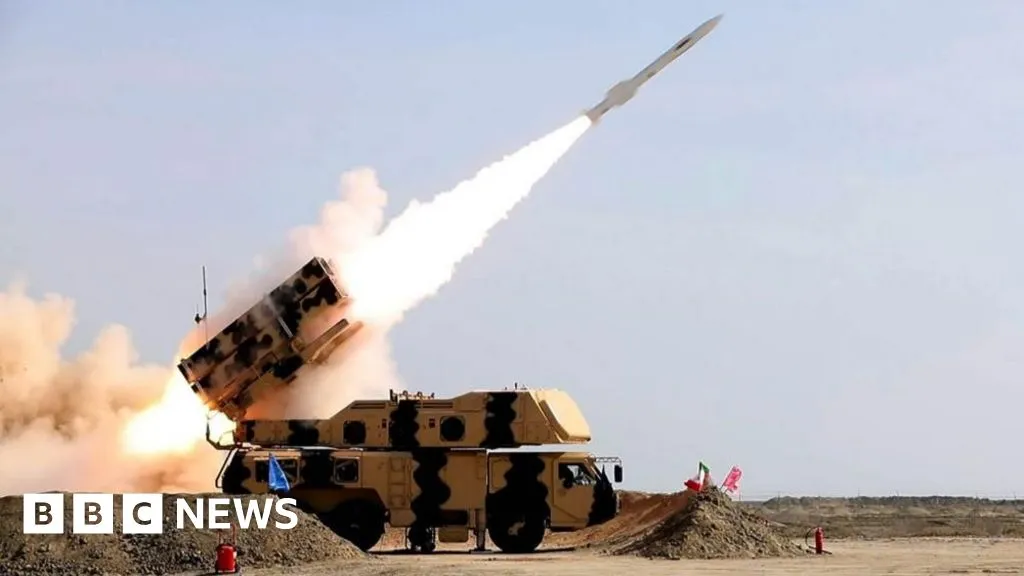
51 minutes agoAmir AzimiBBC News PersianMike Blake/ReutersA naval strike group led by the USS Abraham Lincoln has arrived in the Middle East, reports sayThe arrival of the USS Abraham Lincoln carrier strike group into the US Central Command area of responsibility, close to Iranian waters, has sharpened the sense that a broader confrontation may be taking shape. Coming amid the most extensive and violent crackdown on protests in Iran in recent memory, the deployment underscores how close Washington and Tehran may now be to a direct showdown, closer than at any point in recent years. Iranian leaders find themselves squeezed between a protest movement increasingly demanding the removal of the regime itself and a US president who has kept his intentions deliberately opaque, fuelling anxiety not only in Tehran but across an already volatile region.Iran's response to a potential US military strike may not follow the familiar, carefully calibrated pattern seen in earlier confrontations with Washington. President Donald Trump's recent threats, made in the context of Iran's violent suppression of domestic unrest, come at a moment of exceptional internal strain for the Islamic Republic. As a result, any US attack now carries a significantly higher risk of rapid escalation, both regionally and inside Iran.In recent years, Tehran has shown a preference for delayed and limited retaliation. After US strikes on Iranian nuclear facilities on 21-22 June 2025, Iran responded with a missile attack on the US-operated Al Udeid Air Base in Qatar the following day. According to President Trump, Iran had given advance warning of the strike, allowing air defences to intercept most of the missiles. No casualties were reported. The exchange was widely interpreted as a deliberate attempt by Iran to signal resolve while avoiding a wider war.A similar pattern emerged in January 2020, during Trump's first presidency. Following the US assassination of Quds Force commander, Qassem Soleimani near Baghdad airport on 3 January, Iran retaliated five days later by firing missiles at the US Ain al-Asad airbase in Iraq. Again, advance warning was provided. While no US personnel were killed, dozens later reported traumatic brain injuries. The episode reinforced the perception that Tehran sought to manage escalation rather than provoke it.ReutersTrump threatened to attack Iran if protesters were killedThe present moment, however, is markedly different.Iran is emerging from one of the most serious waves of domestic unrest since the establishment of the Islamic Republic in 1979. Protests that erupted in late December and early January were met with a severe violent crackdown. Human rights organisations and medical workers inside the country report that several thousand people have been killed, with many more injured or detained. The exact numbers cannot be verified due to a lack of access and an internet blackout which has continued for more than two weeks. Iranian authorities have not accepted responsibility for the deaths, instead blaming what they describe as "terrorist groups" and accusing Israel of fomenting the unrest.That narrative has been echoed at the highest levels of the state. Iran's secretary of the Supreme National Security Council said recently that the protests should be seen as a continuation of last summer's 12-day war with Israel, a framing that offers insight into the authorities' security-first response and that might have been used as an excuse to justify the scale and intensity of the crackdown.Although the scale of street protests has since diminished, they have not ended. The grievances remain unresolved, and the divide between large parts of society and the ruling system has rarely appeared so wide.On 8 and 9 January, security forces reportedly lost control of parts of several towns and neighbourhoods in major cities before reasserting authority through overwhelming force. That brief loss of control appears to have deeply unsettled the authorities. The calm that followed has been imposed rather than negotiated, leaving the situation highly combustible.Uncompromising rhetoricAgainst this backdrop, the nature of any US strike becomes critical. A limited attack may allow Washington to claim military success while avoiding immediate regional war, but it could also provide Iranian authorities with a pretext for another round of internal repression. Such a scenario risks fresh crackdowns, mass arrests and a new wave of harsh sentences, including death penalties, for protesters already in detention.At the other extreme, a broader US campaign that significantly weakens or cripples the Iranian state could push the country towards the brink of chaos. The sudden collapse of central authority in a country of more than 90 million people would be unlikely to produce a clean or rapid transition. Instead, it could trigger prolonged instability, factional violence, and spillover effects across the region, with consequences that may take years to contain.These risks help explain the increasingly uncompromising rhetoric from Tehran. Senior commanders in both the Islamic Revolutionary Guard Corps and the regular armed forces, along with senior political officials, have warned that any US attack-regardless of scale-would be treated as an act of war.Such declarations have unsettled Iran's neighbours, particularly Gulf states hosting US forces. A rapid Iranian response would place those countries - and Israel - at immediate risk, regardless of their direct involvement, and raises the prospect of a conflict spreading far beyond Iran and the United States.Washington, too, faces constraints. Trump has repeatedly warned Iranian authorities against using violence against protesters and, at the height of the unrest, told Iranians that "help is coming". Those remarks were widely circulated inside Iran and raised expectations among protesters.Maxar Technologies/EPAThe US attacked Iranian nuclear sites during Iran's war with Israel in June 2025Both sides are aware of the broader strategic picture. Trump knows Iran is militarily weaker than it was before last summer's 12-day war, and Tehran is aware that he has little appetite for a full-scale, open-ended conflict. That mutual awareness may provide some reassurance, but it could also create dangerous misperceptions, with each side potentially overestimating its leverage or misreading the opponent's intentions.For Trump, finding a balance, whatever that might be, is crucial. He needs an outcome he can present as a victory, without tipping Iran into either a renewed cycle of repression or a descent into chaos.For Iranian leaders, the danger lies in timing and perception. Iran's previous model of delayed, symbolic retaliation may no longer be sufficient if leaders believe speed is essential to reassert deterrence on the outside and control inside of the country that was shaken by the scale of the recent unrests. Yet, a rapid response would sharply increase the risk of miscalculation, drawing regional actors into a conflict few can afford.With both sides under intense pressure and little room to manoeuvre, a long-running game of brinkmanship may be approaching its most dangerous moment, one in which the cost of getting the balance wrong would be borne not only by governments, but by millions of ordinary Iranians and the wider region beyond.
SRCBBC News - World
LANGEN
LEANCenter
WORDS1 129
ENT9
FRI · 2026-01-30 · 11:04 GMTBRIEF NSR-2026-0130-11922
NSR-2026-0130-11922Analysis·EN·Conflict
Why Iran's response to a US attack could be different this time
The USS Abraham Lincoln carrier strike group's arrival near Iranian waters has heightened tensions between the US and Iran amid significant unrest within Iran. This deployment occurs during a period of intense crackdowns on protests in Iran, increasing the risk of a direct confrontation.
BBC News - WorldFiled 2026-01-30 · 11:04 GMTLean · CenterRead · 5 min
BBC News - WorldFIG 01
Reading time
5min
Word count
1 129words
Sources cited
3cited
Entities identified
9entities
Quality score
100%
§ 01
Briefing Summary
AI-generatedNEWSAR · AI
The USS Abraham Lincoln carrier strike group's arrival near Iranian waters has heightened tensions between the US and Iran amid significant unrest within Iran. This deployment occurs during a period of intense crackdowns on protests in Iran, increasing the risk of a direct confrontation. Unlike past instances where Iran offered measured responses to US actions, the current internal strain within Iran could lead to a more rapid and unpredictable escalation if the US were to attack. Historically, Iran has favored delayed and limited retaliation, such as the missile attacks on Al Udeid Air Base in Qatar and Ain al-Asad airbase in Iraq, often providing advance warning to avoid casualties. However, the present situation, marked by severe domestic turmoil, makes a similar, controlled response less likely.
Confidence 0.90Sources 3Claims 5Entities 9
§ 02
Article analysis
Model · rule-basedFraming
Conflict
Political Strategy
Tone
Mixed Tone
AI-assessed
CalmNeutralAlarmist
Factuality
0.60 / 1.00
Mixed
LowHigh
Sources cited
3
Well sourced
FewMany
§ 03
Key claims
5 extracted01
Following the US assassination of Qassem Soleimani, Iran retaliated five days later by firing missiles at the US Ain al-Asad airbase in Iraq.
factualBBC News Persian
Confidence
0.90
02
After US strikes on Iranian nuclear facilities on 21-22 June 2025, Iran responded with a missile attack on the US-operated Al Udeid Air Base.
factualBBC News Persian
Confidence
0.90
03
President Trump's recent threats come at a moment of exceptional internal strain for the Islamic Republic.
factualBBC News Persian
Confidence
0.80
04
The arrival of the USS Abraham Lincoln carrier strike group has sharpened the sense that a broader confrontation may be taking shape.
predictionBBC News Persian
Confidence
0.70
05
Human rights organisations report that several thousand people have been killed in recent protests in Iran.
factualHuman rights organisations
Confidence
0.60
§ 04
Full report
5 min read · 1 129 words§ 05
Entities
9 identifiedKey playerOppositionContextPositiveNeutralNegative
Organizations1
§ 06
Keywords & salience
8 termsus-iran relations
0.90
military strike
0.80
escalation
0.80
iran protests
0.70
retaliation
0.60
regional conflict
0.50
us central command
0.50
donald trump
0.40
§ 07
Topic connections
Interactive graph Network visualization showing 51 related topics
View Full Graph Person Organization Location Event|Click node to navigate|Edge numbers = shared articles