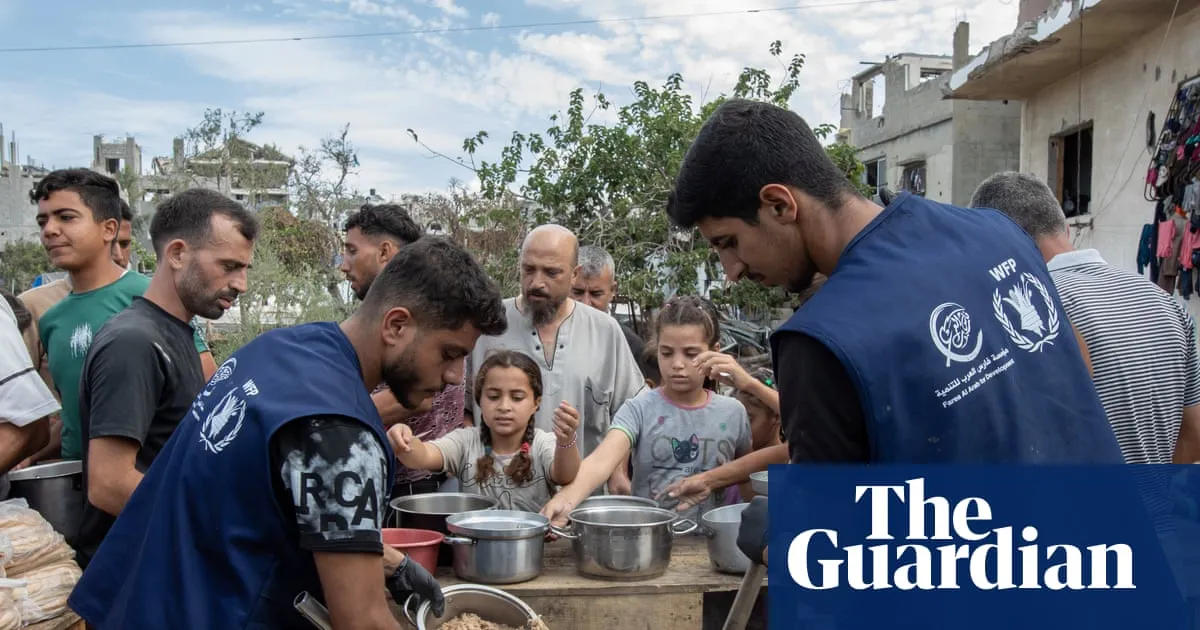
This winter is likely to deepen hunger for Palestinians in Gaza, after sweeping aid cuts forced the UN’s World Food Programme (WFP) to end support for more than half a million people each month, the agency’s director for Palestine said.More than a year after a Trump-brokered ceasefire came into force, promised reconstruction has not begun, there are few jobs and the vast majority in Gaza still rely on aid to eat.This summer, WFP programmes helped feed three-quarters of Gaza’s population, about 1.6 million people, but funding has fallen by more than half from 2025 levels.People receiving aid at the Egyptian camp in central Gaza, where thousands of displaced families live in tents. Photograph: Jaber Badwan/WFPAs a result, from October, aid has been scaled back to 1.1 million people each month. Cuts to deliveries of ration boxes, cash stipends to buy food in markets, and hot meals at community kitchens have already been rolled out.The WFP needs more than £300m over the next six months to restore and maintain critical programmes in Palestine.A year of large aid shipments ended a famine declared in summer 2025 and reduced the most severe hunger, but without steps to rebuild Gaza’s economy, most families still rely on food handouts.Hot meals from community kitchens have only been delivered every other day in October. Photograph: Mohamed Hinnawi/WFP“These are very fragile gains, easily reversed, and the situation is still brutal,” said Shaun Hughes, the WFP’s representative and country director for Palestine.Two-thirds of the population in Gaza face crisis levels of food insecurity, phase three under the Integrated Food Security Phase Classification (IPC), which is used to assess if a population is approaching famine.food insecurity is at emergency levels for 200,000 Palestinians, which means immediate humanitarian supplies are needed to prevent deaths from hunger, Hughes said. This is IPC phase four, one step away from famine conditions.Young children and their mothers are particularly vulnerable. After enduring years of food shortages, one in eight children in Gaza are chronically malnourished or stunted, a recent Unicef survey found, and may have suffered permanent damage.One in eight children in Gaza are chronically malnourished or stunted, a recent Unicef survey found. Photograph: Mohamed Hinnawi/WFPHumanitarian aid will be needed at scale until Israel and the international community launch the large-scale reconstruction promised last year. There is no way for most people to feed their own families at present, because about 80% of Gaza’s population is unemployed, according to UN data.“We need to invest in recovery. This humanitarian operation isn’t affordable or sustainable in the long term,” Hughes said. “Ultimately that’s also what everyone in Gaza is telling us. They really don’t want to be reliant on these handouts, don’t want to stand in the hot meals queue every day. They want to have some chance of stability and recovery.”Gaza was self-sufficient in fruit and vegetables before the war, but the vast majority of farmland has been occupied by Israel’s military. The sophisticated greenhouse and irrigation systems that supported agricultural production have been destroyed.Fish has historically been a key source of protein in the territory, but the Israeli navy bars fishing boats from waters off the coast.Alaa Osama Sarhan, 40, originally from Tal al-Zaatar in Eastern Jabalia Photograph: Amjed Tantesh/The GuardianAlaa Sarhan, 40, lives with his wife and five children aged between four and 16 in a tent near the “yellow line” the marker of Israeli control. They have already noticed the impact of the WFP cuts.“In recent days, we have had to plan our meals around what is available rather than what we want to eat,” he said. A former paramedic, he was injured by Israeli attacks nearly two decades ago, and his disability benefits buy very little.“Often, I give up my share of food so my children can eat. I got accustomed to doing this because the most important thing is that they have something to eat.”For three years, Israeli restrictions on aid shipments have been the main driver of hunger and malnutrition in Gaza. For months at a time, entry of food was restricted or entirely barred as Palestinians went hungry inside the territory.Now, for the first time since October 2023, lack of funds may also become an obstacle to feeding hungry Palestinians. Israel’s controls on shipments into Gaza exacerbate funding shortfalls, because they make humanitarian work particularly expensive compared with other parts of the world.The cost of delivering aid is pushed up by the limited and expensive warehouse space because of the mass destruction of buildings. Photograph: Mohamed Hinnawi/WFPLimits on fuel, engine oil and spare parts, and complex, opaque shipping restrictions push up transport time and costs. Mass destruction of buildings by airstrikes means warehouse space is limited and costly.Even an influx of cash might not allow the WFP to immediately reverse the cuts. Sourcing and shipping the ingredients for ration boxes can take about three months, and the reduction of cash transfers may already be affecting supply chains.The injection of more than £30m a month has “underpinned purchasing power for the private sector in Gaza”, Hughes said, allowing trucks to come in with relatively expensive shipments of both healthy and unhealthy food.For now, the WFP has tried to reduce the impact of funding cuts by scaling back these programmes rather than cutting them entirely. Families who get ration boxes will receive one, rather than two.The WHP’s ration boxes and flour give families essential supplies to prepare meals and bake bread. Photograph: Jaber Badwan/WFPBut even limited reductions may push families with no other food source or income back into dangerous levels of malnutrition. For the poorest of the poor, reduced rations don’t work, Hughes said. “There’s only so far you can cut [support] until you don’t have the food security impact at the household level.”The WFP is trying to monitor hunger levels so they reach the most vulnerable, monitoring “negative coping strategies”. These include whether people have skipped meals, or are seeking exploitative and dangerous work.Nesreen Muqayed, 50, lives with her husband, four children and two grandchildren. She needs a regular diet to manage kidney problems, and a grandson who is on the autism spectrum cannot tolerate many foods.Nesreen Muqayed, 50, originally from Tal al-Zaatar in northern Gaza, displaced at Al Amal seaside camp. Photograph: Amjed Tantesh/The GuardianDespite these urgent medical needs, they often go hungry. “Sometimes we try to save part of a meal for breakfast because we do not know whether we will have anything to eat the following day,” Muqayed said. “The situation has become more difficult over the past two weeks.”Muqayed eating with her family Photograph: Amjed Tantesh/The GuardianThe hot meals from community kitchens that make up a large part of their diet have only been delivered every other day in October, and their meagre backup supplies are already running out.“I used the last of our flour yesterday,” she said. Beyond grappling with daily hunger, she also finds it painful denying her children healthy food they want and need for their development, because they cannot even afford bananas.“Sometimes I pass a fruit seller and look at what he has on display, but I do not have the money to buy,” she said. “Fruit and vegetables have become luxuries that we cannot afford regularly, even though they are basic necessities that every family should be able to access.”
SRCThe Guardian - World News
LANGEN
LEANCenter-Left
WORDS1 210
ENT12
MON · 2026-10-19 · 09:54 GMTBRIEF NSR-2026-1019-120113
NSR-2026-1019-120113News Report·EN·Human Interest
Cuts force World Food Programme to end support for half a million Palestinians in Gaza
The World Food Programme (WFP) has been forced to end support for over half a million Palestinians in Gaza due to significant funding cuts. This reduction means aid now reaches 1.1 million people monthly, down from 1.6 million, impacting ration boxes, cash stipends, and hot meals.
Emma Graham-Harrison in Jerusalem and Seham Tantesh in GazaThe Guardian - World NewsFiled 2026-10-19 · 09:54 GMTLean · Center-LeftRead · 5 min
The Guardian - World NewsFIG 01
Reading time
5min
Word count
1 210words
Sources cited
3cited
Entities identified
12entities
Quality score
100%
§ 01
Briefing Summary
AI-generatedNEWSAR · AI
The World Food Programme (WFP) has been forced to end support for over half a million Palestinians in Gaza due to significant funding cuts. This reduction means aid now reaches 1.1 million people monthly, down from 1.6 million, impacting ration boxes, cash stipends, and hot meals. Two-thirds of Gaza's population face crisis-level food insecurity, with 200,000 at risk of famine. The WFP requires over £300 million in the next six months to restore programs. Reconstruction has stalled, jobs are scarce, and the majority of Gazans rely on aid, with chronic malnutrition affecting one in eight children. Israeli restrictions on aid shipments also contribute to the escalating crisis by increasing operational costs.
Confidence 0.90Sources 3Claims 5Entities 12
§ 02
Article analysis
Model · rule-basedFraming
Human Interest
Economic Impact
Tone
Mixed Tone
AI-assessed
CalmNeutralAlarmist
Factuality
0.70 / 1.00
Factual
LowHigh
Sources cited
3
Well sourced
FewMany
§ 03
Key claims
5 extracted01
One in eight children in Gaza are chronically malnourished or stunted.
statisticUnicef survey
Confidence
1.00
02
Food insecurity is at emergency levels for 200,000 Palestinians (IPC phase four), needing immediate supplies to prevent deaths.
statisticShaun Hughes (WFP)
Confidence
1.00
03
Two-thirds of the population in Gaza face crisis levels of food insecurity (IPC phase three).
statisticShaun Hughes (WFP)
Confidence
1.00
04
Funding for WFP programs in Gaza has fallen by more than half from 2025 levels.
statisticWFP
Confidence
1.00
05
World Food Programme (WFP) ended support for over half a million Palestinians in Gaza due to aid cuts.
factualWFP Director for Palestine
Confidence
1.00
§ 04
Full report
5 min read · 1 210 words§ 05
Entities
12 identifiedKey playerOppositionContextPositiveNeutralNegative
Organizations3
Locations4
§ 06
Keywords & salience
10 termsgaza
1.00
world food programme
1.00
food insecurity
0.90
aid cuts
0.90
humanitarian aid
0.80
hunger
0.70
malnutrition
0.70
food shortages
0.60
ipc phase three
0.50
reconstruction
0.40
§ 07
Topic connections
Interactive graph Network visualization showing 29 related topics
View Full Graph Person Organization Location Event|Click node to navigate|Edge numbers = shared articles