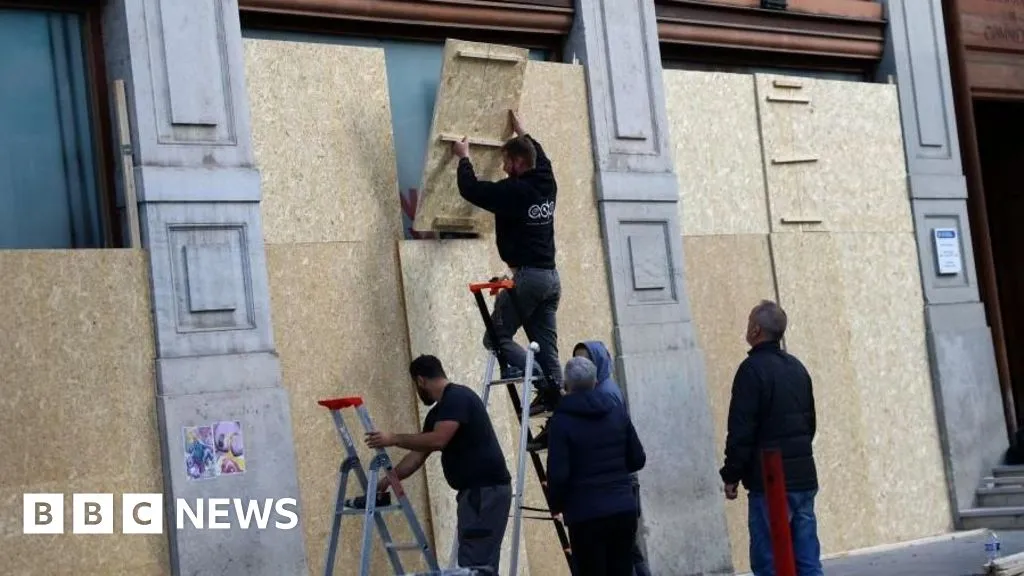
ReutersSome public buildings and businesses across France have been boarded up ahead of Saturday's protestsFrance is on high alert ahead of a new day of nationwide protests on Saturday, a week after the country saw some of its worst unrest in decades.Sweeping restrictions have been imposed on demonstrations across France but hundreds of thousands of protesters are still expected to gather in Paris and elsewhere for a second round of protests organised by students, trade unions and wider anti-government groups.The interior ministry has said it will deploy 70,000 police officers, ramping up the security presence in French cities, after the government was accused by opposition parties of failing to foresee the scale of the unrest on 17 October."We will not let anything go unchallenged," said Interior Minister Laurent Nuñez."We will be uncompromising with the vandals, with the looters, and all those who commit acts of violence," he added, explaining that separate from the planned protests, numerous calls for violence had been seen on social media from the "far left and radical extreme left".Hundreds of people have been jailed for vandalism, arson and looting after fast-track court hearings in recent days.President Emmanuel Macron met high-school students' representatives on Friday ahead of Saturday's protests, and although they said he had made clear commitments to them, they said students should "continue to mobilise".Getty ImagesLeaders of student groups spoke to the media after holding talks with Macron on FridayMacron decreed earlier this week that only demonstrations organised by a recognised trade unions would be permitted to take place on Saturday, and several key cities including Lyon, Nice and Montpellier have gone further by announcing blanket bans on gatherings.Official announcements appear to have done little to deter organisers, with hundreds of large and small demonstrations planned across France.After a week in which some cities have lived under partial curfews - including areas of the capital - there is an inconsistent picture across France's cities as to what level of protest will be permitted by authorities. While some mayors have pressed ahead with broad bans, others have agreed to allow demonstrations registered with authorities - for example, in Marseille, a previous order barring all protests was swiftly reversed to allow a trade union-organised march to go ahead.In Paris, a march organised by the student trade union and supported by labour groups has been ordered to stick to a route which does not go through the city centre - though preparations for unrest in some of the city's most recognisable areas are under way regardless.The Louvre, Orsay and Picasso museums will all be closed on Saturday, a scheduled home match for football team PSG has been moved to Monday, and some businesses have boarded up their windows in anticipation of further looting.ReutersLargely peaceful demonstrations in Paris organised by students and unions devolved into rioting and looting as last Saturday wore onIn a sign of how a student-led protest movement expanded to become a wider anti-government outpouring, protesters associated with a revived gilet jaunes (yellow-vest) movement could be out in force across France on Saturday.The protest movement, which has attracted support from left and right, led huge disruptive demonstrations during Macron's first term in office.A website associated with the group listed more than 500 planned demonstrations and some 200 other actions on Saturday, and demanded that Macron resign. In its online call for action, the group said "we refuse to add our voices to the chorus of outrage" over the violence on 17 October and accused police of attacking protesters.France is still reeling from last week's unrest, which saw police vastly outnumbered by protesters and rioters, shops looted and buildings torched - perhaps most emblematically, the ornate 19th-Century town hall in Limoges.On Friday, Justice Minister Gérald Darmanin said 232 people had been imprisoned for their role in the 17 October riots, and more than 1,100 had appeared in court. Around 260 of those cases involves "charges of organised gang activity", he added.Darmanin has ordered prosecutors to seek punitive measures against people convicted of looting or attacking police officers, including banning them from taking part in demonstrations, removing their right to vote and barring them from accessing social media.Getty ImagesA yellow vest, the symbol of the gilets jaunes movements, was draped over the Monument a la Republique in Paris during last weekend's protestsDisillusionment is high among the French public, who have seen cost-of-living pressures increase, and who are faced with increasingly dire warnings that any future government will likely have to make deep spending cuts in order to finance spiralling levels of debt.On top of that, the recent unrest has played out against the backdrop of a polarised political landscape and with France preparing for what could be the most divisive and unpredictable election period in a generation.Macron will leave office next spring and polls suggest a candidate from his centrist movement could fail to make it through to a run-off vote in May between the top two contenders.That would likely leave French voters to choose between the hard-right National Rally and radical-left La France Insoumise (France Unbowed).Leading figures from both parties have levelled the blame for the disorder at Macron and his ministers, sensing fertile ground among the French public after a period in which his centrist party has struggled to form functioning governments and pass legislation. Jean-Luc Mélenchon, the leader and presidential candidate of La France Insoumise, has criticised what he has framed as heavy-handed policing of demonstrations and has accused Macron of "destroying the republican state" by imposing restrictions.He has called on his supporters to join protests on Saturday as he did the previous week, before condemning the rioting which followed.A two-day National Rally conference in Orléans, around 120 km (75 miles) to the south of Paris, could prove to be a flashpoint on Saturday. Left-wing groups are expected to descend on the small city, where thousands of members of the hard-right party are set to gather to hear its leader Marine Le Pen speak.This week, the city's mayor warned the numbers expected in Orléans were "unprecedented", and said thousands of police would be deployed to manage any clashes, adding that public transport would be suspended.Opinion polls suggest Le Pen could have her strongest chance yet of becoming president as she runs for a fourth time, despite a court finding her guilty of embezzling EU funds earlier this year. She has denied committing any offence and is appealing the verdict.
SRCBBC News - World
LANGEN
LeanCenter
WORDS1,064
ENT3
SAT · 2026-10-24 · 04:03 GMTBRIEF NSR-2026-1024-121502
NSR-2026-1024-121502News Report·EN·Human Rights
France prepares for day of protest a week after nationwide riots
France is preparing for a day of nationwide protests on Saturday, a week after the country saw some of its worst unrest in decades. The government has imposed sweeping restrictions on demonstrations, but hundreds of thousands of protesters are still expected to gather in Paris and elsewhere.
2 hours agoShareSaveAdd as preferred on GoogleSean SeddonBBC News - WorldFiled 2026-10-24 · 04:03 GMTLean · CenterRead · 5 min
BBC News - WorldFIG 01
Reading time
5min
Word count
1,064words
Sources cited
5cited
Entities identified
3entities
NEWSAR · AI
France is preparing for a day of nationwide protests on Saturday, a week after the country saw some of its worst unrest in decades. The government has imposed sweeping restrictions on demonstrations, but hundreds of thousands of protesters are still expected to gather in Paris and elsewhere. Interior Minister Laurent Nuñez has announced that 70,000 police officers will be deployed to maintain security, amid concerns about calls for violence on social media from the "far left and radical extreme left". The protests come after a week of unrest, during which hundreds of people have been jailed for vandalism, arson, and looting. President Emmanuel Macron met with student leaders ahead of the protests, but they urged continued mobilisation. Hundreds of demonstrations are planned across France, including in cities such as Lyon, Nice, and Montpellier.
Confidence 0.90Sources 5Claims 5Entities 3
Framing
Human Rights
Tone
Measured
AI-assessed
CalmNeutralAlarmist
Factuality
0.85 / 1.00
Factual
LowHigh
Sources cited
5
Well sourced
FewMany
01
Some businesses have boarded up their windows in anticipation of further looting.
factualReuters
Confidence
1.00
02
Demonstrations organised by a recognised trade unions will be permitted to take place on Saturday.
statisticPresident Emmanuel Macron
Confidence
1.00
03
President Emmanuel Macron met with high-school students' representatives on Friday ahead of Saturday's protests.
quoteGetty Images
Confidence
1.00
04
70,000 police officers will be deployed to maintain security during the protests.
statisticInterior Ministry
Confidence
1.00
05
Hundreds of people have been jailed for vandalism, arson and looting after fast-track court hearings in recent days.
factualReuters
Confidence
1.00
§ 04
Full report
5 min read · 1,064 wordsKey playerOppositionContextPositiveNeutralNegative
Locations1
protest
0.80
france
0.70
demonstration
0.60
politics
0.50
security
0.50
government
0.40
riots
0.40
§ 07
Connections
Who appears together in the newsIn this articleWider coverageLine weight = articles in common
Laying out network…
Strongest ties articles in common
- 707
- 118
- 25
Recurring context not named in this article
- PDonald Trumplinks 3
- LIsraellinks 3
- OEuropean Unionlinks 3
- LUnited Stateslinks 3
- LSpainlinks 3
- LIranlinks 3
- LParislinks 3
- LUkrainelinks 3