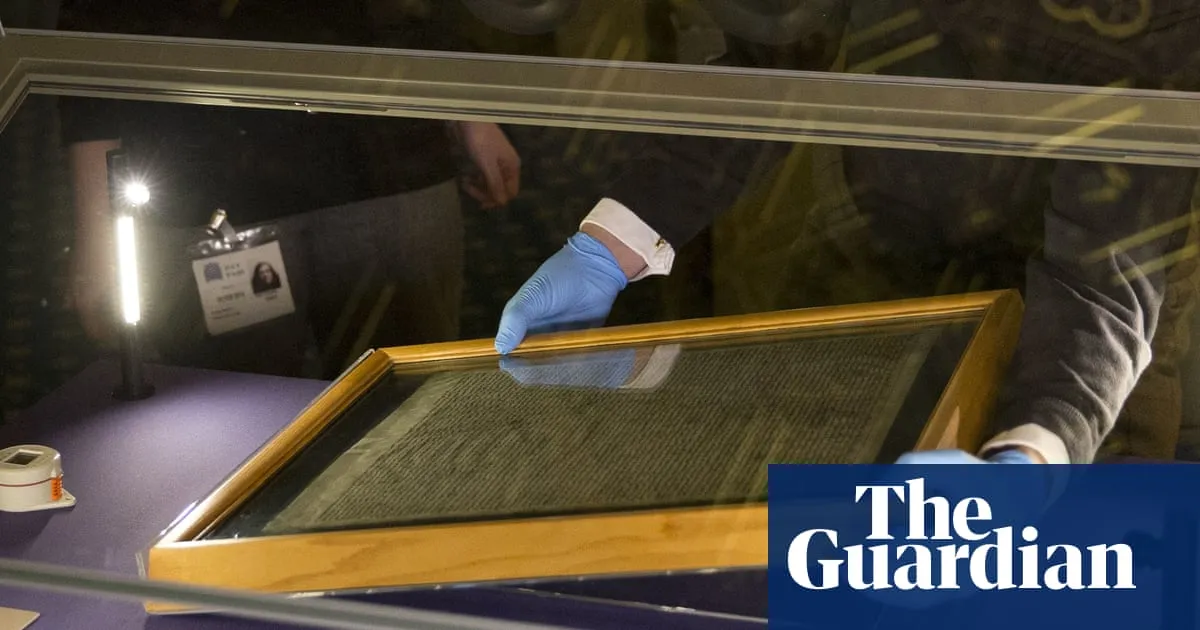
Security cameras guarding Magna Carta are provided by a Chinese CCTV company whose technology has allegedly aided the Uyghur “genocide” and been exploited by Russia during the invasion of Ukraine, it has emerged.In letters seen by the Guardian, campaigners called on Salisbury Cathedral, which houses one of four surviving copies of the “powerful symbol of social justice”, to rip out cameras made by Dahua Technology, based in the Chinese city of Hangzhou.They have also written to the authorities responsible for the Parthenon temple in Greece, which is monitored by cameras produced by another Chinese company, Hikvision.Cameras made by the firms have already been removed from “sensitive” UK government sites, over concerns that they could be remotely accessed by China and used to spy on sensitive sites.Now fresh concerns about the two companies’ roles at sites housing foundational symbols of democracy and human rights have been raised by the World Uyghur Congress (WUC) and a Ukrainian organisation called Don’t Fund Russian Army.China’s Dahua Technology boasts on its website that its low-light surveillance cameras help ensure the safety of a copy of Magna Carta, sealed by King John at Runnymede, England, in 1215.The document established limitations on feudal powers and is widely seen as a precursor to later formulations laying down democratic values and human rights protections.Salisbury Cathedral’s website calls the 810-year-old document a “powerful symbol of social justice” that has “inspired and encouraged freedom movements around the world”.But in a letter that has emerged during Keir Starmer’s visit to China, the WUC said Dahua was implicated in “genocide or crimes against humanity”.The organisation, which represents the persecuted minority ethnic group from China’s Xinjiang region, cited the company’s alleged involvement in facial recognition systems designed to identify Uyghurs and automate police reporting.The WUC said Dahua’s CCTV systems had “played a role in control and surveillance mechanisms” in Xinjiang designed to persecute the primarily Muslim group.“For us, it is particularly painful that the technologies of such companies are being used to protect one of the most prominent symbols of democracy and freedom,” the WUC wrote, in a letter emailed to the cathedral’s head of security.A spokesperson for the cathedral said it had not received the email, sent to its head of security. The Guardian has seen evidence that appears to show that the email was sent on 22 December.The cathedral spokesperson added: “We also do not comment on security matters; however, our systems and suppliers are regularly reviewed, working with external advisers.”Dahua’s technology was installed by a UK security firm, ARC Fire Safety & Security, according to the Chinese company’s website. The UK company did not return a request for comment.The WUC raised the same concerns in an email to authorities in charge of the Parthenon temple in Greece, which uses cameras made by Hikvision, urging it to remove the CCTV.It called for the technology to be removed at both sites.The WUC, which operates from Munich, Germany, also pointed to reports that the companies’ cameras have systemic vulnerabilities that allowed them to be hacked by Russia in reconnaissance during the invasion of Ukraine.Oleksii Kuprienko, of the Ukrainian organisation Don’t Fund Russian Army, said there had been several incidents where footage from surveillance cameras appeared to have been accessed – and even broadcast online – during Russian missile strikes.“Such footage can be used to analyse the effectiveness of strikes and, at the same time, to intimidate civilians by openly showing the power of Russian weapons,” he said.Kuprienko referred to an incident in early 2024 when footage from a camera believed to have been made by Hikvision broadcast the operation of a Ukrainian air defence system. “Shortly afterwards, that position was struck,” he said.A Ukrainian MP, Grigory Mamka, who sits on a parliamentary committee scrutinising law enforcement, confirmed that cameras made by Dahua and Hikvision were being removed.“[The security services] established that entrance codes were hacked and connection was made to equipment installed by these two companies,” Mamka said, in an interview mediated by a translator.Mamka said security services identified in 2024 that the cameras had been hacked, apparently by the Russian army, to spy on defensive positions.Footage of missile strikes, apparently from CCTV cameras, has also appeared on video streaming sites, which Kuprienko said was part of Russian psychological warfare, designed to intimidate Ukrainian civilians.Hikvision and Dahua did not return requests for comment.An email to a representative of the authority responsible for stewardship of the Parthenon went unanswered.
SRCThe Guardian - World News
LANGEN
LEANCenter-Left
WORDS734
ENT7
SAT · 2026-01-31 · 07:24 GMTBRIEF NSR-2026-0131-12155
NSR-2026-0131-12155News Report·EN·Human Rights
Alarm raised over Chinese CCTV cameras guarding ‘symbol of democracy’ Magna Carta
Campaigners are raising alarms about the use of Chinese-made CCTV cameras at sites housing significant symbols of democracy and human rights, specifically Salisbury Cathedral, home to the Magna Carta, and the Parthenon temple in Greece. The security cameras are provided by Dahua Technology and Hikvision, companies already removed from sensitive UK government sites due to security concerns.
Rob DaviesThe Guardian - World NewsFiled 2026-01-31 · 07:24 GMTLean · Center-LeftRead · 3 min
The Guardian - World NewsFIG 01
Reading time
3min
Word count
734words
Sources cited
4cited
Entities identified
7entities
Quality score
100%
§ 01
Briefing Summary
AI-generatedNEWSAR · AI
Campaigners are raising alarms about the use of Chinese-made CCTV cameras at sites housing significant symbols of democracy and human rights, specifically Salisbury Cathedral, home to the Magna Carta, and the Parthenon temple in Greece. The security cameras are provided by Dahua Technology and Hikvision, companies already removed from sensitive UK government sites due to security concerns. The World Uyghur Congress (WUC) and a Ukrainian organization have voiced concerns that Dahua's technology has allegedly aided in the persecution of Uyghurs in China and been exploited by Russia during the invasion of Ukraine. The WUC highlights Dahua's alleged involvement in facial recognition systems targeting Uyghurs, deeming it inappropriate for protecting a symbol of democracy. Salisbury Cathedral claims to not have received the WUC's letter.
Confidence 0.90Sources 4Claims 5Entities 7
§ 02
Article analysis
Model · rule-basedFraming
Human Rights
National Security
Tone
Mixed Tone
AI-assessed
CalmNeutralAlarmist
Factuality
0.70 / 1.00
Factual
LowHigh
Sources cited
4
Well sourced
FewMany
§ 03
Key claims
5 extracted01
Cameras made by Dahua and Hikvision have been removed from “sensitive” UK government sites.
factual
Confidence
1.00
02
Campaigners called on Salisbury Cathedral to rip out cameras made by Dahua Technology.
factual
Confidence
1.00
03
Security cameras guarding Magna Carta are provided by Dahua Technology, a Chinese CCTV company.
factual
Confidence
1.00
04
Dahua was implicated in “genocide or crimes against humanity”.
quoteWorld Uyghur Congress (WUC)
Confidence
0.90
05
Dahua's technology has allegedly aided the Uyghur “genocide” and been exploited by Russia during the invasion of Ukraine.
factual
Confidence
0.80
§ 04
Full report
3 min read · 734 words§ 05
Entities
7 identifiedKey playerOppositionContextPositiveNeutralNegative
Organizations1
§ 06
Keywords & salience
10 termscctv cameras
0.90
chinese technology
0.80
magna carta
0.80
human rights
0.70
surveillance
0.70
uyghur genocide
0.70
dahua technology
0.70
security concerns
0.60
salisbury cathedral
0.60
data security
0.50
§ 07
Topic connections
Interactive graph Network visualization showing 51 related topics
View Full Graph Person Organization Location Event|Click node to navigate|Edge numbers = shared articles