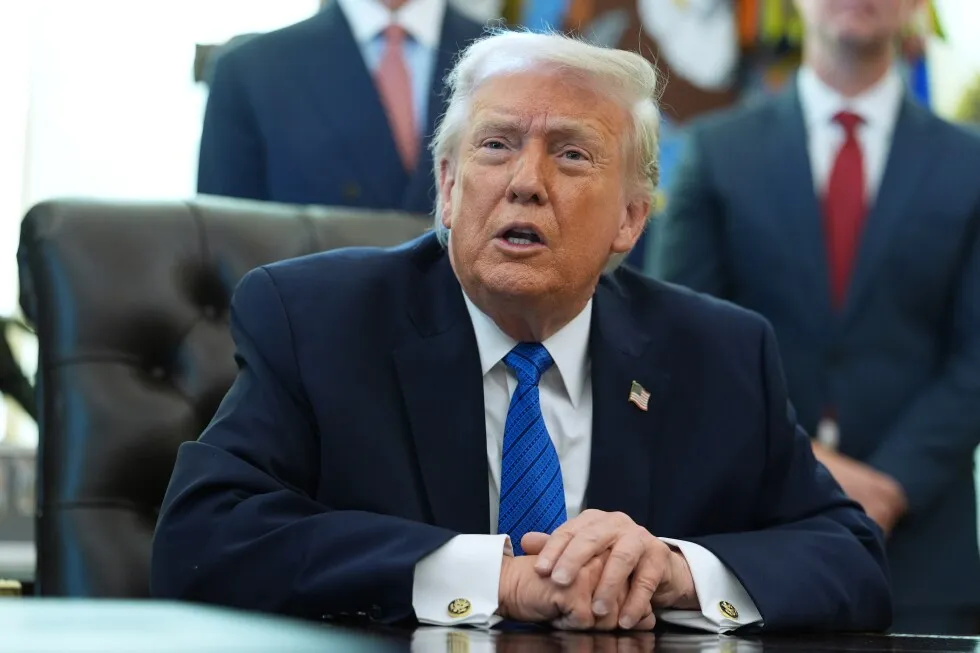
Trump moved fast to cut a funding deal. It’s a striking change from the last shutdown fight 1 of 5 | President Donald Trump speaks during an event in the Oval Office of the White House, Friday, Jan. 30, 2026, in Washington. (AP Photo/Evan Vucci) 2 of 5 | Sen. Katie Britt, R-Ala., who chairs the Department of Homeland Security Appropriations Subcommittee, walks to the chamber following a closed-door meeting with fellow Republicans on spending legislation, at the Capitol in Washington, Wednesday, Jan. 28, 2026. (AP Photo/J. Scott Applewhite) 3 of 5 | With a partial government shutdown looming by week’s end, Senate Majority Leader John Thune, R-S.D., and Sen. Shelly Moore Capito, R-W.Va., face reporters following a closed-door meeting with fellow Republicans on spending legislation that funds the Department of Homeland Security and a swath of other government agencies as the country reels from the deaths of two people at the hands of federal agents in Minneapolis, at the Capitol in Washington, Wednesday, Jan. 28, 2026. (AP Photo/J. Scott Applewhite) 4 of 5 | Senate Minority Leader Chuck Schumer, D-N.Y., speaks during a news conference at the Capitol in Washington, Friday, Jan. 30, 2026. The Senate voted Friday to fund most of the government through the end of September after President Donald Trump made a deal with Democrats to carve out Homeland Security funding and allow Congress to debate new restrictions on federal immigration raids across the country. (AP Photo/Jose Luis Magana) 5 of 5 | Snow covers the ground in front of the White House, Friday, Jan. 30, 2026, in Washington. (AP Photo/Allison Robbert) 1 of 5 President Donald Trump speaks during an event in the Oval Office of the White House, Friday, Jan. 30, 2026, in Washington. (AP Photo/Evan Vucci) Add AP News on Google Add AP News as your preferred source to see more of our stories on Google. 2 of 5 Sen. Katie Britt, R-Ala., who chairs the Department of Homeland Security Appropriations Subcommittee, walks to the chamber following a closed-door meeting with fellow Republicans on spending legislation, at the Capitol in Washington, Wednesday, Jan. 28, 2026. (AP Photo/J. Scott Applewhite) Add AP News on Google Add AP News as your preferred source to see more of our stories on Google. 3 of 5 With a partial government shutdown looming by week’s end, Senate Majority Leader John Thune, R-S.D., and Sen. Shelly Moore Capito, R-W.Va., face reporters following a closed-door meeting with fellow Republicans on spending legislation that funds the Department of Homeland Security and a swath of other government agencies as the country reels from the deaths of two people at the hands of federal agents in Minneapolis, at the Capitol in Washington, Wednesday, Jan. 28, 2026. (AP Photo/J. Scott Applewhite) Add AP News on Google Add AP News as your preferred source to see more of our stories on Google. 4 of 5 Senate Minority Leader Chuck Schumer, D-N.Y., speaks during a news conference at the Capitol in Washington, Friday, Jan. 30, 2026. The Senate voted Friday to fund most of the government through the end of September after President Donald Trump made a deal with Democrats to carve out Homeland Security funding and allow Congress to debate new restrictions on federal immigration raids across the country. (AP Photo/Jose Luis Magana) Add AP News on Google Add AP News as your preferred source to see more of our stories on Google. 5 of 5 Snow covers the ground in front of the White House, Friday, Jan. 30, 2026, in Washington. (AP Photo/Allison Robbert) Add AP News on Google Add AP News as your preferred source to see more of our stories on Google. Updated [hour]:[minute] [AMPM] [timezone], [monthFull] [day], [year] Washington (AP) — President Donald Trump moved quickly this week to negotiate with Democrats to try and avert a lengthy government shutdown over Department of Homeland Security funding, a sharp departure from last year’s record standoff, when he refused to budge for weeks.Some Republicans are frustrated with the deal, raising the possible of a prolonged shutdown fight when the House returns Monday to vote on the funding package. But Trump’s sway over the GOP remains considerable, and he has made his position clear at a moment of mounting political strain.“The only thing that can slow our country down is another long and damaging government shutdown,” Trump wrote on social media late Thursday.The urgency marked a clear shift from Trump’s posture during the 43-day shutdown late last year, when he publicly antagonized Democratic leaders and his team mocked them on social media. This time, with anger rising over shootings in Minneapolis and the GOP’s midterm messaging on tax cuts drowned out by controversy, Trump acted quickly to make a deal with Senate Democratic leader Chuck Schumer of New York.“Trump and the Republicans know that this is an issue where they’re on the wrong side of the American people and it really matters,” Schumer told reporters Friday after Senate passage of the government funding deal. The crisis caused by Minneapolis killingsSenators returned to work this week dealing with the fallout from the fatal shooting of ICU nurse Alex Pretti in Minneapolis by federal immigration officers, as well as the killing of Renee Good in the city weeks earlier.Republicans were far from unified in their response. A few called for the firing of top administration officials such as Homeland Security Secretary Kristi Noem and Stephen Miller, the White House chief of staff for policy. Most GOP senators tried to strike a balance, calling for a thorough investigation into Pretti’s killing while backing the hard-line immigration approach that is central to Trump’s presidency. But many agreed that the shootings threatened public support for Trump’s immigration agenda.“I’ve never seen a political party take its best issue and turn it into its worst issue in the period of time that it has happened in the last few weeks,” said Sen. John Kennedy, R-La. “Some things have to change.”Democrats quickly coalesced around their key demands. Sen. Chris Coons, D-Del., said there “was unanimity” around core principles of enforcing a code of conduct for immigration officers and agents, ending “roving patrols” for immigration enforcement actions and coordinating with local law enforcement on immigration arrests.It helped that Trump himself was looking for ways to de-escalate in Minneapolis.“The world has seen the videos of those horrible abuses by DHS and rogue operations catching up innocent people, and there’s a revulsion about it,” said Sen. Tim Kaine, D-Va.“The White House is asking for a ladder off the ledge,” he added. Avoiding the painful politics of a shutdownRepublicans are also trying to promote their accomplishments in office as they ready for the November elections and the difficult task of retaining control of both chambers of Congress. But the prospect of a prolonged shutdown shifted attention away from their $4.5 trillion tax and spending cuts law, the centerpiece of their agenda. Republicans had hoped the beginning of this year’s tax season on Monday would provide a political boost as voters begin to see larger tax refunds.Republicans are also mindful of the political damage from last year’s shutdown, when they took a slightly larger portion of the blame from Americans than Democrats, according to polling from The Associated Press-NORC Center for Public Affairs Research.“The shutdown was a big factor, negative for the Republicans,” Trump told Republican senators at the White House in November.On a practical level, this funding standoff threatened to destroy months of bipartisan work, including long hours over the holiday break, to craft the 12 spending bills that fund the government and many priorities back home. “We saw what happened in the last government shutdown in regards to how it hurt real, hardworking Americans,” said Sen. Katie Britt, R-Ala., a member of the Senate Appropriations Committee. “I don’t want that to happen again.” A two-week funding battle beginsThe agreement reached this week, if passed by the House, would avoid a prolonged shutdown and fund nearly every federal department through the end of the budget year in September. But it would not resolve one of the most difficult issues for Congress and the White House: DHS funding.Instead of a full-year deal, funding for the department was extended for just two weeks, giving lawmakers little time to bridge the deep divides over immigration enforcement.Democrats are pressing for changes they say are necessary to prevent future abuses, including requiring immigration agents to wear body cameras, carry clear identification, end roving patrols in cities and coordinate more closely with local law enforcement when making arrests. Many Democrats also want tighter rules around warrants and accountability mechanisms for officers in the field. Those demands have met stiff resistance from Republicans. Some are opposed to negotiating with Democrats at all.“Republicans control the White House, Senate and House. Why are we giving an inch to Democrats?” Sen. Tommy Tuberville, R-Ala., wrote on social media.Republican senators said they would take the fight to Democrats by introducing their own bills, including restrictions on “sanctuary cities,” to show their support for Trump’s policies. That term is generally applied to state and local governments that limit cooperation with federal immigration authorities.“We’ve let the issue get away. We’re not leading. We’re trying to avoid losing rather than winning,” said Sen. Lindsey Graham, R-S.C., who held up the spending bills until Senate Majority Leader John Thune, R-S.D., agreed to give him a vote on his sanctuary cities bill at a later date.Thune acknowledged the difficulty of the next two weeks, saying there are “some pretty significant views and feelings.”“We’ll stay hopeful,” Thune told reporters about the upcoming DHS fight. “But there are some pretty significant differences of opinion.”___Associated Press writers Lisa Mascaro and Kevin Freking contributed to this report. Cappelletti covers Congress for The Associated Press. He previously reported on Michigan politics for AP.
SRCAssociated Press (AP)
LANGEN
LEANCenter
WORDS1 626
ENT11
SAT · 2026-01-31 · 14:53 GMTBRIEF NSR-2026-0131-12207
NSR-2026-0131-12207News Report·EN·Political Strategy
Trump moved fast to cut a funding deal. It’s a striking change from the last shutdown fight
In January 2026, President Donald Trump quickly reached a funding deal with Democrats to avert a partial government shutdown. The agreement, made as the deadline approached, allowed most of the government to be funded through the end of September.
By
JOEY CAPPELLETTI and STEPHEN GROVESAssociated Press (AP)Filed 2026-01-31 · 14:53 GMTLean · CenterRead · 7 min
Associated Press (AP)FIG 01
Reading time
7min
Word count
1 626words
Sources cited
4cited
Entities identified
11entities
Quality score
100%
§ 01
Briefing Summary
AI-generatedNEWSAR · AI
In January 2026, President Donald Trump quickly reached a funding deal with Democrats to avert a partial government shutdown. The agreement, made as the deadline approached, allowed most of the government to be funded through the end of September. A key aspect of the deal involved carving out Homeland Security funding for separate debate and consideration of new restrictions on federal immigration raids. This swift action marks a contrast to previous shutdown fights, as evidenced by the Senate's vote to approve the funding. The negotiations took place in Washington D.C., involving key figures like Senate Majority Leader John Thune and Senate Minority Leader Chuck Schumer.
Confidence 0.90Sources 4Claims 5Entities 11
§ 02
Article analysis
Model · rule-basedFraming
Political Strategy
Conflict
Tone
Measured
AI-assessed
CalmNeutralAlarmist
Factuality
0.70 / 1.00
Factual
LowHigh
Sources cited
4
Well sourced
FewMany
§ 03
Key claims
5 extracted01
A partial government shutdown was looming by week’s end.
factualArticle
Confidence
1.00
02
The Senate voted Friday to fund most of the government through the end of September.
factualArticle
Confidence
1.00
03
President Donald Trump made a deal with Democrats to carve out Homeland Security funding.
factualArticle
Confidence
1.00
04
Congress to debate new restrictions on federal immigration raids across the country.
factualArticle
Confidence
0.90
05
The country reels from the deaths of two people at the hands of federal agents in Minneapolis.
factualArticle
Confidence
0.90
§ 04
Full report
7 min read · 1 626 words§ 05
Entities
11 identifiedKey playerOppositionContextPositiveNeutralNegative
People4
Locations4
Events1
§ 06
Keywords & salience
6 termsfunding deal
0.90
government shutdown
0.80
spending legislation
0.70
homeland security
0.60
congress
0.50
immigration raids
0.40
§ 07
Topic connections
Interactive graph Network visualization showing 51 related topics
View Full Graph Person Organization Location Event|Click node to navigate|Edge numbers = shared articles