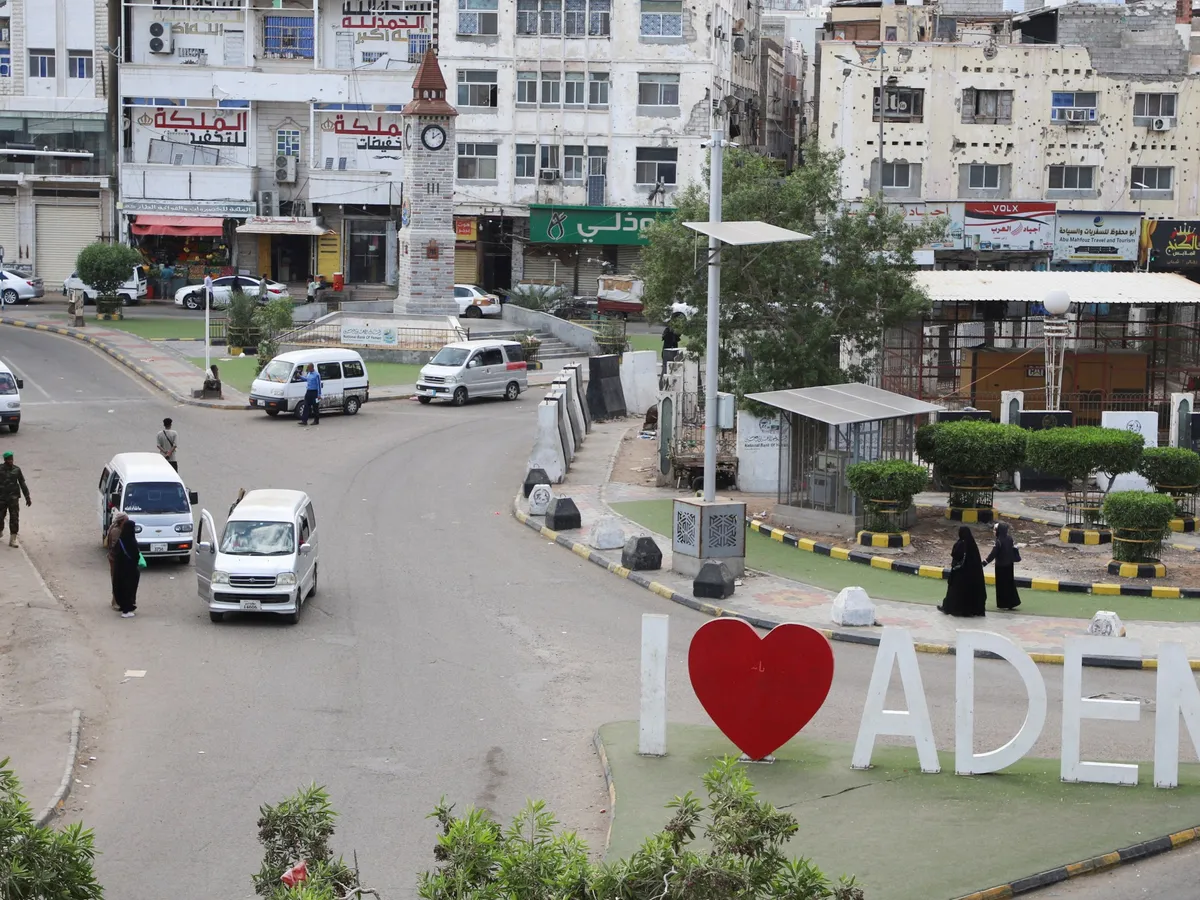
Key southern Yemeni city enters delicate new phase as internationally recognised government re-establishes its presence after fall of STC.People walk along a street in Aden in southern Yemen on January 10, 2026, three days after the Southern Transitional Council was forced out of the port city [Fawaz Salman/Reuters]Published On 1 Feb 2026The lights are on in Aden – at least for most of the day.The apparently mundane detail is a huge difference for people in the southern Yemeni port city, which for years has suffered from extensive electricity blackouts, and a sign that something has changed.It was noticeable enough for Saleh Taher, who lives in the Yemeni capital, Sanaa, to comment on after making a recent visit to Aden.Taher was unsure of what he would find on his trip to Aden, arriving on January 25, just weeks after Yemen’s government re-established its presence in the city.The 32-year-old wondered if the streets would be tense so soon after the fall of the secessionist Southern Transitional Council (STC).The STC controlled the city and much of southern Yemen until a Saudi Arabian-backed government offensive forced them back in early January.But as time passed, Taher’s anxiety faded. The streets of Aden appeared normal, and people were going about their jobs as usual.And then there was the electricity. In a country that has now officially been at war for longer than a decade with multiple groups vying for territory, a utility that is taken for granted in much of the world is a sign of hope.The sudden availability of electricity is partly the result of a multimillion-dollar fuel grant provided by Saudi Arabia to supply power stations. Observers consider it to be an effort to show that the presence of Yemen’s internationally recognised government can improve people’s lives.Badea Sultan, an Aden-based independent journalist, told Al Jazeera that the “positive change” in services in Aden is palpable for residents and the city has entered a completely new stage.Citing electricity as a key example, he said, “Power supply has largely stabilised. Today, we enjoy approximately 20 hours of continuous, uninterrupted service per day. This was a distant dream just two months ago.”Sultan said the ongoing progress in Aden cannot be attributed solely to the United Nations-recognised government. He highlighted the role of Falah al-Shahrani, who arrived in Aden early this year as part of a high-level delegation from the Joint Forces Command of the Coalition to Support Legitimacy in Yemen to follow up on security and military arrangements in the wake of the STC’s military collapse.An adviser to the commander of the forces, al-Shahrani has worked with local and military leaders to reposition military camps outside Aden and has played a critical role in managing what Sultan described as a sensitive phase in the city.“Al-Shahrani is effectively the de facto ruler of Aden now,” Sultan added.Saudi-UAE tensionsIn late December, tensions between Saudi Arabia and the United Arab Emirates over Yemen surfaced publicly, prompting Riyadh to adopt a sharper narrative and launch military operations aimed at pushing back the UAE-backed STC, which had crossed a Saudi red line by trying to take control of eastern Yemeni regions that bordered Saudi Arabia.On December 30, the UAE announced its withdrawal from Yemen “of its own volition” after the Yemeni government demanded it do so. The UAE has been arming and funding the STC since its establishment in 2017.At a news conference in Warsaw on Monday, Saudi Foreign Minister Faisal bin Farhan said, “The UAE has now decided to leave Yemen, and I think if that indeed is the case and the UAE has completely left the issue of Yemen, the Kingdom of Saudi Arabia will take responsibility.”Some STC leaders travelled to Riyadh after the Saudi attacks on the STC and announced the dissolution of the group. But other STC leaders have rejected that statement and continue to try to rally support on the ground in southern Yemen.Mass demoralisationSaleh Qasim, a 45-year-old resident of Aden’s Sheikh Othman district, told Al Jazeera that “the Saudi era” has begun in Aden.“Aden is recovering today, and that could be the path to Yemen’s recovery,” he said.But he added that while the early signs are promising, it is still a bleak time for pro-independence southerners like himself.The STC and its supporters want the restoration of the former South Yemen, an independent state that existed from 1967 to 1990 before uniting with North Yemen to form the united Republic of Yemen.Supporters of secession feel that the south was disenfranchised in the united Yemen. They took their opportunity after the Houthi takeover of Sanaa and northwestern Yemen in 2014 and 2015, taking de facto control over Aden and other parts of southern Yemen.It had finally seemed like the dream of an independent state was on the horizon, particularly with the backing of the UAE. But then came the Saudi-backed counterattack by the Yemeni government, and now, in the space of weeks, the dream of secession has been shattered, in the short term at least.“This is the most frustrating moment for the secessionists,” Qasim said. “They have lost land, weapons and fighters. I can see the mass demoralisation among the independence seekers in Aden.”He added: “I also aspire to see the south independent but through dialogue, not force.”The STC has been trying to showcase its support in Aden with rallies every Friday that are attended by thousands of people in al-Aroudh Square.There, the protesters raise the southern flag and the image of the STC’s on-the-run leader, Aidarous al-Zubaidi. They also chant for independence, pledge to continue their struggle and voice their anger at the Saudi role. However, Sultan, the journalist, views these mass rallies as an emotional outlet for STC supporters that ultimately will not be able to restore the group’s lost leverage.Sultan believes that local authorities are turning a blind eye to the demonstrations as a way of allowing STC supporters to blow off some steam.“In my opinion, there is a deliberate effort to allow separatist demonstrators to vent their frustrations regarding recent developments, which have been quite shocking to them,” Sultan said.Three challengesOn January 15, President Rashad al-Alimi, the head of the Presidential Leadership Council, Yemen’s UN-recognised authority, appointed Foreign Minister Shaya Mohsin al-Zindani as the country’s prime minister.Consultations on the selection of cabinet members have been under way in Riyadh. Once finalised, the cabinet is expected to return to Aden to govern – a major move that would signal that the government is truly in control of the city for the first time in years.However, challenges lie ahead as “the internal and external architects of chaos” have not abandoned their agenda in the south, Yemeni political analyst Sadam al-Huraibi told Al Jazeera, referring to the UAE and armed separatists.Al-Huraibi identified three challenges that the new cabinet will potentially face in Aden. “One major threat is the terrorist or politically motivated bombings in Aden, which could quickly turn the city into a place of mourning.”On January 21, an explosives-laden car detonated as a pro-government military commander’s convoy was moving in Aden. Five soldiers were killed, and three were wounded. No party has claimed responsibility for the attack.“The other challenge is the risk of planned riots. Protesters may exploit the right to assembly and turn to violence in Aden. Such incidents can erupt sporadically and rob the city’s calm, affecting the government’s ability to function,” al-Huraibi said.Al-Huraibi added that the third challenge is the UAE’s alleged covert coordination with separatists in southern cities to undermine Saudi Arabia and the Yemeni government. “The UAE said it withdrew from Yemen, but there is no guarantee it will be completely disengaged,” he said.Yemeni officials today believe that a stable Aden and Saudi support are decisive success factors for shifting the focus to the north, where the Houthis have dominated for a decade.Deputy Foreign Minister Mustafa Noman said in a recent interview that Saudi Arabia “has committed to pay the salaries of all the national army and the brigades, … the salaries of the government staff, including the diplomats”.“And this is the first step,” he said. “First, we have to secure the capital in Aden, and then when the capital is stable and the services are functioning to a certain extent, the government starts operating from Aden.”With the unified political and military bloc in the south, he said, the focus must shift to the peace process and confronting the Iran-backed Houthis.Noman believes the Houthis are not ready for a peace process but they will change their minds when they see the new government operating in Aden and playing a governing role in the south.For their part, the Houthis have downplayed the importance of the recent Saudi moves in the south, arguing that Saudi Arabia puts its interests first, not Yemen’s.In a speech broadcast on January 23, Abdul Malik al-Houthi, the head of the Houthi movement, said: “The Saudi – even at this stage – is not concerned with either unity or separation [in Yemen]. What concerns him is complete control, occupation and domination over the Yemeni people.”The Houthis took control of Sanaa in 2014 and then toppled the Yemeni government in Sanaa in 2015, sparking a conflict that remains unresolved to date. They have been able to continue in power despite years of Saudi-led coalition air strikes, followed by air attacks since 2023 by the United States, the United Kingdom and Israel.Mohammed, a Houthi field commander, told Al Jazeera that he does not see a difference between the UAE and Saudi Arabia in Aden.“Both are occupiers,” he said. “The good services that they offer to the people are not sustainable, so it is naive to celebrate gifts given by your occupier.”
SRCAl Jazeera
LANGEN
LEANCenter
WORDS1 600
ENT5
SUN · 2026-02-01 · 10:03 GMTBRIEF NSR-2026-0201-12365
NSR-2026-0201-12365News Report·EN·Political Strategy
Hope flickers as lights return to war-scarred Aden
After years of extensive electricity blackouts, Aden, Yemen is experiencing improved power supply following the re-establishment of the internationally recognized government in January 2026 after the fall of the Southern Transitional Council (STC). A Saudi Arabian-backed government offensive forced the STC out of the city, and the return of the government is seen as a sign of hope for residents.
Al Jazeera StaffAl JazeeraFiled 2026-02-01 · 10:03 GMTLean · CenterRead · 7 min
Al JazeeraFIG 01
Reading time
7min
Word count
1 600words
Sources cited
2cited
Entities identified
5entities
Quality score
100%
§ 01
Briefing Summary
AI-generatedNEWSAR · AI
After years of extensive electricity blackouts, Aden, Yemen is experiencing improved power supply following the re-establishment of the internationally recognized government in January 2026 after the fall of the Southern Transitional Council (STC). A Saudi Arabian-backed government offensive forced the STC out of the city, and the return of the government is seen as a sign of hope for residents. A multimillion-dollar fuel grant from Saudi Arabia is supplying power stations, enabling approximately 20 hours of electricity per day. This improvement is considered a positive change for residents, signaling a new phase for the war-scarred city. While the government is credited, the role of the Joint Forces Command of the Coalition to Support Legitimacy in Yemen is also cited.
Confidence 0.90Sources 2Claims 5Entities 5
§ 02
Article analysis
Model · rule-basedFraming
Political Strategy
Human Interest
Tone
Measured
AI-assessed
CalmNeutralAlarmist
Factuality
0.70 / 1.00
Factual
LowHigh
Sources cited
2
Limited
FewMany
§ 03
Key claims
5 extracted01
Saudi Arabia provided a multimillion-dollar fuel grant to supply Aden's power stations.
factualAl Jazeera
Confidence
1.00
02
The Southern Transitional Council (STC) was forced out of Aden by a Saudi Arabian-backed government offensive.
factualAl Jazeera
Confidence
1.00
03
Yemen’s government re-established its presence in Aden in early January 2026.
factualAl Jazeera
Confidence
1.00
04
Power supply has largely stabilised in Aden, with approximately 20 hours of continuous service per day.
quoteBadea Sultan, Aden-based independent journalist
Confidence
0.90
05
Falah al-Shahrani is effectively the de facto ruler of Aden now.
quoteBadea Sultan, Aden-based independent journalist
Confidence
0.70
§ 04
Full report
7 min read · 1 600 words§ 05
Entities
5 identifiedKey playerOppositionContextPositiveNeutralNegative
§ 06
Keywords & salience
8 termsaden
1.00
yemen
0.90
electricity
0.80
government
0.70
southern transitional council
0.60
war
0.50
fuel grant
0.40
saudi arabia
0.40
§ 07
Topic connections
Interactive graph Network visualization showing 51 related topics
View Full Graph Person Organization Location Event|Click node to navigate|Edge numbers = shared articles