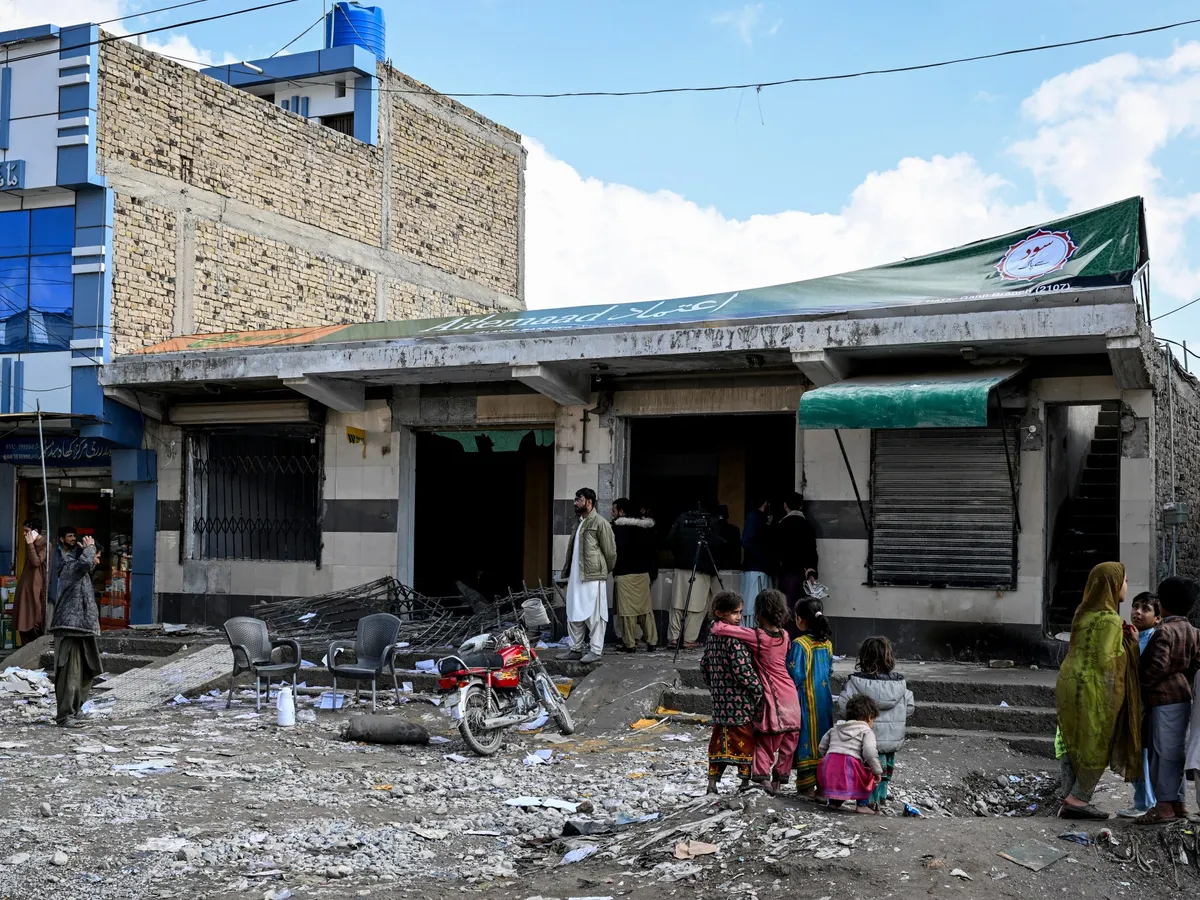
Balochistan is at the heart of Pakistan’s economic promises to the US and China. The attacks are a reminder of the risks for Pakistan and potential investors.Local residents look at a damaged bank on the outskirts of Quetta on February 1, 2026, a day after an attack by Baloch separatists [AFP]Published On 2 Feb 2026Islamabad, Pakistan – When meeting United States President Donald Trump in the Oval Office in September, Pakistan’s army chief, Field Marshal Asim Munir, opened a briefcase with Prime Minister Shehbaz Sharif standing next to him.Inside were a set of glistening minerals. Their display was part of Pakistan’s latest offer to the Trump administration: The country was willing to open up its minerals to US investment.Recommended Stories list of 4 itemslist 1 of 4Who are the BLA – the group behind Pakistan’s deadly train hijack?list 2 of 4‘Strategic handshake’: How Pakistan is wooing Trump with critical mineralslist 3 of 4Pakistani forces kill 145 fighters in Balochistan after deadly attackslist 4 of 4‘Army alone can’t neutralise grievances’: What fuels Balochistan violenceend of listLess than five months later, a cloud has moved over that promise. Most of Pakistan’s richest mineral deposits are in the province of Balochistan. The province – the country’s largest by area and its most impoverished – has long witnessed a separatist movement driven by anger over perceptions that the interests of the local population have been ignored by the federal government. On Saturday, coordinated attacks across Balochistan in which fighters killed 31 civilians and 17 security personnel while the military gunned down 145 fighters served up an urgent reminder of the challenges that Pakistan – and potential investors – face in the province.Balochistan is also at the heart of China’s investments in Pakistan, making Saturday’s attacks particularly sensitive for Islamabad.Within hours of the attacks across at least 12 locations, Interior Minister Mohsin Naqvi blamed neighbouring India. “These were not normal terrorists. India is behind these attacks. I can tell you for sure that India planned these attacks along with these terrorists,” Naqvi said without offering any evidence to back up his claims.The attackers belonged to the Baloch Liberation Army (BLA), a separatist group that has long sought independence for Balochistan and has waged a decades-long insurgency against the Pakistani state alongside several other armed groups.In a video posted on social media, BLA leader Bashir Zeb said the attacks were part of the group’s “Herof 2.0” operation, a follow-up to a similar coordinated assault launched in August 2024.India on Sunday rejected Pakistan’s allegations, calling them an attempt to divert attention from what it described as Pakistan’s “internal failings”.“Instead of parroting frivolous claims each time there is a violent incident, it would do better to focus on addressing long-standing demands of its people in the region,” Randhir Jaiswal, spokesperson for India’s Ministry of External Affairs, said in a statement.Amid this blame game, analysts said the roots of Pakistan’s crisis in Balochistan run deeper than any one incident – and ignoring them won’t help Islamabad as it tries to woo both the US and China to invest in the province.Roots of the unrestBalochistan is home to about 15 million of Pakistan’s 240 million people, according to the 2023 census. It is the country’s poorest province despite its vast natural resources wealth.It holds significant reserves of oil, coal, gold, copper and gas, resources that generate substantial revenue for the federal government.With Pakistan having promised parts of this resource wealth to China, its closest ally, and to the US under a landmark agreement signed last year, concerns persist that escalating violence could not only jeopardise projects worth billions of dollars but also threaten the country’s fragile economic recovery.Annexed by Pakistan in 1948 soon after partition from India, Balochistan has been the site of a separatist movement almost since the country’s founding.The province has witnessed at least five major rebellions since then. The latest phase began in the early 2000s when demands for greater control over local resources gradually escalated into calls for full independence.The government’s response has been marked by heavy-handed security operations. Human rights groups accuse authorities of killing and forcibly disappearing thousands of ethnic Balochs suspected of being involved in or having sympathy for separatist groups.In March, BLA fighters carried out one of their most audacious attacks, attempting to hijack a passenger train, the Jaffer Express, travelling from Quetta to the northwestern province of Khyber Pakhtunkhwa. More than 300 passengers were rescued after an operation that lasted more than a day, during which at least 33 fighters were killed.The incident was part of a broader uptick in violence across Balochistan along with the rest of the country. According to the Pakistan Institute for Peace Studies, the province saw at least 254 attacks in 2025, a 26 percent increase from the previous year, resulting in more than 400 deaths.The latest wave of violence came just days after Pakistan hosted a minerals summit aimed at attracting Chinese companies.China has already invested heavily in the province, including in the development of Gwadar, Pakistan’s only deep-sea port. The port is a key node in the $60bn China-Pakistan Economic Corridor (CPEC), which aims to connect southwestern China to the Arabian Sea.In September, USSM, a US-based mining firm, also signed a $500m memorandum of understanding to invest in mineral excavation in Pakistan.Saher Baloch, a Berlin-based researcher focusing on Balochistan, said there was a “core contradiction” in Pakistan’s efforts to court international partners by emphasising the province’s resources without addressing its political grievances.“Balochistan’s instability isn’t episodic. It is structural and rooted in longstanding grievances over ownership, political exclusion and militarisation,” she told Al Jazeera.As long as violence persists, she said, large-scale extraction projects will remain high-risk and heavily securitised, making them viable primarily for “state-backed actors like China, not market-driven Western investors”.And “even Chinese projects under CPEC have faced repeated attacks, forcing Pakistan to deploy thousands of troops just to secure limited infrastructure,” she added.Abdul Basit, a research fellow at Singapore’s S Rajaratnam School of International Studies, offered a different perspective, arguing that the province’s main investors, China and potentially the US, are already fully aware of the risks.“China has CPEC investments in the country, and the US signed a minerals deal in September last year, a whole year after Herof 1.0, so they both know the risk profiles and what they are getting into,” Basit told Al Jazeera, referring to another coordinated BLA attack across multiple locations in August 2024.“Obviously, such attacks do shake investor confidence, but these are government-to-government deals. These are part of strategic investment calculus, and neither the US nor China will pull out their investment,” he added.(Al Jazeera)Economic stakes risePakistan’s economy, which has long struggled, has faced sustained pressure in recent years. The country only narrowly avoided default in the summer of 2023, securing a last-minute bailout from the International Monetary Fund (IMF).Since then, Pakistan has regained some stability under its latest IMF programme, the 25th time it has turned to the lender, securing $7bn in funding.Despite official efforts to market Pakistan as an attractive investment destination, foreign direct investment (FDI) has remained weak.Central bank figures released last month showed a sharp decline from July to December. According to the State Bank of Pakistan, the country received just $808m in FDI during the first half of the fiscal year 2026, down from $1.425bn in the same period a year earlier.
SRCAl Jazeera
LANGEN
LEANCenter
WORDS1 220
ENT12
MON · 2026-02-02 · 15:01 GMTBRIEF NSR-2026-0202-12711
NSR-2026-0202-12711News Report·EN·National Security
How Balochistan attacks threaten Pakistan’s promises to China, Trump
Recent coordinated attacks by the Balochistan Liberation Army (BLA) across Balochistan, Pakistan, which resulted in numerous casualties, highlight the risks to Pakistan's economic promises to the US and China. Balochistan, rich in mineral deposits, is central to Pakistan's offer of mineral investments to the US and China's investments in the country.
Abid HussainAl JazeeraFiled 2026-02-02 · 15:01 GMTLean · CenterRead · 5 min
Al JazeeraFIG 01
Reading time
5min
Word count
1 220words
Sources cited
4cited
Entities identified
12entities
Quality score
100%
§ 01
Briefing Summary
AI-generatedNEWSAR · AI
Recent coordinated attacks by the Balochistan Liberation Army (BLA) across Balochistan, Pakistan, which resulted in numerous casualties, highlight the risks to Pakistan's economic promises to the US and China. Balochistan, rich in mineral deposits, is central to Pakistan's offer of mineral investments to the US and China's investments in the country. The attacks underscore the challenges posed by the separatist movement in the province, fueled by local grievances against the federal government. The Pakistani Interior Minister blamed India for supporting the attacks, while the BLA claimed responsibility, seeking independence for Balochistan. The violence raises concerns for Pakistan and potential investors regarding the stability and security of the region.
Confidence 0.90Sources 4Claims 5Entities 12
§ 02
Article analysis
Model · rule-basedFraming
National Security
Economic Impact
Tone
Measured
AI-assessed
CalmNeutralAlarmist
Factuality
0.70 / 1.00
Factual
LowHigh
Sources cited
4
Well sourced
FewMany
§ 03
Key claims
5 extracted01
India rejected Pakistan’s allegations, calling them an attempt to divert attention from Pakistan’s “internal failings”.
quoteRandhir Jaiswal
Confidence
1.00
02
BLA leader Bashir Zeb said the attacks were part of the group’s “Herof 2.0” operation.
quoteBashir Zeb
Confidence
1.00
03
The attackers belonged to the Baloch Liberation Army (BLA).
factualArticle
Confidence
1.00
04
Interior Minister Mohsin Naqvi blamed neighboring India for the attacks.
quoteMohsin Naqvi
Confidence
1.00
05
Coordinated attacks across Balochistan resulted in 31 civilian and 17 security personnel deaths.
factualArticle
Confidence
1.00
§ 04
Full report
5 min read · 1 220 words§ 05
Entities
12 identifiedKey playerOppositionContextPositiveNeutralNegative
People4
Organizations1
§ 06
Keywords & salience
10 termsbalochistan
1.00
pakistan
0.90
attacks
0.80
separatist movement
0.70
baloch liberation army
0.60
economic promises
0.60
mineral deposits
0.60
china
0.50
investment
0.50
india
0.40
§ 07
Topic connections
Interactive graph No topic relationship data available yet. This graph will appear once topic relationships have been computed.